

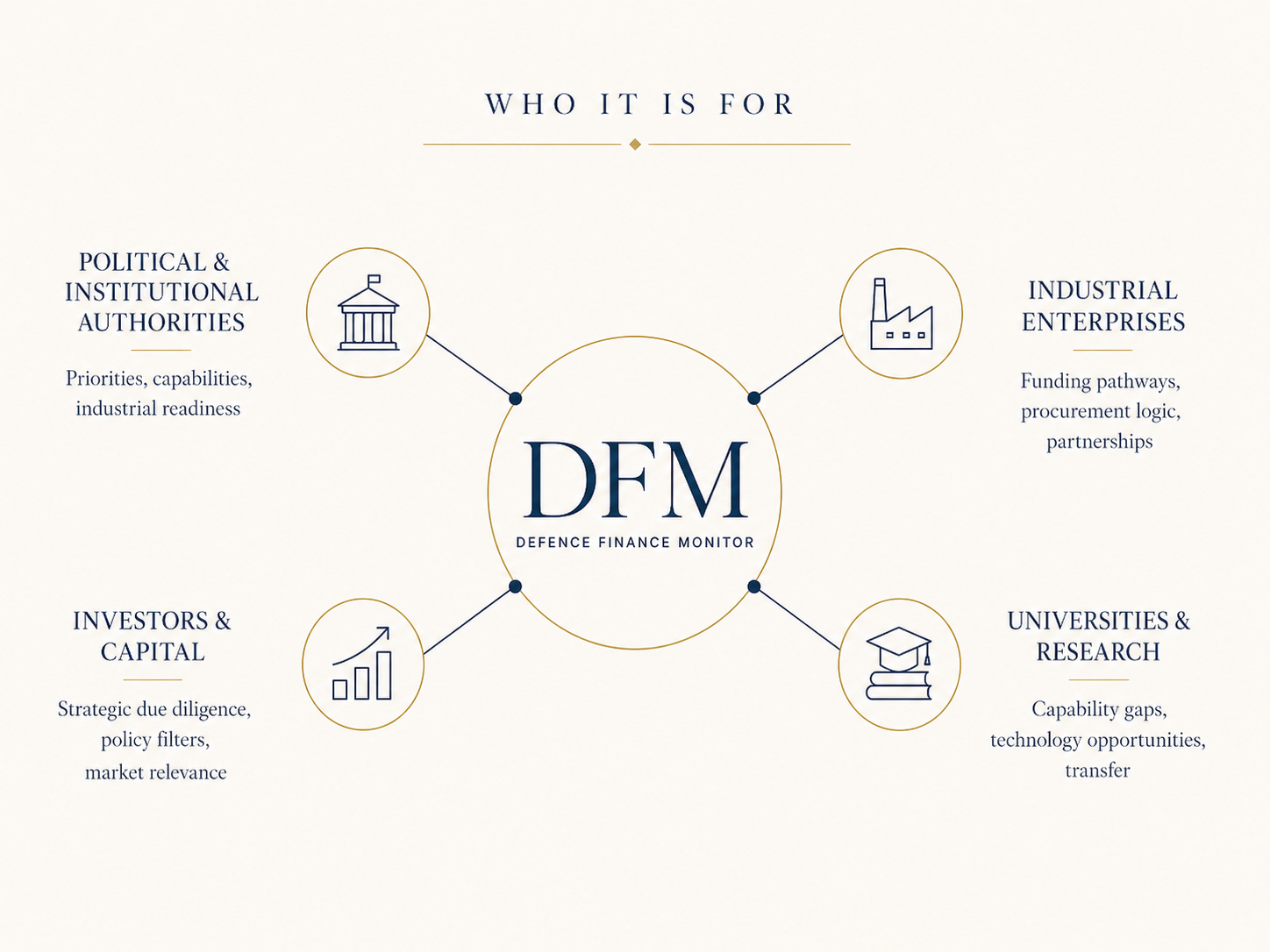
Defence Finance Monitor is built on a straightforward premise: the defence–technology–capital ecosystem is shaped by four distinct groups of actors whose perspectives, when considered together, form a complete and actionable understanding of strategic relevance. These groups are:
Political and institutional authorities (NATO, EU, ministries, directorates, procurement agencies);
Industrial enterprises (prime contractors, mid-caps, SMEs, deep-tech firms);
Investors and capital-market actors (including global Venture Capital, US/Allied Private Equity and Sovereign Funds seeking structured exposure to the European industrial base);
Universities, public research institutes, private R&D centres and technology-transfer offices.
DFM brings these perspectives into a unified analytical vantage point by linking strategic priorities, capability planning, industrial evolution, capital allocation and research trajectories. It clarifies how political objectives translate into capability requirements, how these requirements shape procurement frameworks and industrial pathways, and how they ultimately influence technological relevance, investment decisions and scientific development.
For political and institutional actors
DFM offers a structured and continuously updated map of the technological, industrial and financial landscape. It highlights emerging capabilities, startup ecosystems, research trends and capital flows across allied democracies, helping institutions align strategic intent with scientific advancement and industrial capacity.
For enterprises and industrial stakeholders
DFM provides a clear reading of NATO/EU strategic priorities and the institutional logic behind capability development. It helps companies understand which technologies are becoming essential, how supply chains are reorganising, how procurement rules are evolving, and where opportunities for collaboration with research partners or capital providers are emerging.
For global investors and capital-market professionals
DFM transforms the fragmented European landscape into a structured investment map. It supplies strategic due-diligence criteria tied to capability needs and regulatory constraints, enabling capital to look past bureaucratic opacity and assess whether a technology, platform or company corresponds to long-term defence demand and mission-critical priorities.
For universities, research bodies and TTOs
DFM offers a structured orientation of demand by translating strategic priorities into concrete technological opportunities. It identifies capability gaps, areas where ministries and enterprises seek new solutions, and domains where capital is available to scale innovations from TRL to operational adoption.
Across all four domains, Defence Finance Monitor serves as the analytical framework within which technologies, programmes, enterprises and research outputs acquire strategic meaning. Its role is to reveal how institutional demand shapes opportunity across the European and transatlantic defence economy, providing each actor with the structured intelligence required to operate coherently at the intersection of strategy, industry, capital and science.
To sum up.
Defence Finance Monitor is designed to help professionals interpret how the strategic priorities of NATO, the EU and allied nations are reshaping capability development, industrial policy and technological pathways. Each edition clarifies the structural shifts—rather than the news cycle—that redefine institutional demand, procurement choices and the strategic relevance of companies across the defence and dual-use ecosystem.
A subscription to Defence Finance Monitor does not provide access to a conventional editorial product, but to an integrated set of operational tools designed to connect actors and opportunities across the defence–finance ecosystem:
For Global & Transatlantic Investors: Europe is a critical yet fragmented pillar of the global defence supply chain. DFM acts as the single point of intelligence for international capital seeking to navigate the European market. We identify the hidden champions, deep-tech SMEs and dual-use innovators across 27+ regulatory environments, translating local industrial capacity into a unified, English-language investment map aligned with global security needs.
For Entrepreneurs and Sector Managers: It clarifies which capabilities and technologies are rising to the top of the priority agenda, which public and private funding instruments are realistically accessible, and which technology partners, industrial groups, investors and research institutions can be engaged to co-develop new products, services and programmes.
For Public Decision-Makers: It maps enterprises, funds, technological domains and research centres that are most relevant to their strategic objectives, providing a structured view of how industrial capacity, innovation pipelines and capital flows align with declared NATO, EU and national priorities.
For Universities and Research Centres: It matches scientific directions with urgent capability requirements and private capital to accelerate technology transfer and industrial validation.