

Understand How European Defence Priorities Shape Regulation, Investment and Industrial Capacity
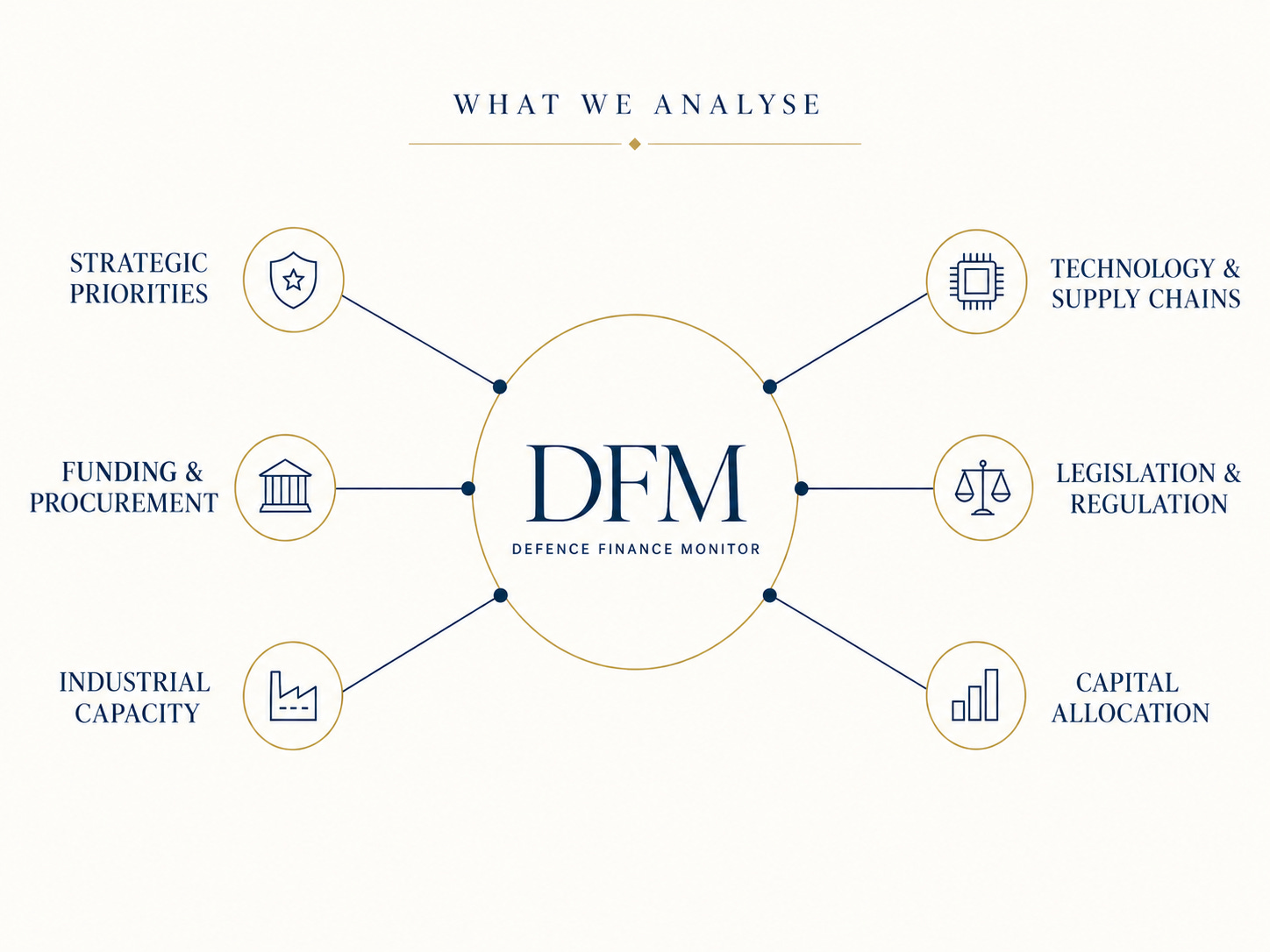
Defence Finance Monitor is an independent research and intelligence service that reduces the time and uncertainty required to understand how European defence priorities become legislation, public funding, procurement and industrial demand. It connects institutional decisions with their consequences for companies, technologies, ownership structures, supply chains and productive capacity.
European defence decisions are distributed across EU institutions, NATO frameworks, national ministries, armed forces, procurement authorities and public financial institutions. The information required to interpret them is often public, but dispersed across legislation, programme documents, budgets, calls for proposals, procurement notices, contracts and institutional announcements. Defence Finance Monitor reconstructs the chain from strategic intention to industrial implementation, distinguishing political announcements from approved measures, allocated funding, procurement procedures, awarded contracts and documented industrial effects.
For investment funds, Defence Finance Monitor reduces the work required to determine which technologies, capabilities and companies are supported by credible public demand. It provides an organised basis for company screening, investment-thesis development and portfolio monitoring, while making the evidence and remaining uncertainties visible.
For banks and other financial institutions, the service distinguishes announced expenditure from authorised budgets, allocated resources, awarded contracts and actual implementation. This helps identify emerging financing requirements, production-capacity investments, execution risks and the industrial activities associated with public programmes.
For established defence companies, Defence Finance Monitor clarifies how capability priorities, joint programmes, procurement decisions and industrial-policy measures affect market positioning, production capacity, partnerships and supply chains. For SMEs, startups and dual-use technology providers, it identifies relevant programmes, eligibility conditions, procurement pathways, deadlines and constraints related to ownership, control and technological origin.
For law firms, the service provides an ordered documentary basis for work concerning public procurement, foreign investment, ownership and control, programme eligibility, transactions and defence-industrial regulation. It reduces the time required to reconstruct the institutional and regulatory context surrounding a client, transaction or market.
For strategy and advisory firms, Defence Finance Monitor provides the initial evidence base needed for client assignments. It reduces preliminary research across fragmented sources and allows professional teams to concentrate on interpretation, strategic alternatives and recommendations.
For public institutions, research organisations and policy professionals, the service provides a structured view of the relationship between strategic objectives, implementation instruments, available resources and industrial capabilities. It helps identify where policy ambition is supported by operational mechanisms and where financing, procurement, capacity or supply-chain constraints remain unresolved.
Defence Finance Monitor provides ongoing analysis, company and technology profiles, funding and procurement intelligence, special reports and access to its research archive. Its purpose is not to reproduce the news cycle, but to make public decisions usable in professional work by explaining how they change the economic and strategic relevance of companies, technologies and productive assets across Europe.
Every analysis is grounded in official European and national documents, legislation, programme rules, procurement material, institutional data and company disclosures. Sources are linked to the relevant statements so that the evidence can be verified, compared and reused in professional analysis.
Seven days of full access are available without registration or payment details. Request seven-day access, and the service will be activated directly.