


Defence Finance Monitor applies a top–down method that traces how NATO, EU and allied strategic priorities are translated into regulations, funding lines and procurement programmes, and then into demand for specific capabilities, technologies and companies. We use official doctrine as the organising frame to identify where strategic relevance is being institutionally defined and where it is materialising in concrete budgets, acquisition pathways and industrial capacity.
Our working assumption is that what becomes structurally relevant in NATO/EU strategy tends, over time, to become relevant also from a financial and industrial point of view. In the European context, this includes the progressive operationalisation of strategic autonomy: the effort to reduce critical dependencies, secure supply chains, strengthen the European defence technological and industrial base, and align regulatory, financial and procurement instruments with long-term security objectives. On this basis, DFM operates as a decision-support tool: it benchmarks investment and industrial choices against institutional demand, clarifies which capabilities are rising on the spending agenda, and maps the funding instruments, eligibility constraints and supply-chain factors that shape real-world feasibility across investors, industry, public authorities and research organisations.
Defence Finance Monitor rests on a single analytical premise: within the Euro-Atlantic security architecture, strategic doctrine precedes regulation and capability planning, regulation precedes budgets, and budgets shape markets.
The Tariffing of Transit at Hormuz
Between mid-May and mid-June 2026, three measures appeared around the Strait of Hormuz: a transit charge per barrel, a maritime-insurance platform settled in Bitcoin, and a Chinese order forbidding firms from complying with US sanctions. Separately they look technical; together they describe a parallel framework for governing passage, built to function outside the London insurance market, the dollar and the conventional law of straits. This report measures that framework against the legal regime reserved for international straits, and asks the oldest question of maritime power in a new form: can a coastal state attach a charge to transit, and what follows when it tries? It reads the Islamabad memorandum clause by clause, sets the episode against the historical precedents the modern law was designed to foreclose, and separates what is verified from what remains an unconfirmed claim.
The full report is reserved for paid subscribers.
The Enforcement Gap: Do Defence Ministries Recover What Contractors Owe?
The revealing question about a failing defence contract is not whether it is late or over budget, but whether the state can convert that failure into money recovered, cost disallowed or a real handicap at the next award. Ministries hold a powerful arsenal on paper — liquidated damages, withheld payments, milestone rejection, advance recovery, termination — yet the gap between the remedy in the contract and the value actually collected is wide, and it is itself a supplier-risk signal that backlog and order figures miss entirely. Working only from public records, this report traces that gap across documented cases — Ajax, A400M, Gorch Fock, the Polish Armament Agency, Australia’s M113, the US FAR/GAO benchmark — and turns them into a framework for reading withheld payments, unclaimed penalties and repeat awards after poor execution.
The full report, including the enforcement taxonomy and the supplier-risk framework, is reserved for paid subscribers.
The Software Product Layer of European Defence
Military advantage increasingly depends on software-defined capability, yet industrial maturity is still read through platforms, order books and budgets — exactly where that advantage is invisible. So how do you tell a firm genuinely becoming a software organisation from one merely attaching an AI slogan to a hardware business? This report’s answer is to read hiring and role architecture as evidence, because certain job families only appear when software is run as a product with its own lifecycle and deployment cadence — and they surface in career pages before they show up in revenue. Working from annual reports, official vacancies and registries, it separates the incumbents adapting from the software-native scale-ups, maps where the layer is concentrating in Europe, and explains why its presence, depth and absence now signal strategic value.
The full report, including the maturity ladder and the company-by-company evidence, is reserved for paid subscribers.
Europe’s Defence Overruns, Measured
Europe’s defence overruns are argued with loud numbers and no common yardstick — and that is the real problem, because cost growth, unit-cost escalation, quantity cuts, slippage and portfolio gaps are disclosed by different institutions under different conventions, so any quick ranking compares things that are not the same object. This report separates the evidence problem from the overrun problem before attempting any comparison, building an index from courts of auditors and parliamentary records that admits a programme only where the public record shows what changed, against which baseline, on whose authority. It then ranks Europe in layers rather than one flattened list, and arrives at a conclusion that reframes the debate: disclosure quality is itself a strategic asset, and weak disclosure must never be mistaken for control.
The full report, including the evidence index and the country-by-country tiers, is reserved for paid subscribers.
DFM Intelligence · Platform Capability
From Weeks of Research to a Single Query
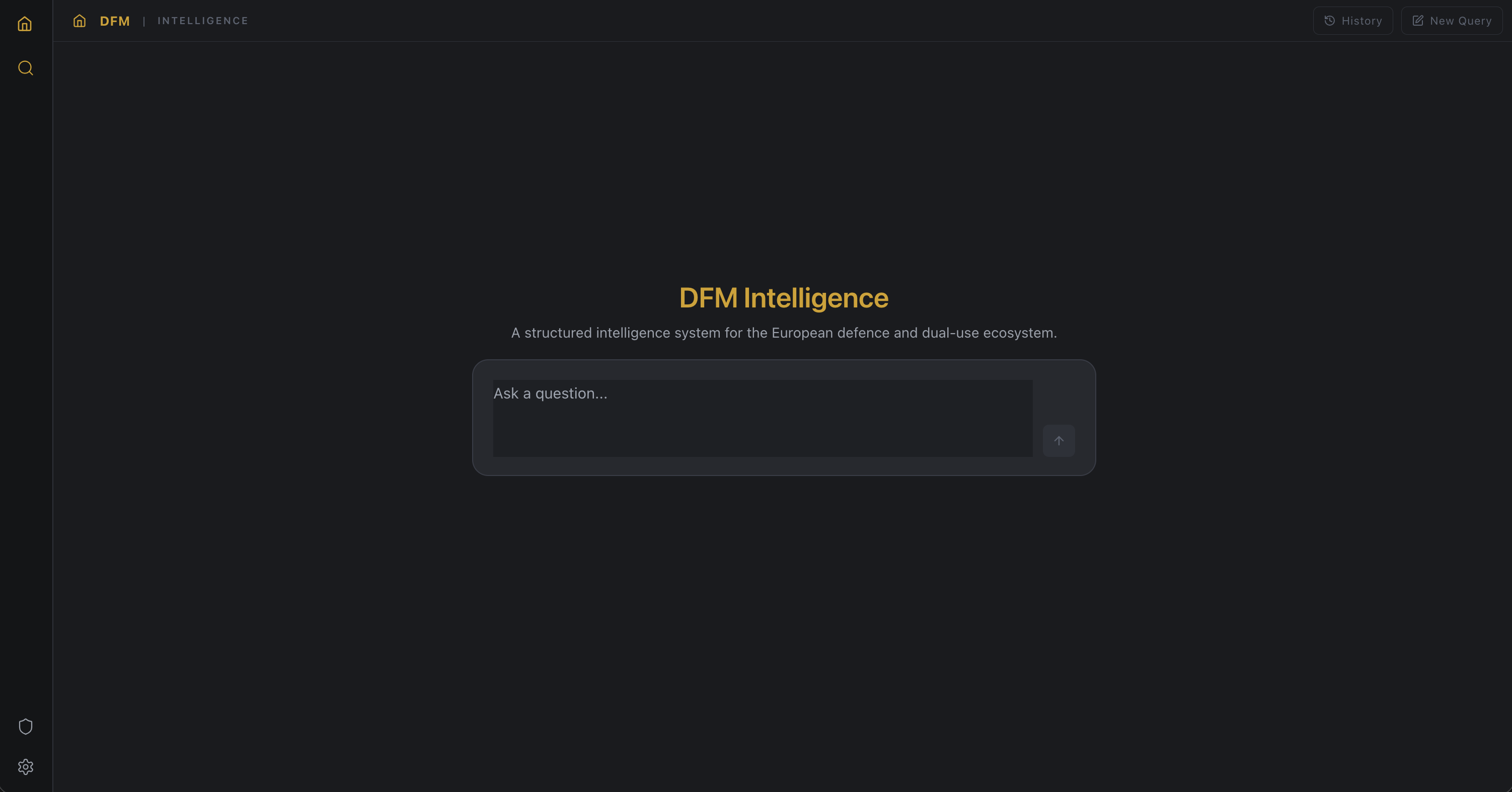
Defence Finance Monitor is an intelligence platform for the European defence-industrial base. It runs on a verified database of more than 2,000 European defence and dual-use enterprises, each mapped against the strategic priorities defined by EU and NATO policy, and maintained as the perimeter evolves through procurement awards, ownership changes, regulatory notifications and programme participation.
Work that has traditionally taken weeks of analyst effort is resolved in a single structured query: identifying the Tier-2 and Tier-3 suppliers behind a prime contractor, determining which firms are exposed to EDIP origin rules or Golden Power notifications, reconstructing contract awards under EDF, EDIRPA and ASAP, tracing the ownership chain behind a strategic asset. Every statement carries a stated confidence level and a citation to the official institutional source it rests on. Where a fact cannot be verified against source, it is marked as such rather than asserted.
The platform also opens a second analytical surface: the full corpus of analysis and publications produced by Defence Finance Monitor over the past year. Sector reports, regulatory readings, deep-research dossiers on industrial inversion and joint-venture architectures, weekly mappings of normative, industrial, financial and technological developments, thematic analyses on SAFE, EDIP, EDF and the Ukraine Support Loan, country dossiers and capability assessments — all are normalised against the same closed ontology that governs the entity layer. The same natural-language query that retrieves a supplier list also retrieves every internal analytical position taken on a given priority code, capability area, regulatory instrument or strategic document, with full source traceability. Institutional users no longer navigate a year of editorial output by date or title; they interrogate it as a structured analytical layer, cross-referenced with the entity, normative and procurement data of the underlying database.
For a law firm, a corporate-development team, a sovereign fund or a procurement office, the consequence is direct: institutional research that once defined the cost and timing of a deliverable now defines where the analysis begins.
DFM Intelligence is reserved for subscribers to the DFM annual programme.
For further information about DFM Intelligence, access conditions or payment by bank transfer, please contact: mastrolia@stroncature.com