


Defence Finance Monitor applies a top–down method that traces how NATO, EU and allied strategic priorities are translated into regulations, funding lines and procurement programmes, and then into demand for specific capabilities, technologies and companies. We use official doctrine as the organising frame to identify where strategic relevance is being institutionally defined and where it is materialising in concrete budgets, acquisition pathways and industrial capacity.
Our working assumption is that what becomes structurally relevant in NATO/EU strategy tends, over time, to become relevant also from a financial and industrial point of view. In the European context, this includes the progressive operationalisation of strategic autonomy: the effort to reduce critical dependencies, secure supply chains, strengthen the European defence technological and industrial base, and align regulatory, financial and procurement instruments with long-term security objectives. On this basis, DFM operates as a decision-support tool: it benchmarks investment and industrial choices against institutional demand, clarifies which capabilities are rising on the spending agenda, and maps the funding instruments, eligibility constraints and supply-chain factors that shape real-world feasibility across investors, industry, public authorities and research organisations.
Defence Finance Monitor rests on a single analytical premise: within the Euro-Atlantic security architecture, strategic doctrine precedes regulation and capability planning, regulation precedes budgets, and budgets shape markets.
Strategy · Political Economy of Interdependence
Wandel durch Handel
We are used to reading globalisation as an economic phenomenon: barriers falling, markets integrating, wealth following. The reading is correct but partial, because it omits the question beneath it — why the West wanted globalisation, and what it expected it to produce beyond profit. Behind the opening of commerce lay a political design: the conviction that trade could accomplish what arms had not, converting authoritarian regimes into stakeholders of a rules-based order. This analysis measures the distance between what the instrument delivered and what it promised. On the economic plane the wager was won — interdependence and prosperity were real. On the political plane it was not merely unachieved but reversed: the network built to elude control became the most sophisticated surveillance apparatus ever assembled, and economic integration was harnessed into industrial dominance and supply-chain leverage. Drawing on Kissinger, Clinton’s WTO case, the Campbell–Ratner reckoning and Johnston’s disciplining counterpoint, the piece explains why adversaries are not tamed by binding them, and what that means for a West that has learned to fear interdependence rather than trust it.
The full analysis is reserved for DFM paid subscribers.
Critical Raw Materials · Industrial Sovereignty
Critical Raw Materials, Refining and Recycling
Europe’s critical-raw-materials problem is not a shortage of rocks. It is a shortage of converters, refiners, separators, metallurgical plants, recyclers and magnet makers — the industrial stages that turn minerals into deployable capability. That is where the real vulnerability sits, and where China’s leverage concentrates: it is the leading refiner for 19 of 20 strategic minerals, supplies all of the EU’s heavy rare earths, and refined lithium, graphite, nickel and cobalt command prices three to four times their raw forms. This is why the Critical Raw Materials Act writes its 2030 benchmarks around processing and recycling, not only extraction, and defines strategic materials by their battery-grade or magnet-grade form rather than by generic mineral name. This report maps the bottleneck material by material — lithium, cobalt, nickel, rare earths, graphite, gallium, germanium, tungsten, titanium, copper and permanent magnets — tests whether Europe’s response matches the real choke-points, and sets out the six axes along which midstream assets should be monitored for strategic pricing power.
The complete bottleneck map — material by material — is available to DFM subscribers.
Industrial Base · Defence Readiness
Steel, Metals and European Power
A main battle tank contains 50 to 60 tonnes of high-quality steel; a self-propelled artillery system up to 100 tonnes; a fighter aircraft around three tonnes of aluminium. Those are the Commission’s own figures, and they explain why the European metals base is not a commodity subsector but a load-bearing structure of strategic autonomy. The stress is now acute: the EU share of global steel production has fallen to 7–8%, domestic output covers only 46% of aluminium demand and 25% of nickel demand, more than half of primary aluminium capacity has been idled since 2021, and steel plants run at around 65% utilisation when competitiveness needs above 85% — all against worsening global overcapacity that the new 2026 safeguard regulation was written to confront. This report treats metals as a strategic production system, distinguishing raw tonnage from certified, specification-compliant metal for defence and infrastructure, and maps the assets, companies and bottlenecks that will decide whether Europe can build and repair what it says it wants to defend.
The full company and asset map is reserved for DFM paid subscribers.
Automotive · Technological Sovereignty
Automotive, Connected Mobility and Industrial Transition
Europe can keep its brands and its assembly lines and still lose the automotive industry that matters. The transition is not simply the replacement of engines with electric drivetrains; it is a reallocation of value towards cells, processed materials, power electronics, semiconductors, sensors, software-defined architectures and vehicle data — and Europe is unevenly placed across exactly those layers. The evidence is already visible: electric vehicles rely on foreign components at 29% against 13% for combustion vehicles, electronics and software may reach half of a car’s value by 2030, and China accounts for 70% of electric-car production, over 80% of cell manufacturing and battery packs roughly a third cheaper than Europe’s. This report separates exposure to the EV transition from control of strategically relevant capability, works through the new technology stack and the regulatory and competitive environment, and maps eight company categories against the bottlenecks that will determine whether Europe’s automotive base is still a sovereignty-relevant manufacturing system by 2030 — or an assembler for other people’s technology.
The complete strategic assessment is available to DFM subscribers.
DFM Intelligence · Platform Capability
From Weeks of Research to a Single Query
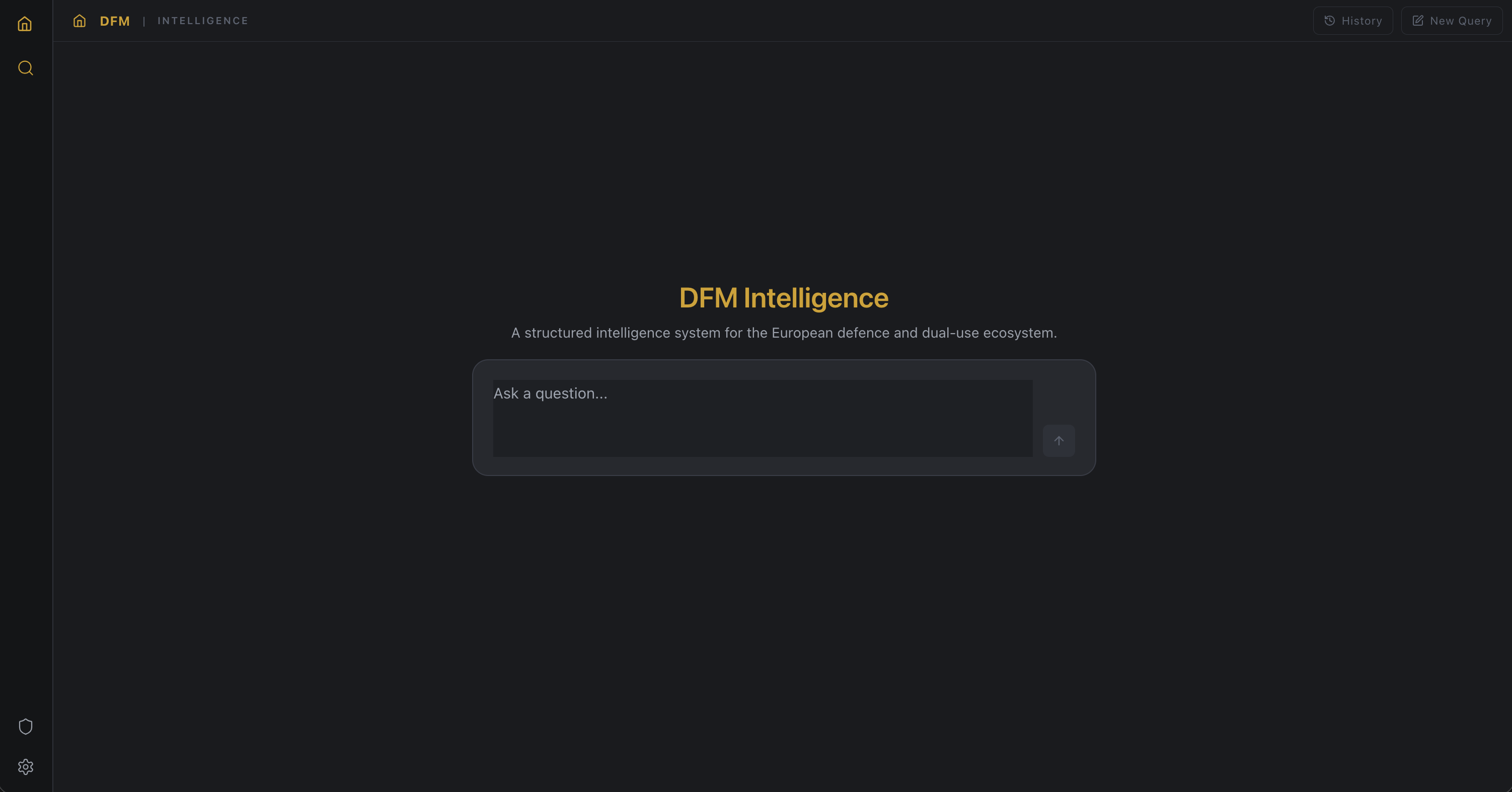
Defence Finance Monitor is an intelligence platform for the European defence-industrial base. It runs on a verified database of more than 2,000 European defence and dual-use enterprises, each mapped against the strategic priorities defined by EU and NATO policy, and maintained as the perimeter evolves through procurement awards, ownership changes, regulatory notifications and programme participation.
Work that has traditionally taken weeks of analyst effort is resolved in a single structured query: identifying the Tier-2 and Tier-3 suppliers behind a prime contractor, determining which firms are exposed to EDIP origin rules or Golden Power notifications, reconstructing contract awards under EDF, EDIRPA and ASAP, tracing the ownership chain behind a strategic asset. Every statement carries a stated confidence level and a citation to the official institutional source it rests on. Where a fact cannot be verified against source, it is marked as such rather than asserted.
The platform also opens a second analytical surface: the full corpus of analysis and publications produced by Defence Finance Monitor over the past year. Sector reports, regulatory readings, deep-research dossiers on industrial inversion and joint-venture architectures, weekly mappings of normative, industrial, financial and technological developments, thematic analyses on SAFE, EDIP, EDF and the Ukraine Support Loan, country dossiers and capability assessments — all are normalised against the same closed ontology that governs the entity layer. The same natural-language query that retrieves a supplier list also retrieves every internal analytical position taken on a given priority code, capability area, regulatory instrument or strategic document, with full source traceability. Institutional users no longer navigate a year of editorial output by date or title; they interrogate it as a structured analytical layer, cross-referenced with the entity, normative and procurement data of the underlying database.
For a law firm, a corporate-development team, a sovereign fund or a procurement office, the consequence is direct: institutional research that once defined the cost and timing of a deliverable now defines where the analysis begins.
DFM Intelligence is reserved for subscribers to the DFM annual programme.
For further information about DFM Intelligence, access conditions or payment by bank transfer, please contact: mastrolia@stroncature.com