


Defence Finance Monitor applies a top–down method that traces how NATO, EU and allied strategic priorities are translated into regulations, funding lines and procurement programmes, and then into demand for specific capabilities, technologies and companies. We use official doctrine as the organising frame to identify where strategic relevance is being institutionally defined and where it is materialising in concrete budgets, acquisition pathways and industrial capacity.
Our working assumption is that what becomes structurally relevant in NATO/EU strategy tends, over time, to become relevant also from a financial and industrial point of view. In the European context, this includes the progressive operationalisation of strategic autonomy: the effort to reduce critical dependencies, secure supply chains, strengthen the European defence technological and industrial base, and align regulatory, financial and procurement instruments with long-term security objectives. On this basis, DFM operates as a decision-support tool: it benchmarks investment and industrial choices against institutional demand, clarifies which capabilities are rising on the spending agenda, and maps the funding instruments, eligibility constraints and supply-chain factors that shape real-world feasibility across investors, industry, public authorities and research organisations.
Defence Finance Monitor rests on a single analytical premise: within the Euro-Atlantic security architecture, strategic doctrine precedes regulation and capability planning, regulation precedes budgets, and budgets shape markets.
The Client’s Dilemma
On the eve of the NATO summit in Ankara, Europe received an uncomfortable reminder of its own position: the question that most affects its security — how large an American presence will remain to defend it — was decided inside the American administration, and reached European capitals through a press leak rather than a negotiation. This essay treats that episode not as Washington turf politics but as the occasion to ask a question the continent has deferred for eighty years, and that the classical strategic tradition poses with unusual precision: whether entrusting one’s security to a far stronger ally is the safest arrangement available or the most fragile, and whether a power that has behaved as a client can be surprised when it is finally treated as one. It reads the patron–client relationship through classical strategy and the contemporary middle-power turn, and builds from it the case for European strategic autonomy — not as an aspiration, but as the logical response to a dependence that the language of partnership no longer disguises.
The full essay is reserved for paid subscribers.
Europe’s Seabed Security Test
That undersea infrastructure matters is no longer in doubt; the open question is whether Europe can actually protect it. The cables, interconnectors, pipelines, landing stations and ports through which European connectivity, energy and financial continuity pass are largely invisible, privately operated and slow to replace — and exposed to a spectrum that runs from ordinary faults and poor seamanship through to sabotage and hybrid pressure. This report moves past the now-familiar alarm to the harder question of capacity: whether Europe has the surveillance reach, legal architecture and repair depth to keep this layer functioning under stress. It reconstructs the framework that has grown up around cable security — NIS2, the Critical Entities Resilience Directive, DORA, UNCLOS and IMO rules — maps the value chain from cable manufacturers and repair vessels to naval drones, sensors, port operators and reinsurers, and sets out where the exposure is greatest and where public policy is turning seabed protection into a durable resilience market.
The full report is reserved for paid subscribers.
Space Sovereignty and Secure Connectivity
Europe’s space programmes are usually discussed as industrial achievements; the strategic problem is what sits beneath them. Secure government communications, military connectivity, trusted timing, maritime and border surveillance and near-real-time crisis awareness now depend on space services — and that dependence becomes a vulnerability wherever Europe does not control the communications, navigation, observation, launch and ground layers those services rest on, even when the underlying activity looks civilian. This report treats space as a sovereignty question rather than an aerospace market. It sets out the EU’s legal and institutional architecture — the Union Space Programme, IRIS², GOVSATCOM, Galileo, Copernicus, space-situational-awareness and the proposed EU Space Act — maps the capability stack from secure SATCOM and PNT through Earth observation, launch autonomy and ground infrastructure, and assesses which industrial positions are most exposed to recurring sovereign demand, programme-execution risk and the financial logic of Europe’s space build-out.
The full report is reserved for paid subscribers.
Europe’s Maritime Industrial Base
Owning ports, cables, offshore assets and naval requirements is not the same as being able to build, equip, repair and sustain them — and it is the second capacity, not the first, that decides whether maritime autonomy is real. Where the seabed question is one of protection, this report addresses the industrial base underneath it: shipyards and naval yards, port-equipment suppliers, offshore-wind and cable-laying vessels, underwater drones, maritime robotics and the strategic ports that now form a single connected system across defence, energy security and critical-infrastructure policy. It frames maritime autonomy as an industrial and financial problem rather than a procurement one, maps that base and its bottlenecks, examines how port policy, decarbonisation, cybersecurity and military mobility are converting regulation into demand, and gives the DFM judgement on the companies, revenue pools and procurement dependencies that will determine whether Europe’s maritime autonomy becomes credible, partial or structurally constrained.
The full report is reserved for paid subscribers.
DFM Intelligence · Platform Capability
From Weeks of Research to a Single Query
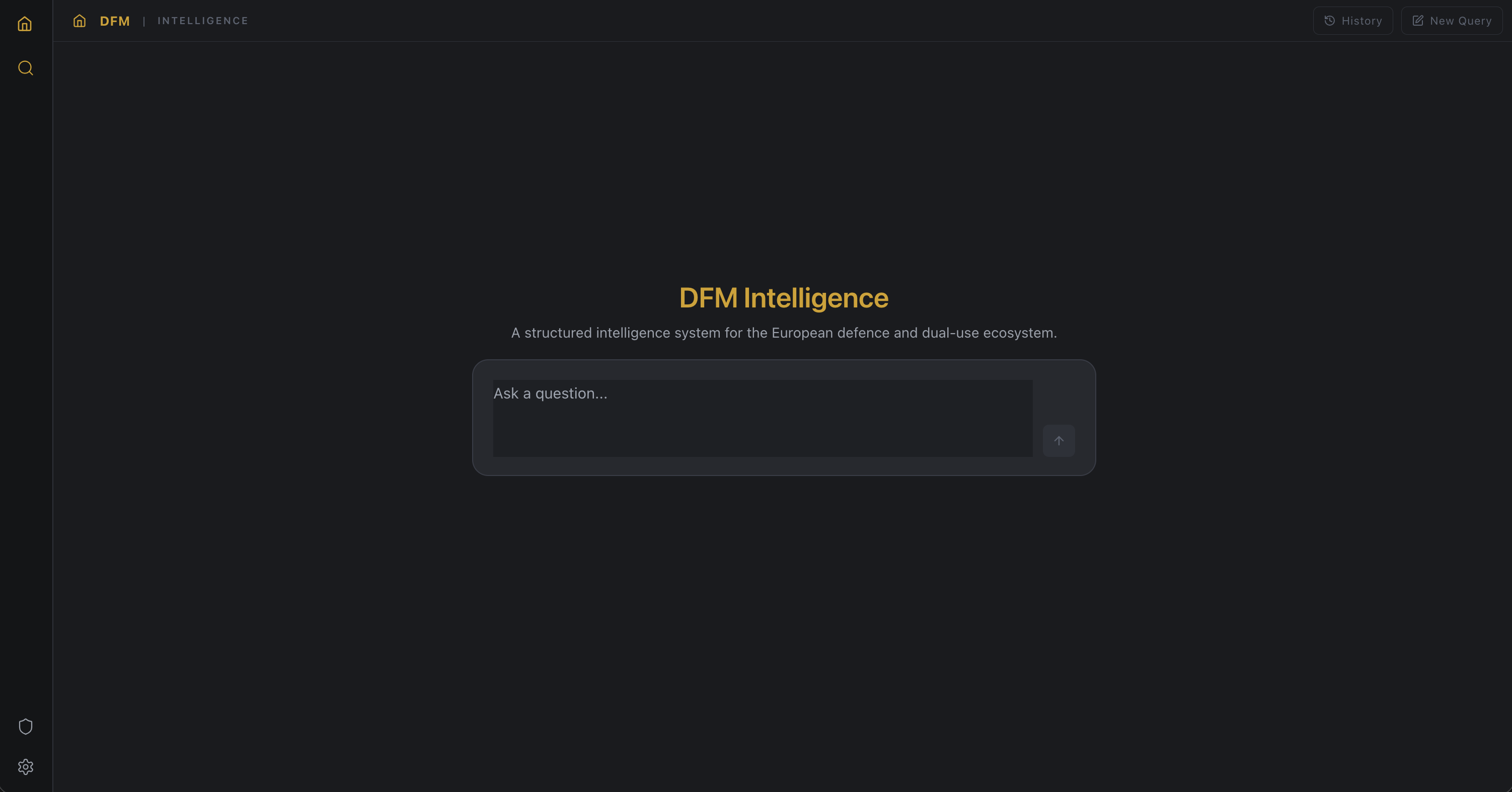
Defence Finance Monitor is an intelligence platform for the European defence-industrial base. It runs on a verified database of more than 2,000 European defence and dual-use enterprises, each mapped against the strategic priorities defined by EU and NATO policy, and maintained as the perimeter evolves through procurement awards, ownership changes, regulatory notifications and programme participation.
Work that has traditionally taken weeks of analyst effort is resolved in a single structured query: identifying the Tier-2 and Tier-3 suppliers behind a prime contractor, determining which firms are exposed to EDIP origin rules or Golden Power notifications, reconstructing contract awards under EDF, EDIRPA and ASAP, tracing the ownership chain behind a strategic asset. Every statement carries a stated confidence level and a citation to the official institutional source it rests on. Where a fact cannot be verified against source, it is marked as such rather than asserted.
The platform also opens a second analytical surface: the full corpus of analysis and publications produced by Defence Finance Monitor over the past year. Sector reports, regulatory readings, deep-research dossiers on industrial inversion and joint-venture architectures, weekly mappings of normative, industrial, financial and technological developments, thematic analyses on SAFE, EDIP, EDF and the Ukraine Support Loan, country dossiers and capability assessments — all are normalised against the same closed ontology that governs the entity layer. The same natural-language query that retrieves a supplier list also retrieves every internal analytical position taken on a given priority code, capability area, regulatory instrument or strategic document, with full source traceability. Institutional users no longer navigate a year of editorial output by date or title; they interrogate it as a structured analytical layer, cross-referenced with the entity, normative and procurement data of the underlying database.
For a law firm, a corporate-development team, a sovereign fund or a procurement office, the consequence is direct: institutional research that once defined the cost and timing of a deliverable now defines where the analysis begins.
DFM Intelligence is reserved for subscribers to the DFM annual programme.
For further information about DFM Intelligence, access conditions or payment by bank transfer, please contact: mastrolia@stroncature.com