


Defence Finance Monitor applies a top–down method that traces how NATO, EU and allied strategic priorities are translated into regulations, funding lines and procurement programmes, and then into demand for specific capabilities, technologies and companies. We use official doctrine as the organising frame to identify where strategic relevance is being institutionally defined and where it is materialising in concrete budgets, acquisition pathways and industrial capacity.
Our working assumption is that what becomes structurally relevant in NATO/EU strategy tends, over time, to become relevant also from a financial and industrial point of view. In the European context, this includes the progressive operationalisation of strategic autonomy: the effort to reduce critical dependencies, secure supply chains, strengthen the European defence technological and industrial base, and align regulatory, financial and procurement instruments with long-term security objectives. On this basis, DFM operates as a decision-support tool: it benchmarks investment and industrial choices against institutional demand, clarifies which capabilities are rising on the spending agenda, and maps the funding instruments, eligibility constraints and supply-chain factors that shape real-world feasibility across investors, industry, public authorities and research organisations.
Defence Finance Monitor rests on a single analytical premise: within the Euro-Atlantic security architecture, strategic doctrine precedes regulation and capability planning, regulation precedes budgets, and budgets shape markets.
European Strategic Autonomy as an Investable System
European strategic autonomy has moved from diplomatic vocabulary into the field of capital allocation, but as a slogan it is analytically useless: the task is to separate ordinary commercial dependence from critical dependence, and to identify the capability layer through which Europe actually reduces its exposure to coercion or disruption. This report treats autonomy not as a sector but as an organising principle that converts geopolitical stress into differentiated industrial demand across raw materials, semiconductors, energy, compute, defence, cyber, space, medicines, grids and financial infrastructure. It builds the dependency map that links political sovereignty to industrial capability, works through the enabling technologies, bottlenecks and financing mechanisms that determine whether policy becomes capacity, and sets out an investment logic anchored in capability scarcity, regulated demand, procurement visibility and control of critical supply-chain nodes rather than in European domicile or thematic branding. It is the foundational dossier against which DFM’s sector and company coverage of the subject should be read.
The full report is reserved for paid subscribers.
Defence Industrial Readiness
European defence has entered a phase in which higher budgets are no longer the central test: the harder question is whether Europe can convert political urgency, EU industrial instruments and NATO capability pressure into real military output at the speed a high-intensity crisis would demand. This report separates the EU defence-industrial architecture into its distinct instruments — SAFE, ASAP, EDIRPA, the EDF and EDIP, distinguishing capacity tools from procurement incentives and R&D funding — and shows why the framework is enabling legislation and conditional finance rather than automatic mobilisation. It then assesses readiness across the capability domains where production depth actually binds — ammunition and missiles, air and missile defence, ground systems, naval, drones, electronic warfare, and the neglected layer of maintenance and stockpiles — treating each as a bottleneck problem rather than a slogan. It closes with a company-mapping logic that starts from conversion capacity, not exposure to defence budgets: which firms can turn demand into serial output, usable backlog and recurring sustainment revenue.
The full report is reserved for paid subscribers.
Cybersecurity and Digital Resilience
Cybersecurity in Europe is no longer a discretionary line of enterprise IT: through NIS2, the Cyber Resilience Act, DORA, the Cybersecurity Act and the Cyber Solidarity Act, the Union is turning cyber risk management, incident reporting, product security, certification and crisis response into enforceable obligations across critical sectors. The investment question is therefore not whether cyber spending stays fashionable, but which capabilities become structurally necessary once resilience is written into the operating rules of the strategic economy. This report explains why cybersecurity has become a regulated resilience layer rather than a cyclical software market, reconstructs the legal and institutional architecture instrument by instrument, and maps the recurring operational demand it creates — secure software development, SBOMs, vulnerability handling, managed detection and response, sovereign cloud controls, cryptographic transition, OT security and sectoral testing across energy, transport, finance, health, defence and space. It closes with a company-mapping framework identifying the capability classes positioned at Europe’s new mandatory cyber control points.
The full report is reserved for paid subscribers.
DFM Intelligence · Platform Capability
From Weeks of Research to a Single Query
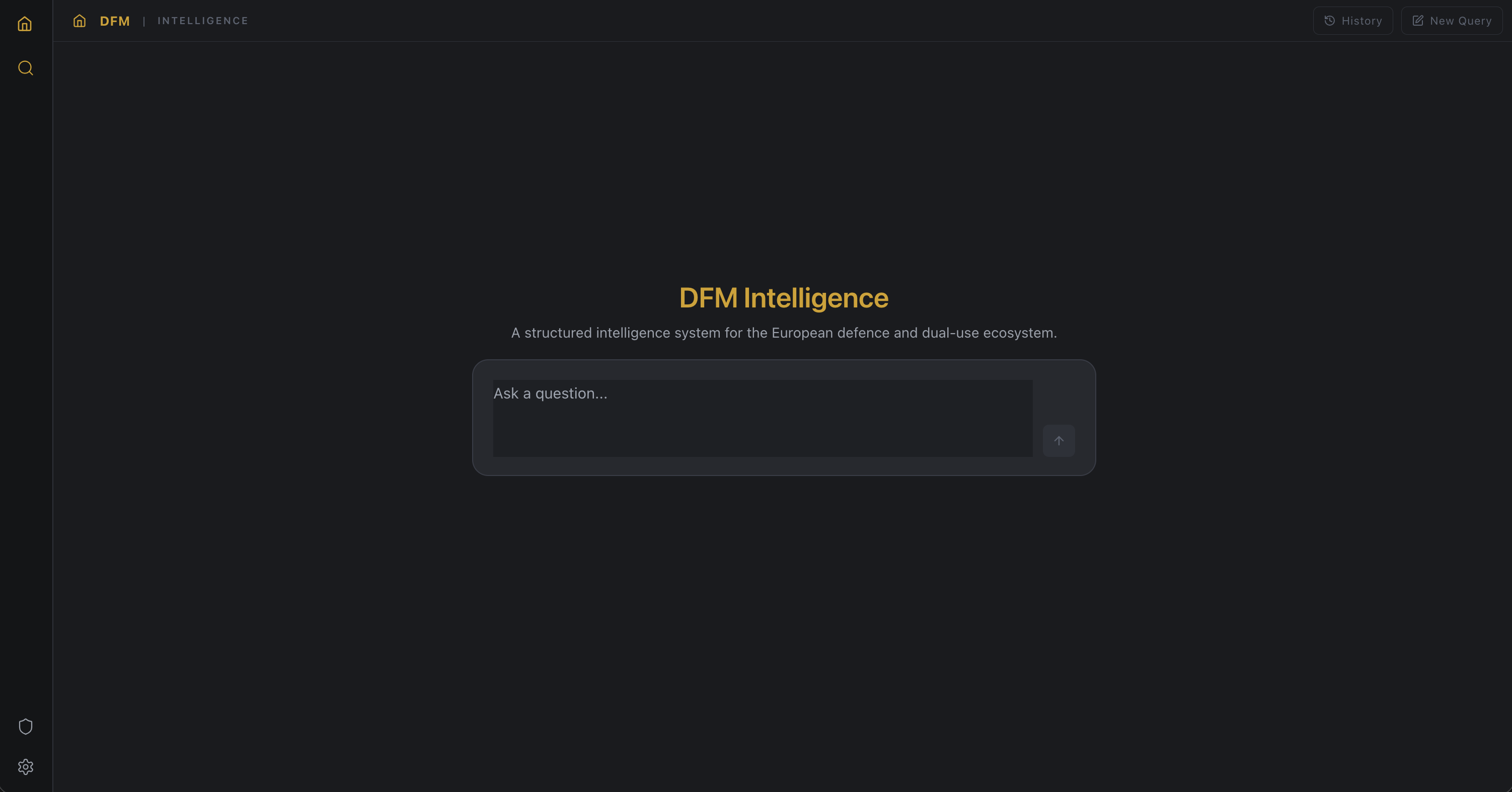
Defence Finance Monitor is an intelligence platform for the European defence-industrial base. It runs on a verified database of more than 2,000 European defence and dual-use enterprises, each mapped against the strategic priorities defined by EU and NATO policy, and maintained as the perimeter evolves through procurement awards, ownership changes, regulatory notifications and programme participation.
Work that has traditionally taken weeks of analyst effort is resolved in a single structured query: identifying the Tier-2 and Tier-3 suppliers behind a prime contractor, determining which firms are exposed to EDIP origin rules or Golden Power notifications, reconstructing contract awards under EDF, EDIRPA and ASAP, tracing the ownership chain behind a strategic asset. Every statement carries a stated confidence level and a citation to the official institutional source it rests on. Where a fact cannot be verified against source, it is marked as such rather than asserted.
The platform also opens a second analytical surface: the full corpus of analysis and publications produced by Defence Finance Monitor over the past year. Sector reports, regulatory readings, deep-research dossiers on industrial inversion and joint-venture architectures, weekly mappings of normative, industrial, financial and technological developments, thematic analyses on SAFE, EDIP, EDF and the Ukraine Support Loan, country dossiers and capability assessments — all are normalised against the same closed ontology that governs the entity layer. The same natural-language query that retrieves a supplier list also retrieves every internal analytical position taken on a given priority code, capability area, regulatory instrument or strategic document, with full source traceability. Institutional users no longer navigate a year of editorial output by date or title; they interrogate it as a structured analytical layer, cross-referenced with the entity, normative and procurement data of the underlying database.
For a law firm, a corporate-development team, a sovereign fund or a procurement office, the consequence is direct: institutional research that once defined the cost and timing of a deliverable now defines where the analysis begins.
DFM Intelligence is reserved for subscribers to the DFM annual programme.
For further information about DFM Intelligence, access conditions or payment by bank transfer, please contact: mastrolia@stroncature.com