


Defence Finance Monitor applies a top–down method that traces how NATO, EU and allied strategic priorities are translated into regulations, funding lines and procurement programmes, and then into demand for specific capabilities, technologies and companies. We use official doctrine as the organising frame to identify where strategic relevance is being institutionally defined and where it is materialising in concrete budgets, acquisition pathways and industrial capacity.
Our working assumption is that what becomes structurally relevant in NATO/EU strategy tends, over time, to become relevant also from a financial and industrial point of view. In the European context, this includes the progressive operationalisation of strategic autonomy: the effort to reduce critical dependencies, secure supply chains, strengthen the European defence technological and industrial base, and align regulatory, financial and procurement instruments with long-term security objectives. On this basis, DFM operates as a decision-support tool: it benchmarks investment and industrial choices against institutional demand, clarifies which capabilities are rising on the spending agenda, and maps the funding instruments, eligibility constraints and supply-chain factors that shape real-world feasibility across investors, industry, public authorities and research organisations.
Defence Finance Monitor rests on a single analytical premise: within the Euro-Atlantic security architecture, strategic doctrine precedes regulation and capability planning, regulation precedes budgets, and budgets shape markets.
The Strait and the Hegemon
A maritime order is decided at a strait. Carthage’s long ruin began not in open water but in the war over the Strait of Messina and the loss of Sicily; Britain’s began with the fall of Singapore in 1942, the fortress built to lock the eastern seas. In each case the thalassocracy did not decline evenly across the whole sea, but broke at a single point — a passage that slipped from its grasp. The question this essay poses, the third in the publication’s sequence on thalassocracy and the one that brings the series to the present, is whether Hormuz is now that point. In mid-June 2026 the United States and Iran signed, under Pakistani mediation, the preliminary framework known as the Islamabad Memorandum of Understanding, and beneath its clauses on the nuclear file and sanctions its maritime core is an agreement about a single channel: the United States to lift its naval blockade within thirty days, Iran to ensure “safe passage of commercial vessels, with no charge for 60 days only,” to clear its mines, and to open a dialogue with Oman over the “future administration and maritime services in the Strait of Hormuz.” The essay reads the memorandum, paragraph by paragraph, against what the law of the sea actually says about straits — the Corfu Channel judgment that condemns mining a passage to the open sea; the transit-passage regime of UNCLOS Part III, non-suspendable and free of charge, which the naval powers secured as the price of the twelve-mile territorial sea; the Montreux precedent of a strait held at the coastal state’s discretion — and shows that the memorandum negotiates precisely what the law declares non-negotiable: a passage that can be neither suspended nor taxed. The “no charge for 60 days only” implies a future toll; the open-ended “administration” slides toward a discretionary, Montreux-style regime Hormuz has no legal basis to establish. Beneath the legal analysis runs the thread that joins this essay to the whole series: freedom of navigation has always been the principle of the dominant maritime power, and the open strait the mark of its hegemony. The crux it reaches is the crux of world order — whether we still live under a maritime order held together by those who keep the straits open, or have entered the fragmented sea that follows the decline of every thalassocracy.
The full essay is reserved for paid subscribers.
The Public Mandate Register: Investment Banks in European Defence M&A
Everyone knows European defence is consolidating, but the question of who actually advises those transactions is usually answered with commercial league tables that quietly mix rumour, vendor databases and self-reported credits. This report does something stricter and more useful: it builds a public mandate register governed by one rule — no public attribution, no league-table credit — and counts a bank as principal M&A adviser only where an admissible primary or official source (a Rule 2.7 announcement, a scheme document, an SEC exhibit, an issuer release) expressly names it as such. The problem it solves is that conflating financing architecture with advisory credit produces a false picture of the market: the same bank can be adviser, lender, bookrunner or fairness-opinion provider on one deal, and only the source language can tell them apart. Working through the documented universe — Advent–Cobham, Parker–Meggitt, Cobham–Ultra, HENSOLDT–ESG, Fincantieri–Leonardo UAS, Leonardo–Iveco Defence — it shows a visible market narrower, more British and more concentrated than commercial tables imply: Rothschild the most recurrent on seller and board mandates, Morgan Stanley and Goldman the most cross-sided, Citi the clearest repeat buy-side name in UK aerospace, Deutsche Bank concentrated in continental champion-building, Numis appearing once but in a formally decisive Rule 3 role. It is candid about its own negative space — Safran–Collins, Thales–Cobham Aerospace, Safran–Preligens and others belong in the universe but yield no principal credit because the official record names no adviser — and that candour is the point: the register is a map of documentary exposure that can be verified and challenged from source, not inferred from market noise.
The full report, including the bank-by-bank recurrence analysis, is reserved for paid subscribers.
Entering the German Procurement Machine
Germany’s procurement reform is widely read as having made the Bundeswehr market faster and more open — and for a supplier that reading is a trap. The reform has not flattened the market; it has made it more discretionary and more selective, with more money, more urgency and more security-driven choice concentrated in the buyer’s hands. The problem this report solves is that the supplier’s real question is no longer “how do I find a tender?” but “how do I become a contractable entity inside a bureaucracy that now has wider under-threshold discretion, can disapply lotting, can favour EU origin, and can convert installed-base and interoperability logic into legally defensible sole-source speed?” It walks the supplier’s actual route in: the institutional door (BAAINBw for armaments and IT versus BAIUDBw for the rest, and why unsolicited pitches outside the portals cannot be considered); what the February 2026 reform law actually changes — market-available solutions, advance payments that can genuinely lower entry barriers for undercapitalised firms, widened direct awards up to the EU threshold, EU-preference tools, the centralisation of remedies that strips the suspensive effect from losing challengers; and the path from visibility to contract through AQAP quality assurance, VS-NfD security handling and the €25-million parliamentary gate that can leave a “won” deal exposed until the Budget Committee signs. Read against real 2026 TED notices — competitive transport awards alongside single-bidder sole-source awards to Heckler & Koch — it maps the three different logics by which the machine now allocates opportunity, and identifies who wins after the reform: incumbents and recognised subsystem suppliers, market-mature firms in genuinely competitive categories, and SMEs only where their uniqueness is already legible to the state.
The full report, including the supplier-route map and the winners-and-bottlenecks analysis, is reserved for paid subscribers.
The Legal Infrastructure of Rearmament
In defence, a signed agreement is rarely enough. Before industrial intent becomes enforceable ownership, cleared capital, transferable technology and valid procurement continuity, a sensitive asset must pass through merger control, foreign-investment screening, national-security review, golden power, export control, sanctions checks and, in contested cases, litigation — and the law firms that recur at those gates are not incidental service providers but part of the infrastructure through which rearmament is made executable. The problem this report addresses is that legal-market commentary ranks firms by reputation, which tells an investor nothing about who actually papers, clears or repairs a defence deal. So it applies the same documentary discipline as a register: a firm earns a place only where a public record — an issuer release, a Rule 2.7 announcement, a competition decision, a law-firm mandate note checkable against the deal — ties it to a transaction or dispute. On that basis it works through verified dossiers across munitions, naval, systems integration, AI and cyber: Herbert Smith Freehills Kramer recurring across Rheinmetall’s Expal, Hagedorn-NC and NVL acquisitions, both as transaction and as competition/FDI counsel; Gleiss Lutz and Hengeler Mueller on HENSOLDT–ESG; BonelliErede and Freshfields on opposing sides of Leonardo–Iveco, with Freshfields expressly handling antitrust and the Foreign Subsidies Regulation; Kirkland and Slaughter and May in Cobham–Ultra, Kirkland reappearing on the Ultra Cyber sale to Airbus. The analytical payoff is a map sorted by function rather than prestige — transaction executors, clearance specialists, sovereignly embedded domestic firms — and a warning that follows directly: a defence deal stopped at the FDI or export-control gate is not saved by first-rate generic M&A paper. As a companion to the investment-bank register, it shows the other half of how Europe’s defence consolidation is actually made to work.
The full report, including the firm-by-firm map and the jurisdictional patterns, is reserved for paid subscribers.
DFM Intelligence · Platform Capability
From Weeks of Research to a Single Query
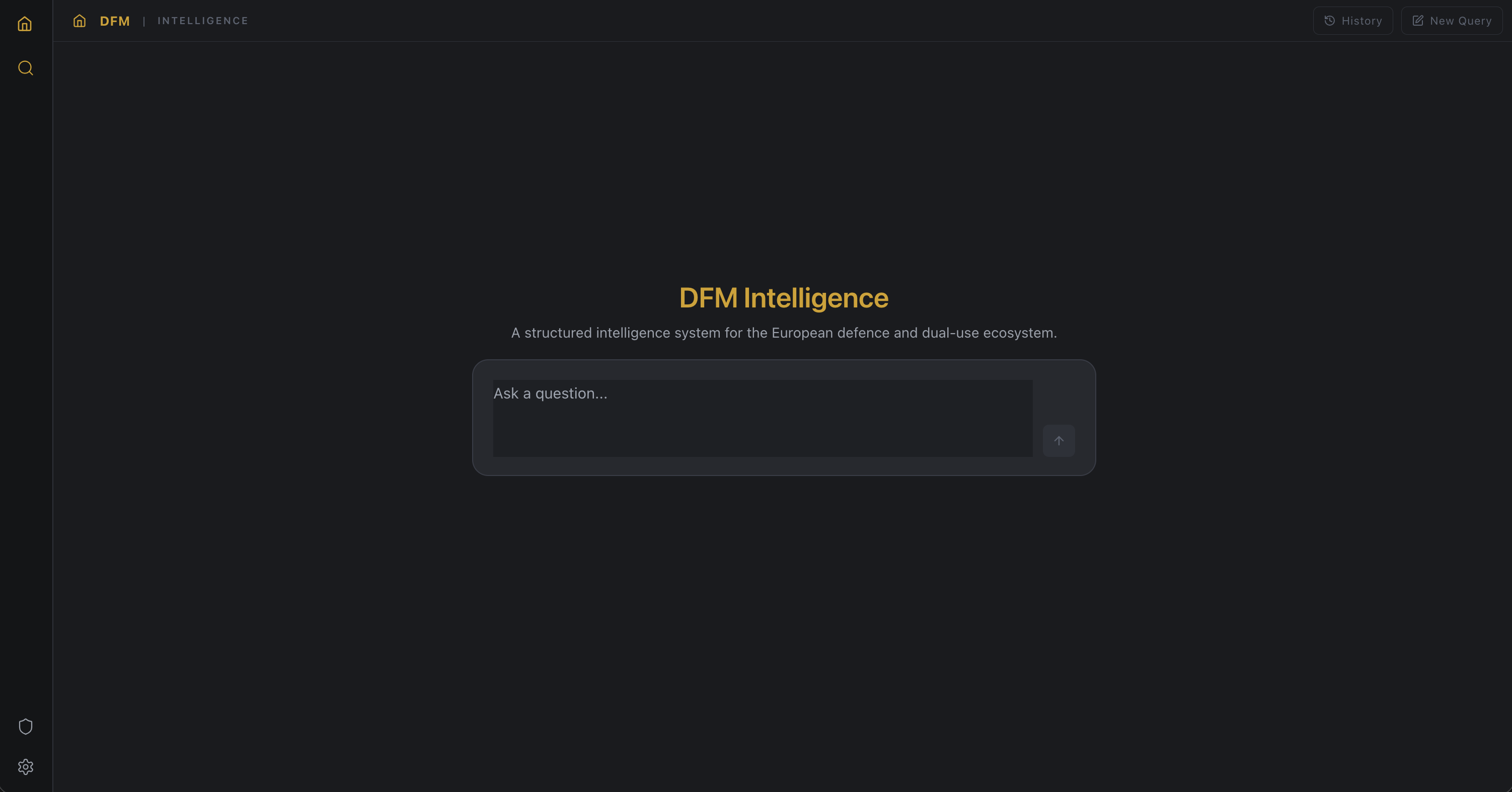
Defence Finance Monitor is an intelligence platform for the European defence-industrial base. It runs on a verified database of more than 2,000 European defence and dual-use enterprises, each mapped against the strategic priorities defined by EU and NATO policy, and maintained as the perimeter evolves through procurement awards, ownership changes, regulatory notifications and programme participation.
Work that has traditionally taken weeks of analyst effort is resolved in a single structured query: identifying the Tier-2 and Tier-3 suppliers behind a prime contractor, determining which firms are exposed to EDIP origin rules or Golden Power notifications, reconstructing contract awards under EDF, EDIRPA and ASAP, tracing the ownership chain behind a strategic asset. Every statement carries a stated confidence level and a citation to the official institutional source it rests on. Where a fact cannot be verified against source, it is marked as such rather than asserted.
The platform also opens a second analytical surface: the full corpus of analysis and publications produced by Defence Finance Monitor over the past year. Sector reports, regulatory readings, deep-research dossiers on industrial inversion and joint-venture architectures, weekly mappings of normative, industrial, financial and technological developments, thematic analyses on SAFE, EDIP, EDF and the Ukraine Support Loan, country dossiers and capability assessments — all are normalised against the same closed ontology that governs the entity layer. The same natural-language query that retrieves a supplier list also retrieves every internal analytical position taken on a given priority code, capability area, regulatory instrument or strategic document, with full source traceability. Institutional users no longer navigate a year of editorial output by date or title; they interrogate it as a structured analytical layer, cross-referenced with the entity, normative and procurement data of the underlying database.
For a law firm, a corporate-development team, a sovereign fund or a procurement office, the consequence is direct: institutional research that once defined the cost and timing of a deliverable now defines where the analysis begins.
DFM Intelligence is reserved for subscribers to the DFM annual programme.
For further information about DFM Intelligence, access conditions or payment by bank transfer, please contact: mastrolia@stroncature.com