


Defence Finance Monitor applies a top–down method that traces how NATO, EU and allied strategic priorities are translated into regulations, funding lines and procurement programmes, and then into demand for specific capabilities, technologies and companies. We use official doctrine as the organising frame to identify where strategic relevance is being institutionally defined and where it is materialising in concrete budgets, acquisition pathways and industrial capacity.
Our working assumption is that what becomes structurally relevant in NATO/EU strategy tends, over time, to become relevant also from a financial and industrial point of view. In the European context, this includes the progressive operationalisation of strategic autonomy: the effort to reduce critical dependencies, secure supply chains, strengthen the European defence technological and industrial base, and align regulatory, financial and procurement instruments with long-term security objectives. On this basis, DFM operates as a decision-support tool: it benchmarks investment and industrial choices against institutional demand, clarifies which capabilities are rising on the spending agenda, and maps the funding instruments, eligibility constraints and supply-chain factors that shape real-world feasibility across investors, industry, public authorities and research organisations.
Defence Finance Monitor rests on a single analytical premise: within the Euro-Atlantic security architecture, strategic doctrine precedes regulation and capability planning, regulation precedes budgets, and budgets shape markets.
The EDIP/SAFE Eligibility Evidence File
A defence company can have the right technology, the right order book and a genuinely European footprint, and still lose a bid, stall a financing or take a valuation cut — because it cannot prove, on paper, that its ownership, control, executive management, component origin, classified-information handling and design authority are clean enough to qualify. That is the shift EDIP and SAFE have forced: eligibility used to be a legal status you either had or didn’t; it is now a documentary burden you have to assemble, maintain and defend at every layer, through procurement contracts, grant agreements and ex-post audit. With SAFE already drawing at least €127 billion of Member State requests and EDIP deploying a €1.5 billion work programme, weak evidence stops being a paperwork irritant and becomes a capital-allocation problem. This report is built as the evidence file itself. It explains, layer by layer, exactly what has to be documented — establishment and executive management, the control test that looks past shareholding into decisive influence, FDI-screening status and mitigation, the guarantee package where control sits outside the perimeter, classified-information clearances, the costed bill of materials behind the 35% origin cap, critical-subcontractor identification, technical-data and design-authority rights, and security-of-supply undertakings — and then shows how that file travels through procurement, grant milestones, prime-to-subcontractor flow-down, M&A diligence, lending covenants and audit. The conclusion is the one that should change behaviour: fundability is now a legal-regulatory asset, and the company that can prove it earns a premium while the company that cannot absorbs delay, redesign cost and a discount.
The full evidence file, layer by layer, is reserved for paid subscribers
The Biodefence Eligibility Gap
Europe is now funding defence-relevant health-security and biotech research — diagnostics, medical countermeasures, biosurveillance, CBRN — but research eligibility is not defence capacity, and that gap is where most of the value is won or lost. A scientifically excellent platform can still fail the tests that decide whether it becomes a usable European defence asset: who controls it, who owns the IP, where it is manufactured, whether its supply chain survives a crisis, whether a foreign licensor or export-control regime can veto its adaptation or sale. This report examines that conversion gap from the standpoint of strategic capital, and its central finding reframes the whole sector: the scarce asset in European biodefence is not promising science, of which there is plenty, but a company that is legally controllable, industrially scalable, financially fundable and procurement-compatible. It walks the full institutional pathway — from the EDF’s small but real defence-medical lane (€40 million in 2026, three selected projects), through EUDIS spin-in and the Defence Equity Facility, EIB debt eligibility, and on to where the pipeline narrows hardest, EDIP industrialisation and SAFE-backed procurement, neither of which currently runs a broad biodefence lane. It then tests company types, ownership structures and transaction models against the eligibility conditions that actually bite, showing why minority rights, contract-manufacturing dependencies and background-IP constraints are no longer ancillary diligence points but eligibility variables that move valuations. For investors, primes and counsel, the practical takeaway is a conversion-probability framework: where European control, design authority and sovereign supply are present, regulation creates a premium; where they are absent, it creates a discount.
The full analysis and the conversion-probability framework are reserved for paid subscribers.
The Translation Gap: Why Europe’s Quantum and Advanced-Materials Research Does Not Automatically Become Defence Capability
Europe’s problem in quantum and advanced materials is not a shortage of scientific excellence. It is the weakness of the chain that has to carry research from the laboratory to qualified components, integrable subsystems, procurement vehicles and sustained military use — the standards, testing, qualification, certification, prime-contractor integration and acquisition routes that sit between a published result and a fielded capability. This report analyses that gap from the demand side rather than the technology side, which is what makes it useful to capital: it starts from the capability priorities EU and NATO institutions have actually declared — resilient PNT, secure communications, electromagnetic-spectrum operations, undersea awareness, signature reduction, component sovereignty — and then shows exactly where the chain breaks, from research-to-demonstrator, demonstrator-to-standard, standard-to-qualified-component, and on through integration, procurement and sustainment. It treats quantum and advanced materials not as fashionable labels but as functions, assessing each only where it relieves an identified bottleneck, and it builds a maturity hierarchy for 2025–2030 that an investor can act on: post-quantum cryptography migration and quantum sensing for contested-GNSS navigation are near-term and procurement-relevant; tactical QKD and multifunctional soldier textiles are demonstrator-stage; broad military quantum computing is long-duration optionality, not deployable capability. The discipline it imposes is the one the market most lacks — not to pay deployment valuations for technologies still sitting in the testbed or roadmap stage — and the conclusion is exact: the winners will not be the organisations with the most advanced science in isolation, but those that can align science with requirements, standards, secure supply, integration and procurement logic.
The full analysis and the 2025–2030 maturity hierarchy are reserved for paid subscribers.
The Control of the Straits and the Naval Policy of the British Empire
The naval policy of the British Empire can be read through the same categories that describe the maritime power of Rome — the control of obligatory passages, the command of communications, the capacity to make others’ transit conditional — across two millennia and a complete technological transformation, from sail to steam, from the broadside to the submarine telegraph cable. This essay, the second in the publication’s sequence on thalassocracy, reconstructs British naval policy through that single thread and states its argument at the outset: a sea power is built on the control of a handful of straits, and when it loses them its collapse begins. It follows the logic through its phases — the defence of the Narrow Seas, Selden’s claim to a “closed sea” against Grotius, the seizure of Gibraltar in 1704, the blockade that could starve a port without a battle, and the nineteenth-century network of bases from Malta to Aden to Singapore that made Suez the “Clapham Junction of imperial communications” — drawing on the first rank of naval historiography and theory: Corbett, who defined command of the sea as the control of communications; Kennedy, who distinguished naval mastery from mere sea power; Darwin, Holland, Lambert and Rodger. The criterion it arrives at is deliberately negative, the same one that governed Rome: maritime hegemony is measured not by what the dominant power can do with the sea but by what it can prevent others from doing, and the Pax Britannica’s “free sea” was simply British supremacy under another name. The decline is then legible in the fate of the straits themselves — Singapore in 1942, Suez in 1956 — and the conclusion reaches the present: because no single power today holds all the keys at once, the straits have become contested ground again, and the oldest question in maritime history, the right to open or close a passage, has returned to the centre of international politics.
The full essay is reserved for paid subscribers.
DFM Intelligence · Platform Capability
Problems DFM Intelligence Now Solves
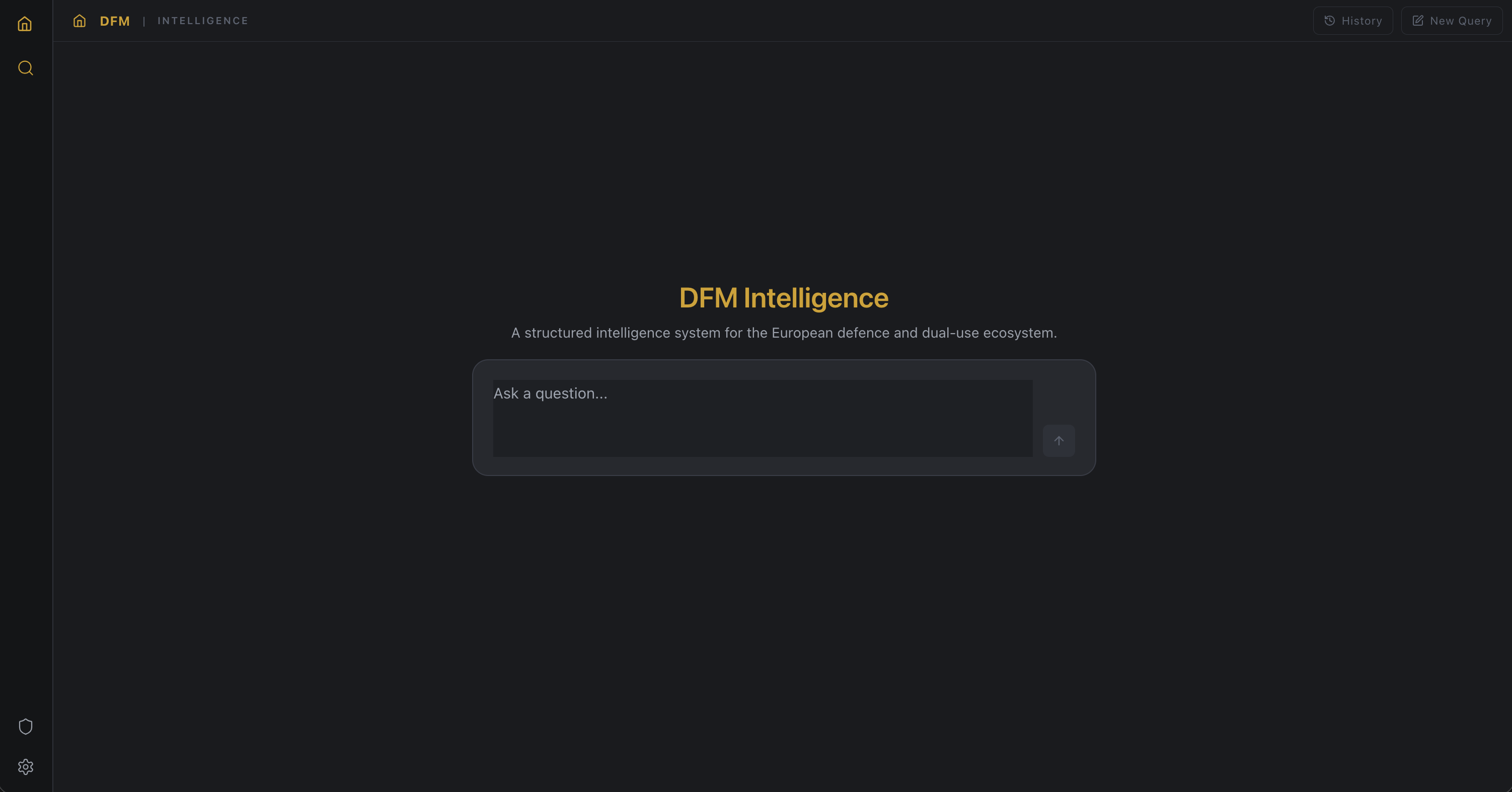
Defence Finance Monitor is an intelligence platform for the European defence-industrial base. It runs on a verified database of more than 2,000 European defence and dual-use enterprises, each mapped against the strategic priorities defined by EU and NATO policy, and maintained as the perimeter evolves through procurement awards, ownership changes, regulatory notifications and programme participation.
A single structured query resolves work that has traditionally required extended analyst effort: identifying the Tier-2 and Tier-3 suppliers behind a prime contractor, determining which firms are exposed to EDIP origin rules, Golden Power notifications or critical-raw-material dependencies, reconstructing contract awards under EDF, EDIRPA and ASAP, or tracing the ownership chain behind a strategic asset. Every statement carries a stated confidence level and a citation to the official institutional source it rests on. Where a fact cannot be verified against source, it is marked as such rather than asserted.
For a law firm, a corporate-development team, a sovereign fund or a procurement office, the consequence is direct: institutional research that once defined the cost and timing of a deliverable now defines where the analysis begins.
DFM Intelligence is reserved for subscribers to the DFM annual programme.
For further information about DFM Intelligence, access conditions or payment by bank transfer, please contact: mastrolia@stroncature.com