


Defence Finance Monitor applies a top–down method that traces how NATO, EU and allied strategic priorities are translated into regulations, funding lines and procurement programmes, and then into demand for specific capabilities, technologies and companies. We use official doctrine as the organising frame to identify where strategic relevance is being institutionally defined and where it is materialising in concrete budgets, acquisition pathways and industrial capacity.
Our working assumption is that what becomes structurally relevant in NATO/EU strategy tends, over time, to become relevant also from a financial and industrial point of view. In the European context, this includes the progressive operationalisation of strategic autonomy: the effort to reduce critical dependencies, secure supply chains, strengthen the European defence technological and industrial base, and align regulatory, financial and procurement instruments with long-term security objectives. On this basis, DFM operates as a decision-support tool: it benchmarks investment and industrial choices against institutional demand, clarifies which capabilities are rising on the spending agenda, and maps the funding instruments, eligibility constraints and supply-chain factors that shape real-world feasibility across investors, industry, public authorities and research organisations.
Defence Finance Monitor rests on a single analytical premise: within the Euro-Atlantic security architecture, strategic doctrine precedes regulation and capability planning, regulation precedes budgets, and budgets shape markets.
The Power to Close the Sea
Maritime power is never decided on the open sea. The horizon cannot be held, blockaded or taxed; what can be held are the narrows where the traffic of whole basins must funnel — and it is there, not on open water, that the fate of every thalassocracy is settled, because it is there that a single power on the shore can do the one thing the open sea forbids: it can close. This essay traces the history of sea empire as a history of chokepoints, from the strait at Messina where the First Punic War began to the imperial peace that followed, and arrives at a criterion that is deliberately negative: Rome’s hegemony over the Mediterranean is measured not by what it could do with the water, but by what it could prevent others from doing with it. The plurality of closures did not dissolve of its own accord — it was gathered into a single hand; Rome opened the sea not by renouncing the power to close it but by monopolising that power, stripping every coastal city, every rival fleet, every pirate of the capacity to make passage conditional on consent. The argument runs from Carthage’s claim that Rome “will not be allowed even to wash their hands in the sea,” through the peace of 241 that pried one hand off the valve, to the moment six centuries on when the monopoly failed and the gates fell open again. For readers who follow this publication’s work on straits, seabed infrastructure and the contest over obligatory passages, it is the long historical frame beneath all of it: whoever can close the door commands the sea.
The National Budget Layer Behind EU Defence Funding
European defence funding is read through the size of the Brussels headline. That reading is incomplete — and for an investor, dangerous. The €800 billion of Readiness 2030 is not €800 billion of Union grants: roughly €650 billion is fiscal space created by the national escape clause and €150 billion is SAFE borrowing capacity, and both still require sovereign decisions to spend, borrow, procure and pay. This report isolates the layer that actually converts EU signals into supplier revenue — national co-financing, budget authorisation, procurement commitment, payment execution — and shows why every instrument, from EDF and EDIP to SAFE, presupposes a financing and decision-making layer that sits outside the grant agreement. The distinction it draws is the one most often missed: between appropriation, which authorises expenditure, and execution, which produces industrial cash flow. It then tests that distinction against five national systems with real budget figures — Germany’s special fund, France’s multiannual programming law, Italy’s DPP, Poland’s unusually large autonomous capacity, Romania’s SAFE pre-financing — and converts the whole into a usable hierarchy for capital allocation: an EDF research award is a positioning signal, an EDF development award a stronger one, a SAFE allocation revenue-relevant only once an approved plan, a Council decision, a loan agreement and an identifiable procurement exist. The conclusion is exact: EU funding should never be valued at headline amount, but at the point where national budget authorisation, procurement execution and credible payment capacity join it.
EU Funding for Test, Demonstration and Certification Infrastructure
Most defence and dual-use technologies do not fail because the science is weak. They fail because the path from prototype to usable capability runs through infrastructure no single company can build alone — pilot lines, testbeds, cyber ranges, qualification procedures, certification pathways — and that infrastructure layer has become Europe’s decisive bottleneck. This report maps the instruments that finance access to it, and reads them through a distinction the market routinely blurs: a testbed improves a technology’s validation status; it is not the same as certification, which is a separate regulatory milestone, which is in turn not the same as procurement, an actual market event. It works through the full architecture — EDF testing and qualification actions, EUDIS and BraveTech EU as the entry layer, EDA’s HEDI, OPEX and the Defence Test and Evaluation Base for operational testing and mutual acceptance, Digital Europe’s TEFs, the ECCC’s cyber and post-quantum testing infrastructure, and the Chips JU pilot lines now representing €3.7 billion of combined investment — and is careful to flag what is operational versus merely proposed, placing AGILE firmly in the latter category. For investors it reframes due diligence: the relevant documents are not grant letters but test reports, the identity of the validating infrastructure, the standardisation pathway and the degree of end-user involvement. The dividing line it draws is the one that matters for capital: infrastructure that creates procurability, and infrastructure that merely creates visibility.
The NATO-Side Signal: DIANA, NIF and the Reading of Defence-Tech Validation
For European private capital, the strategic relevance of defence technology is settled. The harder question is how to read early institutional validation — and this report answers it by treating the NATO-side signal as something distinct from, and not interchangeable with, EU-side eligibility. DIANA selection, NATO test access, trusted-capital screening and NATO Innovation Fund backing do not amount to procurement certainty or revenue visibility, but they compress a specific class of uncertainty: whether a technology is legible to Alliance priorities, whether end users will engage, whether the cap table is moving toward trusted capital. The report separates four cumulative signals — selection, validation-access, capital, adoption-proximity — and grades them: baseline DIANA selection is meaningful, Mission Track stronger, Rapid Adoption Service eligibility procurement-adjacent. It then draws the sharpest distinction in the field: DIANA is a NATO body offering non-dilutive validation, while NIF is a standalone venture fund deploying over €1 billion of sovereign-aligned equity in which NATO itself takes no investment decisions — and it shows what it means when the two stack, as in NIF’s €15 million Series A into Kelluu after two DIANA phases. What the signal de-risks and what it cannot replace is stated with equal precision: it makes operational relevance and trusted ownership readable; it does not replace commercial, legal, export-control or IP diligence, and it does not create procurement certainty.
DFM Intelligence · Platform Capability
Problems DFM Intelligence Now Solves
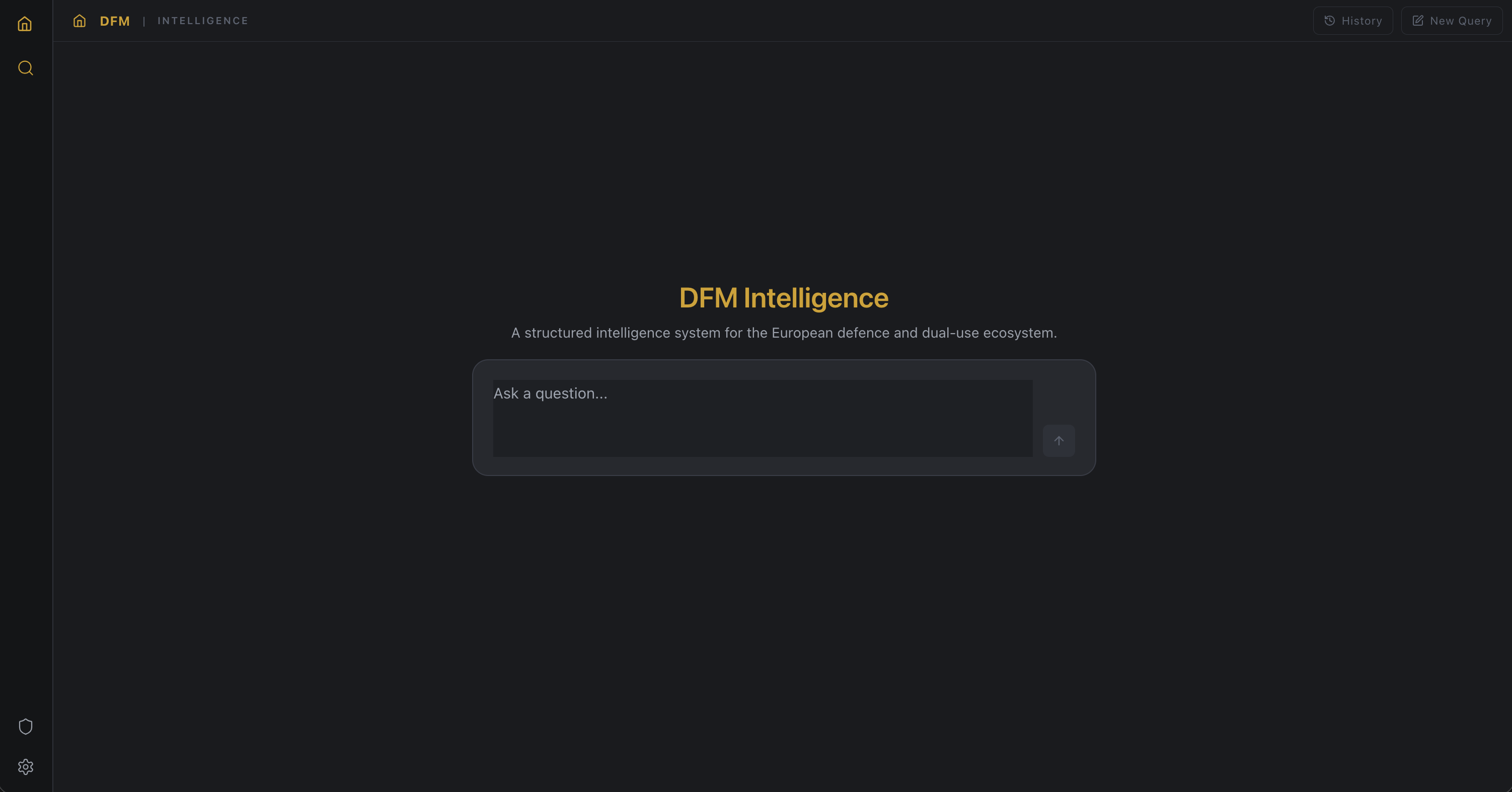
Defence Finance Monitor is an intelligence platform for the European defence-industrial base. It runs on a verified database of more than 2,000 European defence and dual-use enterprises, each mapped against the strategic priorities defined by EU and NATO policy, and maintained as the perimeter evolves through procurement awards, ownership changes, regulatory notifications and programme participation.
A single structured query resolves work that has traditionally required extended analyst effort: identifying the Tier-2 and Tier-3 suppliers behind a prime contractor, determining which firms are exposed to EDIP origin rules, Golden Power notifications or critical-raw-material dependencies, reconstructing contract awards under EDF, EDIRPA and ASAP, or tracing the ownership chain behind a strategic asset. Every statement carries a stated confidence level and a citation to the official institutional source it rests on. Where a fact cannot be verified against source, it is marked as such rather than asserted.
For a law firm, a corporate-development team, a sovereign fund or a procurement office, the consequence is direct: institutional research that once defined the cost and timing of a deliverable now defines where the analysis begins.
DFM Intelligence is reserved for subscribers to the DFM annual programme.
For further information about DFM Intelligence, access conditions or payment by bank transfer, please contact: mastrolia@stroncature.com