

Defence Finance Monitor applies a top–down method that traces how NATO, EU and allied strategic priorities are translated into regulations, funding lines and procurement programmes, and then into demand for specific capabilities, technologies and companies. We use official doctrine as the organising frame to identify where strategic relevance is being institutionally defined and where it is materialising in concrete budgets, acquisition pathways and industrial capacity.
Our working assumption is that what becomes structurally relevant in NATO/EU strategy tends, over time, to become relevant also from a financial and industrial point of view. In the European context, this includes the progressive operationalisation of strategic autonomy: the effort to reduce critical dependencies, secure supply chains, strengthen the European defence technological and industrial base, and align regulatory, financial and procurement instruments with long-term security objectives. On this basis, DFM operates as a decision-support tool: it benchmarks investment and industrial choices against institutional demand, clarifies which capabilities are rising on the spending agenda, and maps the funding instruments, eligibility constraints and supply-chain factors that shape real-world feasibility across investors, industry, public authorities and research organisations.
Defence Finance Monitor rests on a single analytical premise: within the Euro-Atlantic security architecture, strategic doctrine precedes regulation and capability planning, regulation precedes budgets, and budgets shape markets.
The Tyranny That Athens Became
Reading Thucydides as a strategic analyst rather than as a classicist is the most efficient laboratory available for isolating the structural laws of power from the noise of the contemporary. The figures move slowly enough to be tracked, the documentation is sparse enough to compel disciplined inference, and the categories — public goods, extraction, voluntary loyalty, compelled obedience, centripetal and centrifugal force — appear without the protective coating of euphemism that contemporary diplomacy applies to them. The metamorphosis of the Delian League is the original paradigm of every order that ceases to build and begins only to take. The sequence is exact: provision of a genuine public good (security against Persia); inclusive consolidation with autonomy and collective deliberation; exhaustion of the external threat that justified the order; conversion of tribute from contribution into rent, with the structural disarmament of the allies — Thucydides records that the allies, preferring to send money rather than ships, “went into each revolt without preparation or experience in war”; coercive repression of defections, beginning with Naxos “against what had been arranged”; Pericles’ private admission that the empire was held “like a tyranny” that could not be released without retaliation from those it had oppressed; Cleon’s elevation of terror to method at Mytilene; the stripping bare of every legal fiction in the Melian Dialogue; and finally collapse at the first great military reversal. An order founded on consent survives a defeat because its members have an interest in its continuation. An order founded only on fear collapses the moment the fear dissolves. Athens did not fall because Sparta grew; it fell because the Delian League became a tyranny — because the order itself, through its internal transformation, generated the forces that would destroy it. The laws of power are persistent and recurrent, and they press directly upon the economic, industrial and financial life of nations: who finances whose fleet, which capacities a state retains and which it surrenders, where investment flows and where dependence accumulates. Reading Thucydides with the eye of an analyst is the cheapest and clearest way to see what is already operating in the present. The parallels are left to the reader.
The full reconstruction is reserved for DFM paid subscribers.
France’s Military Nuclear Defence Industrial Base
The single most consequential fact about the French deterrent, from an investor’s standpoint, is that you cannot buy it. The companies that actually design and build the submarines, missiles, naval reactors and warheads — Naval Group, TechnicAtome, ArianeGroup, the CEA — are unlisted, state-controlled, or held inside protected joint ventures, and they were deliberately constructed that way. The listed perimeter is what remains visible: Airbus, Safran, Dassault, Thales, Leonardo, BAE Systems. But in each case the deterrent-relevant work is a fraction of total revenue, the State retains either a direct stake or a structural means of control, and the order flow runs on long-cycle sovereign procurement rather than market demand. Naval Group is held 62.25 per cent by the State and 35 per cent by Thales. TechnicAtome is held 50.32 per cent by the APE, with Naval Group, the CEA and EDF holding the rest in a closed loop that does not touch a stock exchange. ArianeGroup is a 50/50 Airbus–Safran joint venture, not separately listed. This piece reconstructs the full architecture — the doctrinal principle that release authority is non-delegable and presidential, the foreign-investment screen that prevents control of these assets from moving abroad, the April 2026 budget actualisation adding roughly €36 billion through 2030 and lifting defence spending toward 2.5 per cent of GDP, the planned warhead expansion and the new political framing around extended European deterrence — and shows how each element reinforces the same conclusion. There is no pure-play French deterrent equity. Exposure can only be obtained indirectly, through diversified primes whose nuclear share is small and whose returns are subordinated to sovereign requirements. For analysts treating the French complex as a sector, this is the wrong frame. It is a sovereign ecosystem with an industrial dimension, not an industrial sector that happens to serve strategy.
The full ownership map and the implications for investors and primes are reserved for DFM paid subscribers.
The Joint Expeditionary Force as Demand-Shaper
The Joint Expeditionary Force places no orders. It holds no procurement authority. That is precisely why it is becoming one of the most valuable leading indicators in European defence finance. Because the Force aggregates political will, operational planning and joint exercises around the same regional problems — undersea-infrastructure protection, maritime domain awareness, anti-submarine warfare, drones and counter-drone capability, ammunition resilience, cold-weather logistics — it makes capability gaps visible before traditional procurement cycles formalise them. Read carefully, the pattern is now coherent across signed agreements: Operation Nordic Warden converted the Estlink-2 cable damage into a permanent AI-enabled maritime surveillance system run from Northwood with personnel from all ten member nations; the Lunna House Agreement of December 2025 produced an interchangeable UK–Norway fleet of thirteen Type 26 anti-submarine frigates built at BAE Systems’ Clyde shipyards, with Royal Navy vessels standardising on Kongsberg’s Naval Strike Missile in a reversal of the usual export pattern; the October 2025 Nordic UAS Technical Arrangement among Finland, Sweden, Norway and Denmark aggregated drone demand for the explicit purpose of giving industry the order certainty that justifies new capacity; the June 2025 Nammo Strategic Partnership underwrote a potential tripling of Nordic ammunition production through a manufacturer jointly owned by the Norwegian state and Finland’s Patria. The disciplined reading is that the Force does not command — it renders shared requirements legible and lowers the political cost of buying together. Two analytical disciplines must hold for the conclusion to be sound: the Force should not be credited with everything that happens within its geography, and the link between its signals and specific procurements is, in the public record, more often concurrent than demonstrably causal. With those disciplines observed, the bottom line is firm. The Force tells the careful observer, earlier than almost any other source, where the orders in Northern Europe are likely to fall.
The full mapping of domains, frameworks and industrial beneficiaries is reserved for DFM paid subscribers.
DFM Intelligence · Platform Capability
Problems DFM Intelligence Now Solves
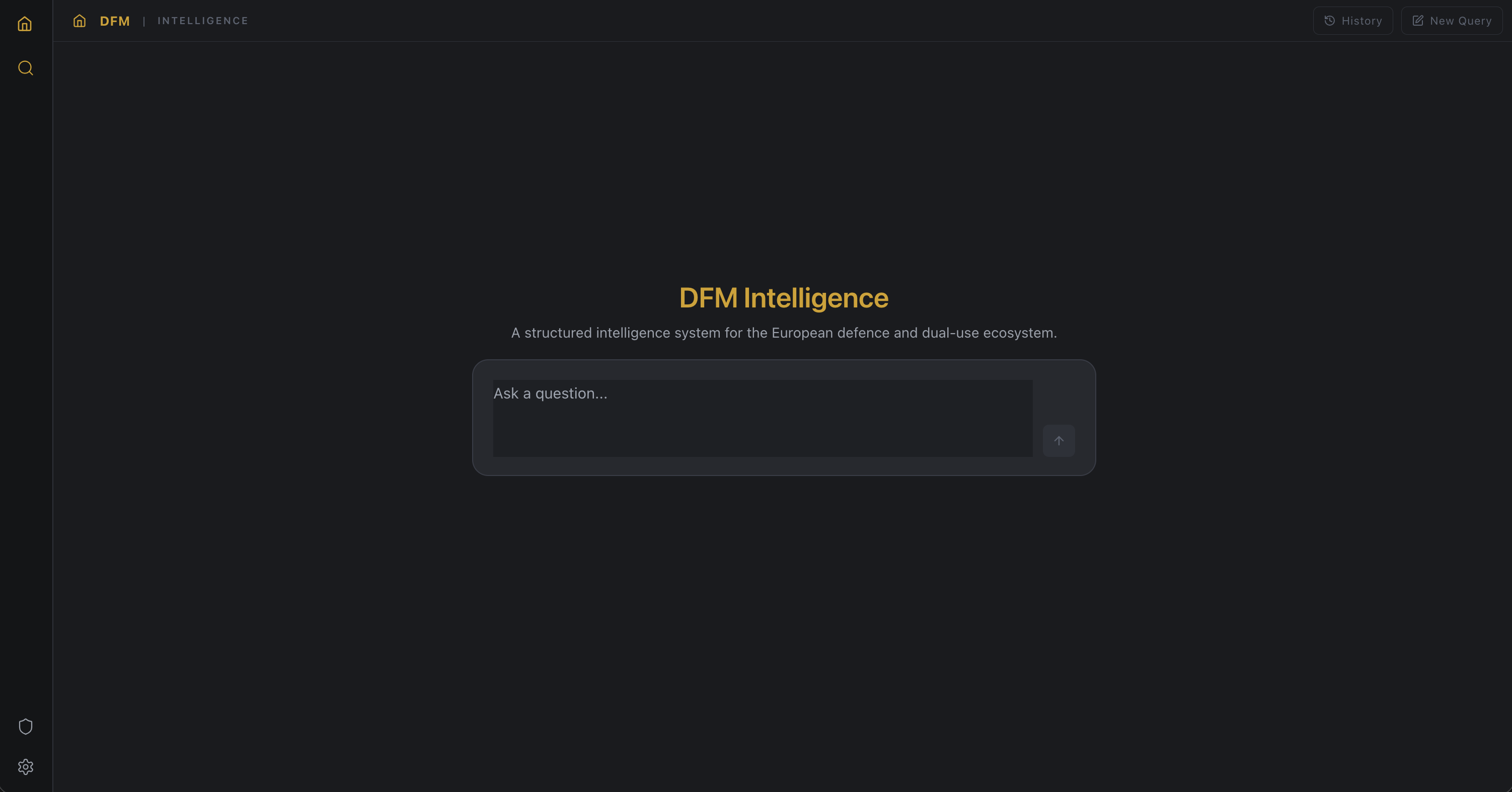
Defence Finance Monitor is not an editorial product. It is a cognitive platform built to identify the enterprises and technologies that matter against European strategic priorities and the architecture of transatlantic collective security, anchored to a verified database of more than 2,000 enterprises mapped against the European defence-industrial perimeter and extended every week with new entities as the perimeter itself evolves through procurement awards, ownership changes, regulatory notifications and programme participation. Mapping a Tier-2 or Tier-3 supplier base behind a single prime contractor, identifying which firms in a portfolio are exposed to EDIP origin rules, Golden Power notifications or critical raw materials dependencies, reconstructing contract awards under EDF, EDIRPA and ASAP, tracing ownership cascades behind a strategic asset — work that used to require weeks of analyst coordination now resolves inside a single structured query, with confidence levels marked for every statement and citations to official institutional sources. For a law firm partner, a corporate development team, a sovereign fund or a procurement office, the consequence is direct: the work that used to define the cost and timing of a deliverable now defines the starting point of an analysis. Institutional research stops being a project and becomes a capability.
DFM Intelligence is reserved for subscribers to the DFM annual programme.
For further information about DFM Intelligence, access conditions or payment by bank transfer, please contact: mastrolia@stroncature.com