

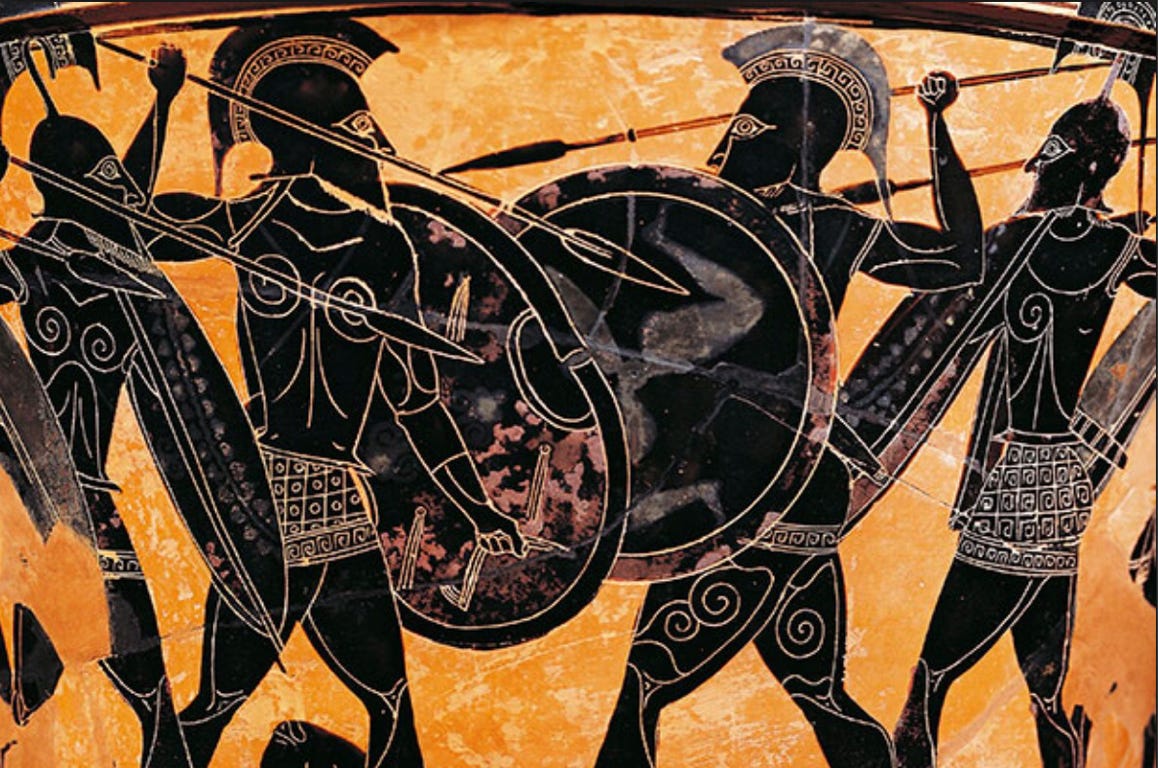
In the essay published yesterday, The Architecture of Order: On the Rise and Decline of International Systems, it was argued that a power stands at the center of an international system when it supplies public goods, generating centripetal forces that consolidate the order, and that the system enters crisis when it ceases to produce them or turns into a mechanism of extraction for the exclusive benefit of the center, activating centrifugal forces that pull it apart. That argument found in Thucydides its original historical paradigm. It is worth now reconstructing that paradigm in detail, following the text of The Peloponnesian War step by step. The thesis we mean to demonstrate is that Thucydides documented, with great analytical precision, the exact sequence by which the Delian League passed from an inclusive phase, founded on the provision of a genuine public good, to an extractive phase, founded on pure coercion—and that it is in this metamorphosis, and not simply in the growth of Spartan power, that the deep cause of the empire’s collapse resides.
The exercise is not one of classical erudition; it is perfectly anchored in the founding thesis of Defence Finance Monitor. That thesis holds that the laws of power and the imperatives of security are persistent and recurrent, that their logic does not change across the centuries even as its intensity waxes and wanes, growing more compelling in some periods than in others—and that these same laws and imperatives press directly upon the economic, industrial, financial, and scientific life of nations. They dictate who finances whose fleet, which capacities a state retains and which it surrenders, where investment flows and where dependence accumulates. Ancient history serves here as a laboratory: a setting in which these forces can be isolated from the noise of the contemporary, observed in their pure form, and thereby read with a clarity the present rarely affords. The aim is not to extract a universal law but to identify recurrences, and the metamorphosis of Athens is one such recurrence—the parable of an order that, born to furnish security to its members, ends by extracting from them a rent so intolerable that it sets the forces of disintegration in motion. Having recognized the pattern in the controlled conditions of the past, we are better equipped to see it operating, now, in the present.