

Defence Finance Monitor applies a top–down method that traces how NATO, EU and allied strategic priorities are translated into regulations, funding lines and procurement programmes, and then into demand for specific capabilities, technologies and companies. We use official doctrine as the organising frame to identify where strategic relevance is being institutionally defined and where it is materialising in concrete budgets, acquisition pathways and industrial capacity.
Our working assumption is that what becomes structurally relevant in NATO/EU strategy tends, over time, to become relevant also from a financial and industrial point of view. In the European context, this includes the progressive operationalisation of strategic autonomy: the effort to reduce critical dependencies, secure supply chains, strengthen the European defence technological and industrial base, and align regulatory, financial and procurement instruments with long-term security objectives. On this basis, DFM operates as a decision-support tool: it benchmarks investment and industrial choices against institutional demand, clarifies which capabilities are rising on the spending agenda, and maps the funding instruments, eligibility constraints and supply-chain factors that shape real-world feasibility across investors, industry, public authorities and research organisations.
Defence Finance Monitor rests on a single analytical premise: within the Euro-Atlantic security architecture, strategic doctrine precedes regulation and capability planning, regulation precedes budgets, and budgets shape markets.
EU AI Act Defence Exemption Boundary
The most common mistake currently being made about the AI Act in defence circles is to treat Article 2(3) as an institutional carve-out — armed forces in, civilian agencies out — and to plan around it accordingly. The text does the opposite. The exemption is purpose-based, not status-based, and it turns on a single word: “exclusively.” A ministry of defence receives no blanket exclusion because it is a ministry of defence; a private contractor can benefit from the carve-out where exclusivity is genuine. Recital 24 then narrows what looks like a defence shield into a fragile one — temporary civilian, humanitarian, law-enforcement or public-security use pulls the system back into scope. There is also a structural point almost no commentary has surfaced: Article 2(3) speaks about AI systems, not models. The downstream defence application may be exempt; the upstream GPAI model placed on the Union market continues to carry Article 53 and 55 obligations regardless. That asymmetry decides whether the compliance perimeter wraps the deployment or the supply chain. The reading on which most current product-line and procurement decisions rest is generous to the supplier. The law is not.
The full boundary test — and how Germany, France and Italy are operationalising the line differently — is reserved for DFM paid subscribers.
European AESA T/R Module Supply Chain
900,000 GaN semiconductor components by 2030, contracted by HENSOLDT from UMS in March 2026, explicitly for the transmit and receive modules of its radar systems. That is the single hardest data point currently available about the layer of European defence industry almost no public commentary touches: the microelectronics stack behind active electronically scanned array radars. Antenna geometry does not win the next generation of European naval, ground-based air-defence, counter-UAS and ballistic-defence radars. The T/R module does — the elemental unit where semiconductor material, MMIC design, thermal management, packaging and digital beamforming convert into operational range, refresh rate and multi-mode performance. The GaN transition is real; the European industrial ladder behind it is uneven in a way the public conversation has not yet absorbed. Imec sits at the 300 mm research frontier. Fraunhofer IAF reaches modules and small series, not large series. UMS bridges III-V depth into contracted prime demand. The OMMIC site near Paris — ESA-qualified, GaAs and GaN — is owned by MACOM, a US-listed company. Geography on the continent is not the same as European control, and that distinction will set how the sovereignty calculation actually resolves.
The five-layer stack analysis, the verifiable demand picture, and the seven industrial variables that will decide sovereignty before 2030 are available to DFM subscribers.
EUDIS Tech Alliances for Defence
The honest question about the Tech Alliances for Defence is not whether the launch took place — the 28 November 2025 event is documented, with more than forty EU and Ukrainian firms and the leaders of the drone and counter-drone capability coalition in the room — but whether what was launched, as of May 2026, is a codified programme or a strategically grounded convening mechanism that has yet to harden into one. The public record is precise enough to answer that. There is no published cohort roster, no standalone application page, no autonomous governance document, no budget line distinct from the broader EUDIS envelope. The decisive comparison is with NATO DIANA, whose 2026 cohort of 150 innovators, sixteen accelerator sites, more than two hundred test centres and the Rapid Adoption Service offering follow-on contracts without further competition has already built the operational-adoption mechanics EUDIS is still assembling. The risk is not duplication. It is that the most capable European firms use DIANA for adoption credibility while using EUDIS mainly for grants.
The full pipeline tracker — and the markers that will distinguish a working mechanism from a coordination layer over the next four quarters — is reserved for DFM paid subscribers.
DFM Intelligence · Platform Capability
Problems DFM Intelligence Now Solves
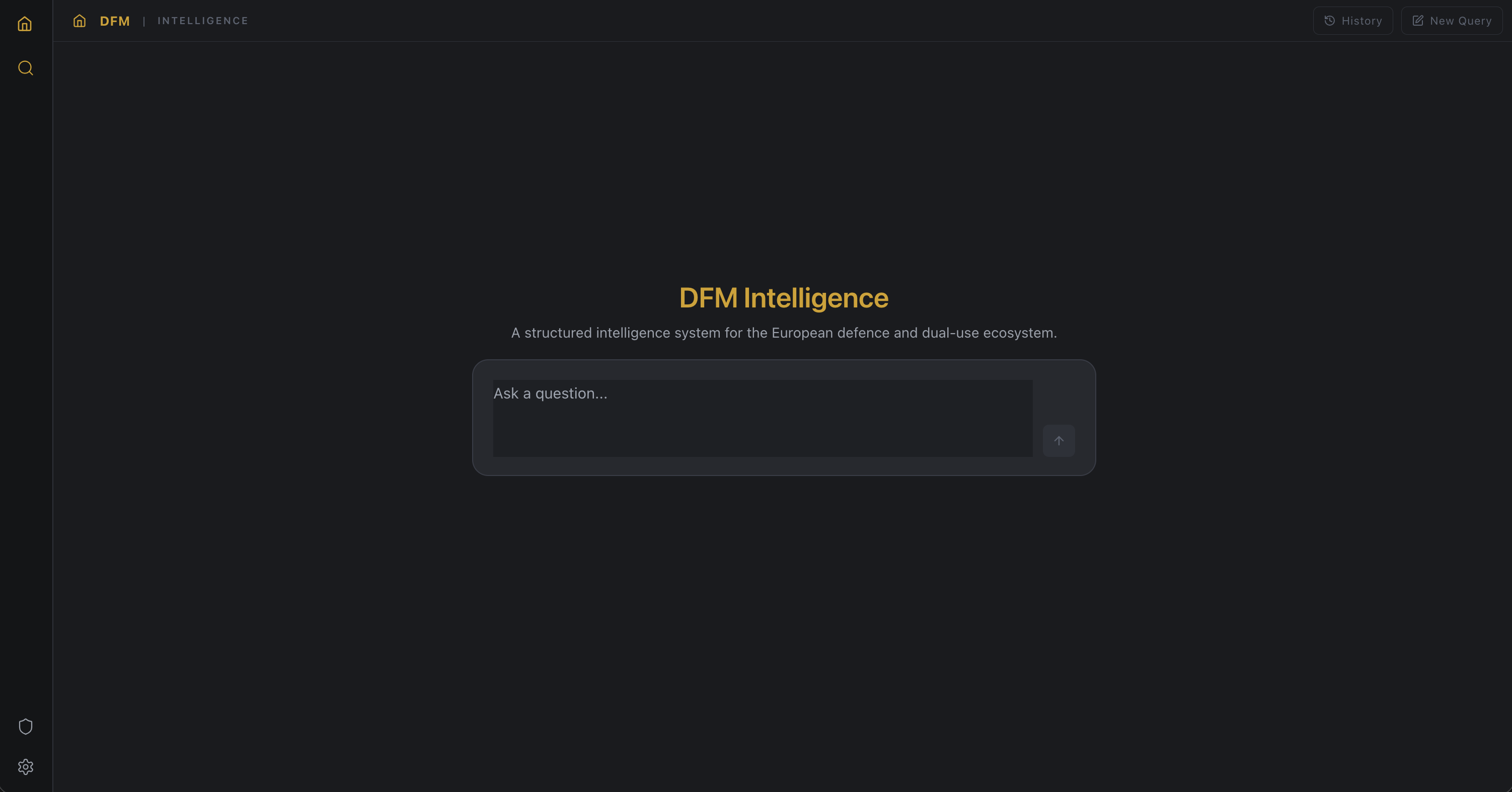
Defence Finance Monitor is not an editorial product. It is a cognitive platform built to identify the enterprises and technologies that matter against European strategic priorities and the architecture of transatlantic collective security, anchored to a verified database of more than 2,000 enterprises mapped against the European defence-industrial perimeter and extended every week with new entities as the perimeter itself evolves through procurement awards, ownership changes, regulatory notifications and programme participation. Mapping a Tier-2 or Tier-3 supplier base behind a single prime contractor, identifying which firms in a portfolio are exposed to EDIP origin rules, Golden Power notifications or critical raw materials dependencies, reconstructing contract awards under EDF, EDIRPA and ASAP, tracing ownership cascades behind a strategic asset — work that used to require weeks of analyst coordination now resolves inside a single structured query, with confidence levels marked for every statement and citations to official institutional sources. For a law firm partner, a corporate development team, a sovereign fund or a procurement office, the consequence is direct: the work that used to define the cost and timing of a deliverable now defines the starting point of an analysis. Institutional research stops being a project and becomes a capability.
DFM Intelligence is reserved for subscribers to the DFM annual programme.
For further information about DFM Intelligence, access conditions or payment by bank transfer, please contact: mastrolia@stroncature.com