

Defence Finance Monitor applies a top–down method that traces how NATO, EU and allied strategic priorities are translated into regulations, funding lines and procurement programmes, and then into demand for specific capabilities, technologies and companies. We use official doctrine as the organising frame to identify where strategic relevance is being institutionally defined and where it is materialising in concrete budgets, acquisition pathways and industrial capacity.
Our working assumption is that what becomes structurally relevant in NATO/EU strategy tends, over time, to become relevant also from a financial and industrial point of view. In the European context, this includes the progressive operationalisation of strategic autonomy: the effort to reduce critical dependencies, secure supply chains, strengthen the European defence technological and industrial base, and align regulatory, financial and procurement instruments with long-term security objectives. On this basis, DFM operates as a decision-support tool: it benchmarks investment and industrial choices against institutional demand, clarifies which capabilities are rising on the spending agenda, and maps the funding instruments, eligibility constraints and supply-chain factors that shape real-world feasibility across investors, industry, public authorities and research organisations.
Defence Finance Monitor rests on a single analytical premise: within the Euro-Atlantic security architecture, strategic doctrine precedes regulation and capability planning, regulation precedes budgets, and budgets shape markets.
European Security & Defence Industry · Regulatory Intelligence
EDIP Eligibility and the New Geometry of European Defence Supply Chains. How Design Authority and the 65% Component-Origin Rule Are Redefining Industrial Control in European Defence
The European Defence Industry Programme marks a shift in how the Union links defence funding to industrial sovereignty. Its eligibility rules do not only ask whether a company is established in Europe. They also test where critical components originate, who controls the product design, who owns the relevant intellectual property, and whether European actors can modify, sustain, substitute and export defence systems without dependence on third-country permissions. The 65% component-origin rule is a necessary screen but not a sufficient one; design authority is the decisive sovereignty filter, because low-cost components can carry overwhelming strategic leverage when they determine exportability, software compatibility or substitution rights. The report reconstructs the cumulative eligibility architecture combining corporate location, executive control, industrial geography, component origin and design governance, identifies the hardest dependencies hidden beneath cost-based arithmetic, and sets out the minimum prudent evidence pack that compliance functions will need before the first calls translate into grant agreements.
European Security & Defence Industry · Capital Markets Intelligence
National Promotional Banks and Europe’s Defence-Finance Gap. How KfW, BGK, CDP, Bpifrance, ICO and CDC Are Becoming the Operational Layer Between EIB Eligibility, SAFE Loans and Defence-Industrial Mobilisation
The European defence-finance architecture is expanding, but it remains structurally non-uniform. The EIB has broadened its security and defence perimeter while continuing to exclude weapons and ammunition; SAFE provides sovereign borrowing capacity but does not reach corporate balance sheets directly. The Munich meeting of February 2026 is best read as an institutional coordination layer rather than a defence-specific common envelope, and the often-cited €300 billion figure refers to total aggregate financing by the participating institutions, not defence-specific deployment. The decisive question is therefore which national public bank can transact where the EIB cannot. The report maps mandate asymmetry across KfW, Bpifrance, CDP, BGK, ICO and CDC, distinguishes seven financing channels now operating in parallel, and identifies the three national models that have crossed from declaratory architecture into documented execution. It separates the financing routes available to pure-play munitions producers, mixed-revenue suppliers, strategic primes and growth-stage defence-tech companies, and clarifies why the next phase will be defined by State Aid structure as much as by political appetite.
European Security & Defence Industry · Industrial Intelligence
Capital Capture versus Ecosystem Building in European Defence. Why Headline Funding Does Not Automatically Create Industrial Capacity
European defence is entering a financing cycle shaped by SAFE, EDF, EDIP and expanding national rearmament plans, but the central question is no longer how much capital is being mobilised. It is whether that capital is being converted into durable defence-industrial capacity. The largest approved SAFE envelopes do not map neatly onto the strongest ecosystems: one of Europe’s most consequential defence-industrial states is absent from the official SAFE approved-state list entirely, while two of the largest capital recipients show innovation and collaborative-R&D leadership indicators materially below their headline allocations. The report tests six case-study states across a four-quadrant model that combines EU capital intensity with ecosystem stock variables — national defence effort, EDF leadership density, patent performance, prime-contractor scale, supplier depth and venture-scale-up momentum — and distinguishes states that capture capital from states that convert it into productive advantage. It identifies five signals that will determine over the next eighteen to thirty-six months whether Europe’s new defence spending becomes industrial capacity, including the conditions under which a country with a large SAFE envelope can still fail the ecosystem test.
Defence Finance Monitor · Platform Intelligence
DFM Intelligence. Structured Intelligence System for the European Defence and Dual-Use Ecosystem
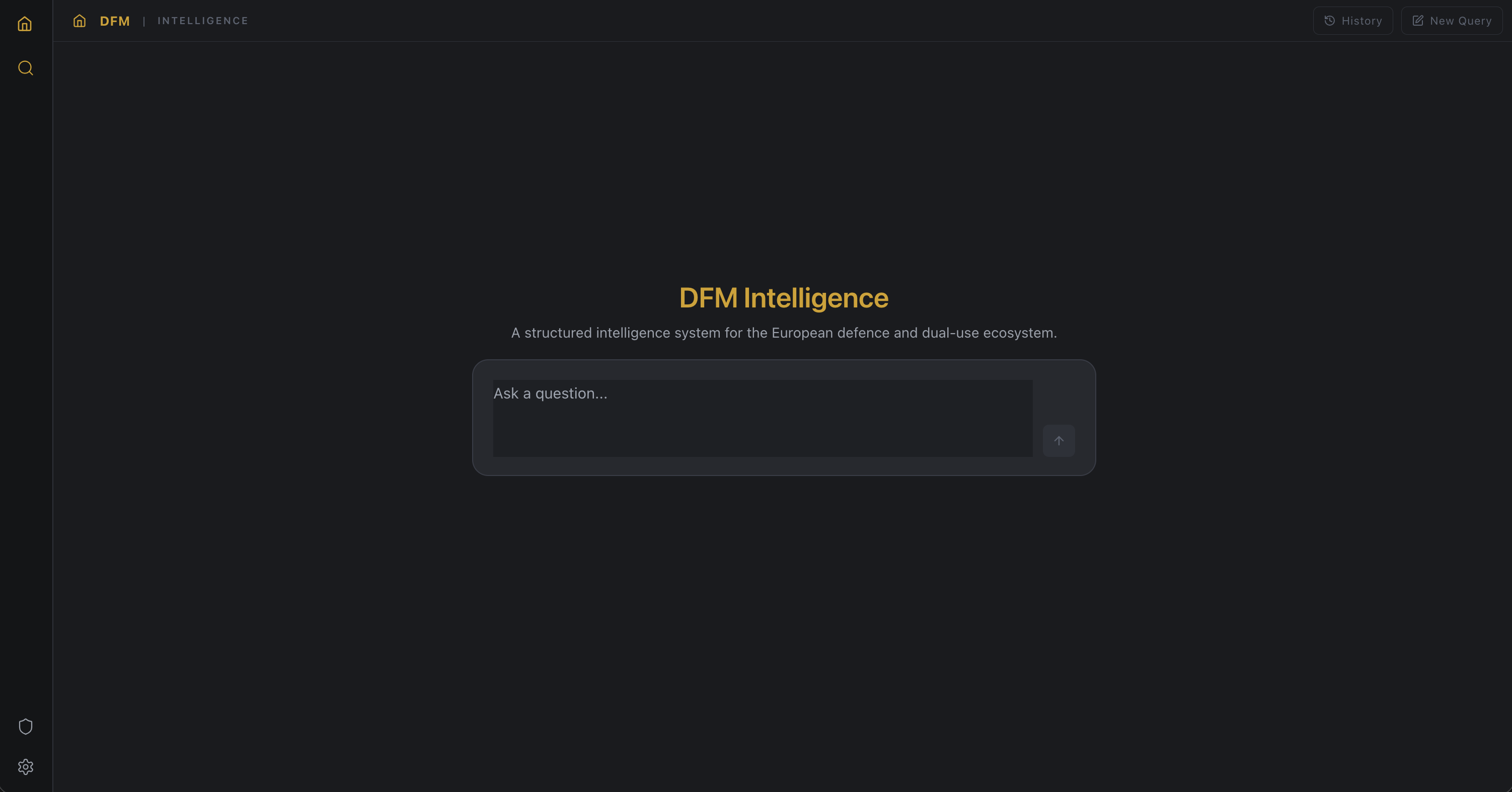
DFM Intelligence is a structured research engine built on a proprietary ontology and taxonomy that maps the European defence and dual-use ecosystem against the strategic, operational and tactical priorities derived from NATO and EU doctrine. Its core purpose is to let subscribers identify, in minutes rather than weeks, which companies are actually relevant to a given priority — including the tier-2 and tier-3 suppliers that remain invisible in conventional market maps and prime-contractor lists. Starting from a closed knowledge graph of 1,915 verified entities and more than 138,000 typed relationships covering supply chains, ownership structures, procurement contracts, programme participations and patent co-development, the platform answers plain-English questions and returns structured responses with citations to the specific entities and documents that support each claim. This allows analysts, investors and compliance professionals to move from a strategic, operational or tactical priority directly to the relevant industrial actors at every tier of the supply chain, with full traceability of the evidence behind each result.
DFM Intelligence is reserved for subscribers to the DFM annual programme.
For further information about DFM Intelligence, access conditions or payment by bank transfer, please contact: mastrolia@stroncature.com