

Defence Finance Monitor applies a top–down method that traces how NATO, EU and allied strategic priorities are translated into regulations, funding lines and procurement programmes, and then into demand for specific capabilities, technologies and companies. We use official doctrine as the organising frame to identify where strategic relevance is being institutionally defined and where it is materialising in concrete budgets, acquisition pathways and industrial capacity.
Our working assumption is that what becomes structurally relevant in NATO/EU strategy tends, over time, to become relevant also from a financial and industrial point of view. In the European context, this includes the progressive operationalisation of strategic autonomy: the effort to reduce critical dependencies, secure supply chains, strengthen the European defence technological and industrial base, and align regulatory, financial and procurement instruments with long-term security objectives. On this basis, DFM operates as a decision-support tool: it benchmarks investment and industrial choices against institutional demand, clarifies which capabilities are rising on the spending agenda, and maps the funding instruments, eligibility constraints and supply-chain factors that shape real-world feasibility across investors, industry, public authorities and research organisations.
Defence Finance Monitor rests on a single analytical premise: within the Euro-Atlantic security architecture, strategic doctrine precedes regulation and capability planning, regulation precedes budgets, and budgets shape markets.
European Security & Defence Industry · Strategic Intelligence
Cold War 2.0 and the Axis of Upheaval. The Defence-Industrial Logic of Systemic Multi-Theatre Rivalry
The analytical question for institutional readers is not whether the present international system should be called a new Cold War. The more material question is whether doctrine, procurement, sanctions, export controls, munitions demand, industrial capacity and capital allocation are already moving according to the logic of prolonged, multi-theatre confrontation involving the United States, China, Russia, Iran, North Korea and the Western alliance system. Ukraine, the Red Sea, the Middle East, the Indo-Pacific and the technology-control contest are often analysed as separate crises, but the institutional evidence increasingly suggests they are connected pressure points within a wider systemic rivalry that is reshaping how Western governments and firms plan industrial capacity, stockpile depth and capital deployment. The report tests two distinct frameworks — Cold War 2.0 as a historical-strategic interpretation and the Axis of Upheaval as a political-operational interpretation — against official doctrine, ODNI assessments and the strongest critical objections. It then translates the evidence into the practical variables that matter for defence finance: munitions depletion, defence-industrial capacity, export controls, sanctions architecture, strategic materials, semiconductor restrictions, thematic defence exposure and the difference between firms whose valuation tracks security narratives and firms genuinely tied to procurement or control regimes. It closes with a four-dimensional coding system that allows any event, rule or disclosure to be assessed for its contribution to long-duration rivalry, operational convergence among adversaries, Western deterrence and defence-industrial structure.
European Security & Defence Industry · Fiscal & Regulatory Intelligence
The Two-Speed Fiscal Architecture of European Defence. National Escape Clauses, Common Loans, Budgetary Windows, Enhanced Cooperation and the Industrial Consequences of Fiscal Differentiation Among Member States
Europe’s defence build-up is no longer driven only by strategic urgency or national political will. It is increasingly shaped by a layered fiscal architecture that gives some Member States materially more room than others to convert defence priorities into funded procurement, factory expansion and investable order visibility. The interaction between the National Escape Clause activated for seventeen Member States, SAFE loan participation across eighteen approved national plans, the proposed MFF 2028–2034 defence and space window, and the Ukraine Support Loan implemented under enhanced cooperation is beginning to redraw the map of European defence investment along lines that do not correspond to threat proximity, industrial depth or political ambition alone. The report reconstructs the legal and fiscal basis of each instrument and corrects the most common analytical errors in market commentary, including the inaccurate framing of France’s position relative to SAFE and the conflation of temporary fiscal flexibility with permanent fiscal architecture. It maps Member State fiscal space across four clusters defined by NEC status, SAFE stage, debt and deficit position, and defence-budget trajectory, identifies the post-2028 cliff effect that current legal instruments do not by themselves resolve, and translates the evidence into procurement visibility, prime-contractor order books, industrial concentration and the conditions under which the first wave of consolidation is likely to appear in supplier acquisitions rather than in cross-border megamergers. It closes with the variables that now require continuous monitoring for any allocator exposed to European defence between 2026 and 2032.
European Security & Defence Industry · Industrial Intelligence
Dual-use Mechanical Components: Europe’s Hidden Defence Bottleneck. Mechanical Suppliers, EDIP Origin Rules and the 2025–2030 Consolidation Window
Gears, bearings, transmissions, actuation systems, hydraulic assemblies, forged parts, fasteners and precision-machined components rarely define public debates on rearmament, yet they shape delivery times, programme qualification, repairability, supply-chain resilience and regulatory eligibility across European defence production. Recent supply-chain analysis estimates that roughly three quarters of prime-level value added is created upstream by component manufacturers and specialised service providers, and that consolidation in dual-use mechanical components could unlock around €2.6 billion in annual run-rate cost synergies — one of the largest immediately addressable value pools in European defence, located in an area politically quieter than platform consolidation and less visible than defence electronics but more tightly linked to actual output expansion. The report analyses the segment through five reinforcing forces now operating simultaneously: the demand shock documented by EDA and NATO planning, the regulatory repricing introduced by EDIP origin rules, the persistence of Tier-2 and Tier-3 bottlenecks, the succession crisis in owner-managed industrial SMEs documented most clearly by KfW in Germany, and the emergence of capital pathways through private equity, public markets, prime-led acquisitions and state-supported finance. It examines the transactions that have already crystallised in the recent record — RENK, Leonardo–IDV, ITP Aero, Barnes–MB Aerospace, Liebherr-Aerospace, CSG — and the geographies of fragmentation that distinguish German succession pressure, Italian dual-use pyramids, Polish state-led mobilisation, Spanish PE-backed scaling and Czech capital-market repricing. It closes with the analytical distinction that now determines value in this segment: not mechanical simplicity versus technological sophistication, but generic capacity versus qualified capacity inside the emerging European compliance perimeter.
Defence Finance Monitor · Platform Intelligence
DFM Intelligence. Structured Intelligence System for the European Defence and Dual-Use Ecosystem
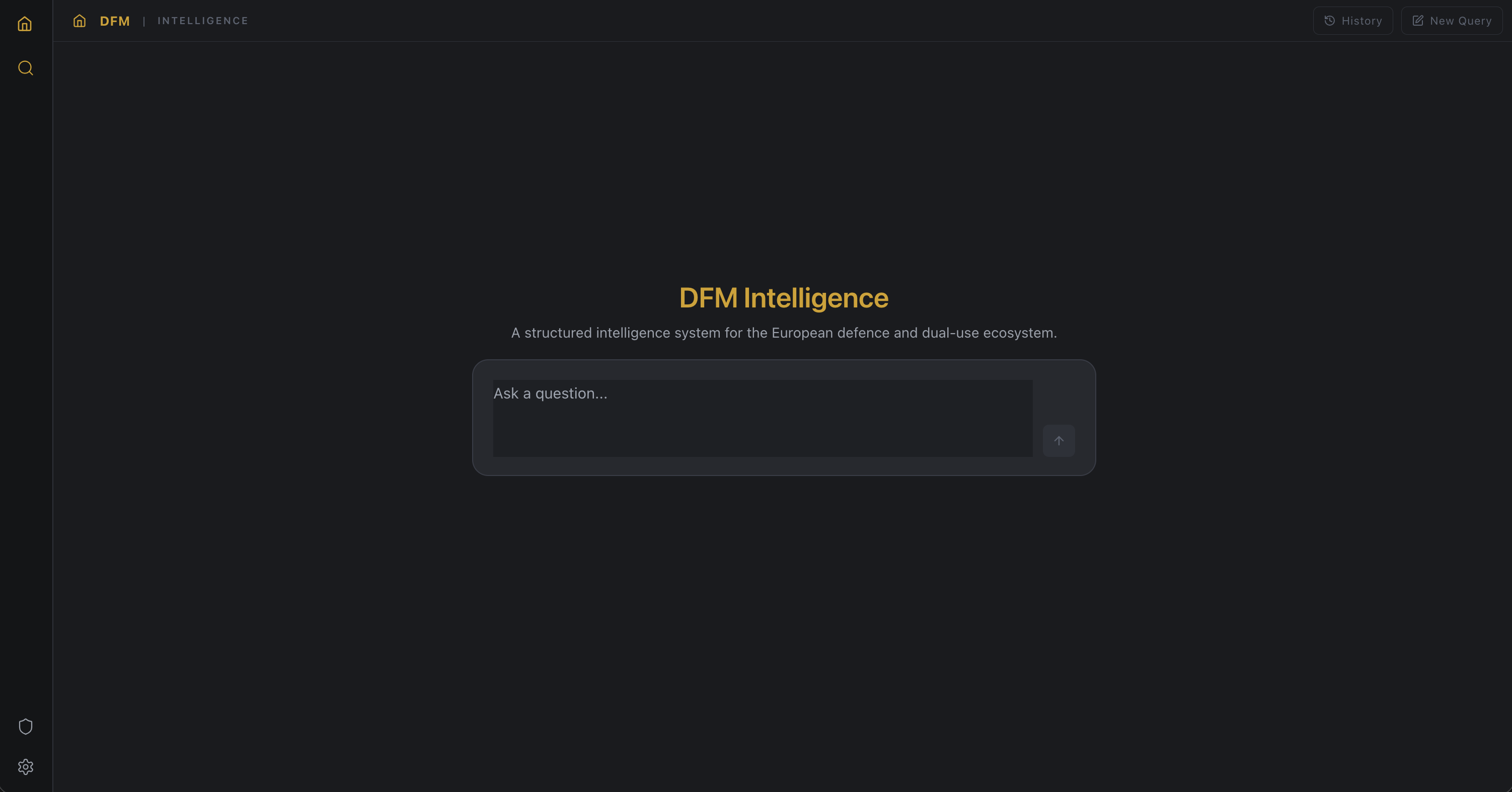
DFM Intelligence is a structured research engine built on a proprietary ontology and taxonomy that maps the European defence and dual-use ecosystem against the strategic, operational and tactical priorities derived from NATO and EU doctrine. Its core purpose is to let subscribers identify, in minutes rather than weeks, which companies are actually relevant to a given priority — including the tier-2 and tier-3 suppliers that remain invisible in conventional market maps and prime-contractor lists. Starting from a closed knowledge graph of 1,915 verified entities and more than 138,000 typed relationships covering supply chains, ownership structures, procurement contracts, programme participations and patent co-development, the platform answers plain-English questions and returns structured responses with citations to the specific entities and documents that support each claim. This allows analysts, investors and compliance professionals to move from a strategic, operational or tactical priority directly to the relevant industrial actors at every tier of the supply chain, with full traceability of the evidence behind each result.
DFM Intelligence is reserved for subscribers to the DFM annual programme.
For further information about DFM Intelligence, access conditions or payment by bank transfer, please contact: mastrolia@stroncature.com