

Defence Finance Monitor applies a top–down method that traces how NATO, EU and allied strategic priorities are translated into regulations, funding lines and procurement programmes, and then into demand for specific capabilities, technologies and companies. We use official doctrine as the organising frame to identify where strategic relevance is being institutionally defined and where it is materialising in concrete budgets, acquisition pathways and industrial capacity.
Our working assumption is that what becomes structurally relevant in NATO/EU strategy tends, over time, to become relevant also from a financial and industrial point of view. In the European context, this includes the progressive operationalisation of strategic autonomy: the effort to reduce critical dependencies, secure supply chains, strengthen the European defence technological and industrial base, and align regulatory, financial and procurement instruments with long-term security objectives. On this basis, DFM operates as a decision-support tool: it benchmarks investment and industrial choices against institutional demand, clarifies which capabilities are rising on the spending agenda, and maps the funding instruments, eligibility constraints and supply-chain factors that shape real-world feasibility across investors, industry, public authorities and research organisations.
Defence Finance Monitor rests on a single analytical premise: within the Euro-Atlantic security architecture, strategic doctrine precedes regulation and capability planning, regulation precedes budgets, and budgets shape markets.
European Security & Defence Industry · Strategic Intelligence
Production Is Deterrence. Industrial Capacity and the New Material Foundations of Conventional Credibility
The credibility of conventional deterrence is no longer determined only by deployed forces or technological superiority. Between 2022 and 2026, a distinct body of specialist literature and a parallel set of U.S. and European institutional measures have made industrial capacity part of deterrence credibility in a far more explicit and measurable way than in the post-Cold War era. The report reconstructs this paradigm shift and converts it into a framework for measuring it. It traces the intellectual genealogy of the concept from RUSI’s work on industrial warfare and attrition, through the U.S. debate on empty bins and precision-strike economics, to its institutional codification in the National Defense Industrial Strategy. It quantifies the gap between declared requirements and actual industrial output across the Ukraine theatre and the Indo-Pacific war-game evidence, and maps Europe’s partial translation of the same logic through ASAP, EDIRPA, SAFE and EDIP, assessing the standing-instrument gap between the U.S. and European architectures. It closes with the DFM framework for measuring production-based deterrence across stockpile depth, surge capacity, replacement timelines, supplier resilience, legal eligibility, co-production and capital allocation, distinguishing the indicators that carry confidence-rated evidence from those that remain classified.
European Security & Defence Industry · Regulatory Intelligence
The Security and Defence Partnership Gateway. How SAFE and EDIP Are Reshaping Third-Country Access to Europe’s Defence-Industrial Market
The report addresses a recurring analytical error: treating an EU Security and Defence Partnership as equivalent to market access. The two are not the same, and the difference now determines billions of euros in potential procurement and funding eligibility. The report rebuilds the architecture from the legal base upwards. It maps the full SDP universe by signature date and legal status from the 2024 founding cohort to the 2026 expansion, and identifies the strategically significant absences from the partnership list. It analyses SAFE as the operational gateway through which partnership status acquires industrial weight, clarifying the third-country participation mechanism, the component-origin rules and the access ladder that runs from political partnership to signed implementation. It then analyses EDIP as the more restrictive industrial-funding framework, focusing on the establishment, control and supply-chain conditions that condition direct Union funding. It develops country-specific access playbooks across the Euro-Atlantic, Indo-Pacific and Gulf jurisdictions, and assesses six categories of risk — political, legal-status, supply-chain, control, foreign-subsidy and procurement-execution — that shape each route. It closes with the corporate-structuring compliance project required to convert partnership into eligibility.
European Security & Defence Industry · Capital Markets Intelligence
The Defence Equity Facility and the New Public Anchor for European Defence Capital. How a €175 Million EIF-Managed Mandate Is Reshaping Defence Venture Capital, Private Equity and Private Credit in Europe
The report tests a specific claim: the Defence Equity Facility matters less for its size than for its function as an institutional certification mechanism in a sector where European LPs have historically been hesitant. It is built to support allocation decisions, not to describe market sentiment. It reconstructs the legal and institutional architecture linking InvestEU, the European Defence Fund, DG DEFIS, the EIF and the wider EIB Group, and documents the deployment trajectory from the January 2024 launch to the near-exhaustion of the initial envelope reported in early 2026. It maps the publicly documented portfolio across the four financing logics now visible inside the facility — dedicated defence venture capital, adjacent deep-tech venture, industrially oriented private equity and specialised private credit — distinguishing funds with disclosed commitments from those publicly named without disclosed amounts and from those officially acknowledged but still undisclosed. It analyses eligibility rules at fund-manager and final-recipient level, including the establishment test, the third-country control prohibition and the weapons-and-ammunition exclusion that remains in force across the EIB Group perimeter. It documents the verified crowding-in evidence from pension funds, banks and family offices, distinguishes mandate-level mobilisation from fund-target sizes, and addresses the post-2027 architecture currently signalled by the institutions. It closes with the unresolved questions in the public record that conditional allocators must monitor.
Defence Finance Monitor · Platform Intelligence
DFM Intelligence. Structured Intelligence System for the European Defence and Dual-Use Ecosystem
The Platform
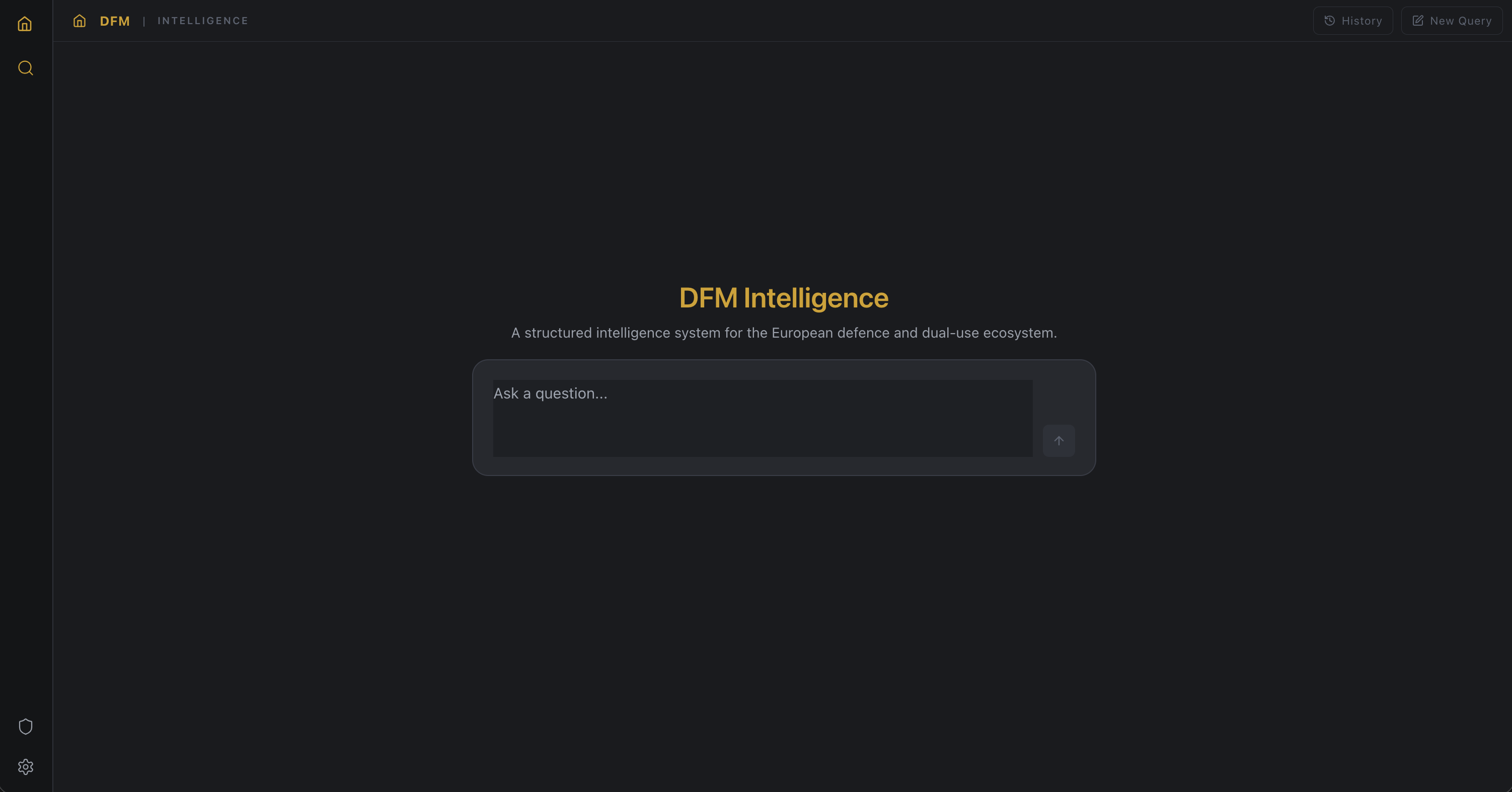
DFM Intelligence is the analytical platform that operates alongside the strategic and industrial analysis work of Defence Finance Monitor. It is a closed-ontology research engine — not a chatbot, not an aggregator — built on a structured knowledge graph of 1,915 verified European defence entities (companies, research institutes, investment funds, public institutions) connected through more than 138,000 typed relationships: supply-chain links, ownership chains, procurement contracts, co-programme participations and patent co-development. Every entity is classified against a proprietary vocabulary derived from NATO and EU strategic doctrine — 13 Strategic Priorities, 53 Operational Priorities and 52 Tactical Capabilities — alongside a separate industrial technology taxonomy of 18 domains, 108 sub-domains and 119 granular codes. The platform draws exclusively from certified institutional sources — TED procurement, CORDIS, GLEIF, EDF and EDIP beneficiary records, EPO patent data, EUR-Lex, national business registries across 25 jurisdictions, and OpenSanctions — together with the analytical research output produced by DFM over the past year. The resulting graph is currently exposed through a single surface — Live Query — designed to answer questions that would otherwise require weeks of manual cross-referencing. Two additional surfaces, the Knowledge Graph and Compare, are scheduled for release in the coming months.
The Query Layer
Live Query is the natural-language surface: given a question in plain English, the system returns a structured analytical response with citations to the specific entities and documents that support each claim. The mechanism combines two parallel retrieval paths — one that captures the meaning of the question (so “anti-drone systems” correctly reaches material indexed as “counter-UAS”), and one that catches exact names, regulation articles and contract identifiers. Both paths draw evidence exclusively from the certified data layer, never from the open web or generic AI knowledge, and only the retrieved evidence is passed to the language model that composes the answer. Each statement is pre-labelled as factual, probabilistic or interpretive, so verified evidence is always distinguishable from inference. Live Query currently handles ten question types: single-entity research, priority-to-company mapping, composite multi-criterion screening, regulatory due diligence, geographic and functional discovery, technology-to-company mapping, entity-versus-entity comparison, full sector mapping (up to 200 entities across nine analytical dimensions), multi-priority comparison, and capability gap discovery. Seven further types are scheduled in the coming months — programme coverage, geographic distribution, supply-chain tier mapping, multi-country and multi-regulation comparison, M&A activity tracking and dual-use crossover analysis.
DFM Intelligence is reserved for subscribers to the DFM annual programme.
For further information about DFM Intelligence, access conditions or payment by bank transfer, please contact: mastrolia@stroncature.com