

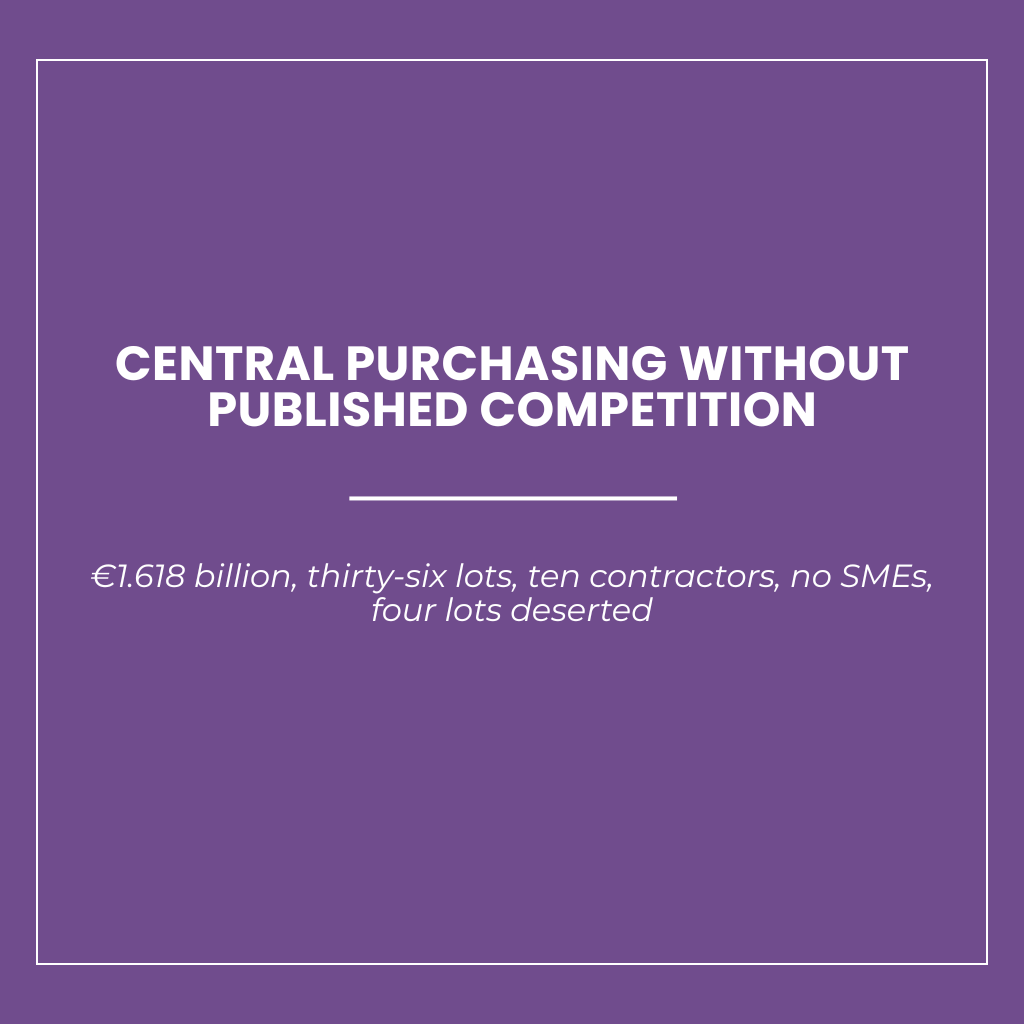
On 7 June 2024 the Supplement to the Official Journal carried contract award notice 336327-2024, recording the supply of 155 mm artillery ammunition across thirty-six lots at a total procurement value of €1,618,100,000 excluding VAT. The contracting authority was the European Defence Agency, and the notice states in its joint-procurement field that the contract is awarded by a central purchasing body. Measured against the Agency’s own institutional means, that value is of a different order: the general budget for 2026 is €68.6 million in appropriations, and the 2024 accounts record budgets associated with ad hoc activities of approximately €270.541 million against general-budget revenue of approximately €55.094 million. The Agency administered, in a single procedure, roughly twenty-three times its annual institutional budget and six times the whole of its ad hoc activity for a year. The structural constraint is written into its own financial rules, which provide that the Agency may not raise loans within the framework of its budget and place its discharge with the Steering Board rather than with a parliament. None of that money is the Agency’s, and none of the resulting equipment is. The question a new procurement structure raises is therefore not whether the Agency can contract at scale, which the notice settles, but which of the functions that constitute a buyer participating governments have transferred, and on what terms those functions were exercised when the scale was largest.
The sections that follow proceed from the functions to the record. The first sets out the bundle of functions that together constitute a buyer and the conditions under which Union law permits them to be divided. The second works the Agency’s constituent instruments, Council Decision (CFSP) 2015/1835 and the financial rules of Council Decision (EU) 2016/1353, against the central-purchasing provisions of Directive 2009/81/EC. The third works the 2026 budget, the establishment plan, the 2024 accounts and the 2025 contract registers to locate the point at which money becomes commitment. The fourth follows the conversion from requirement to order through the preliminary market consultation of 11 February 2026 and the 2024 award notice read in full. The fifth reads the 2025 annual report and the satellite-communications factsheet for what existing projects disclose about participation and ordering. The sixth examines acceptance, title, liability and technological control. The seventh tests industrial access against Commission Recommendation (EU) 2018/624 and against the identities of the firms actually awarded. The eighth reads Council Regulation (EU) 2025/1106, Regulation (EU) 2025/2643 and the Commission’s proposal of 3 July 2026. The last two set the Agency beside OCCAR and NSPA, and examine execution risk. This report does not value any company, does not assess any security, and does not read the project arrangements, which are not published.