

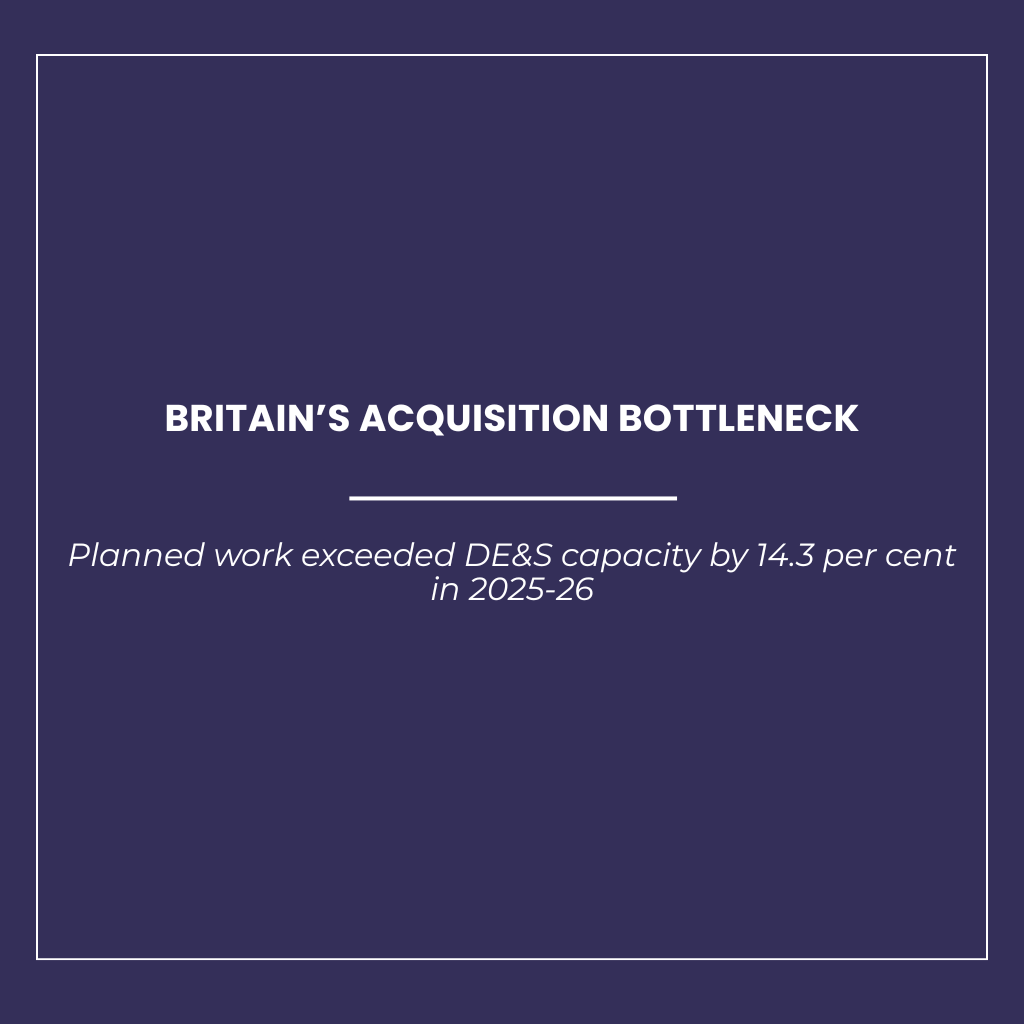
On 15 July 2026 Defence Equipment & Support laid before Parliament accounts recording that it had spent £13.257 billion on behalf of the Front Line Commands against an in-year Equipment Plan budget of £15.870 billion, and that its own core operating costs for the year were £1.328 billion against a final budget of £1.343 billion. The two figures measure different things. The first is the value of the demand the acquisition system was asked to process; the second is the cost of the system that processes it. Set against the Ministry of Defence’s total expenditure of £62.006 billion in the same year, and against the £298 billion the Defence Investment Plan commits over the four years to 2029-30, the running cost of the buying apparatus is a rounding error and its throughput is not. The same accounts record an Equipment Plan outturn of £11.874 billion against an AP02 baseline of £12.526 billion, an underspend DE&S attributes largely to delays in placing contracts, and a gap of 14.3 per cent between planned work and available workforce capacity. The structural constraint follows from that pairing: authorisation, appropriation and industrial capacity are each necessary for capability and none is sufficient while the administrative chain that converts them into signed obligations is already operating beyond its own declared capacity. Whether the British state can widen that chain fast enough to absorb a four-year framework of this size is the question these accounts pose.
The report proceeds in four sections. The first places the acquisition system between the strategic clock of the Strategic Defence Review of 2 June 2025 and the institutional clock of the reorganisation of 1 April 2025 into four leadership Areas, working the Review, the DE&S Corporate Plan for 2025-26, the Public Accounts Committee report of 20 June 2025 and the oral evidence given to the House of Lords International Relations and Defence Committee on 17 June 2026 by the National Armaments Director. The second works the accounting boundary between DE&S operating costs and Equipment Programme expenditure, the indicators for business case cost and time and for in-year budgetary control, the departmental outturn against parliamentary control totals, the single-source pricing regime under Part 2 of the Defence Reform Act 2014, and the procurement reforms set out in the Defence Investment Plan of 30 June 2026. The third works the staff and off-payroll disclosures in both sets of accounts, the operating model’s productivity and capacity measures, the People Survey and the strategic risk register. The fourth sets out what follows for the plan, for suppliers and for the department’s own supervisory metrics. The report does not value companies, rank suppliers, forecast programme outcomes, or judge whether the financial settlement underlying the Defence Investment Plan is adequate.