

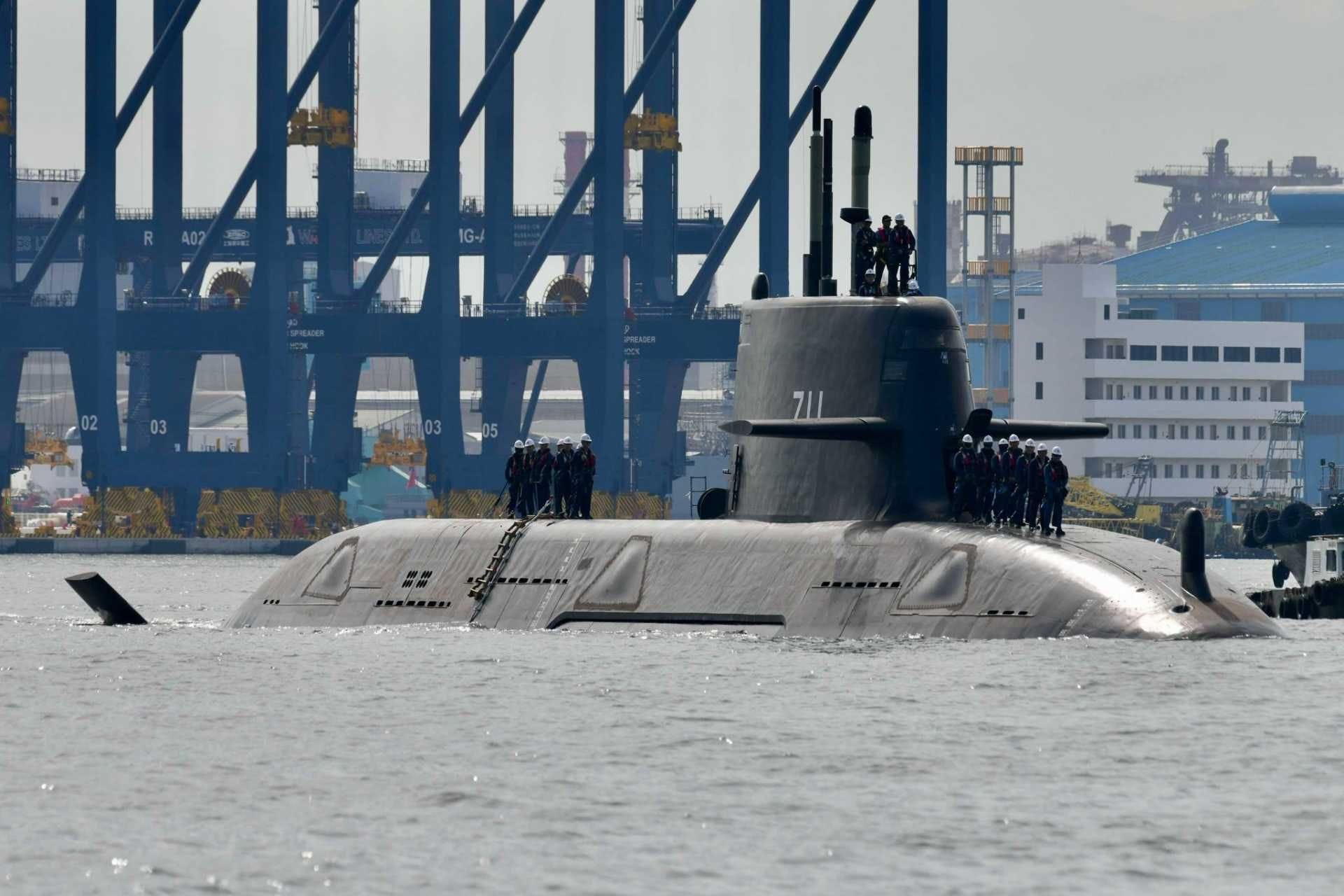
Taiwan has signed a construction contract with CSBC Corporation for two additional Hai Kun-class submarines under its Indigenous Defense Submarine (IDS) program, reaffirming its commitment to building a domestically sustained undersea deterrent. The two new vessels—described as “small variant” models—will incorporate improvements derived from the development and testing of the lead submarine, ROCS Hai Kun (SS-711). This latest step is part of the IDS program’s phased “2+3+2” structure, which aims to deliver a total of eight new submarines by the early 2030s. However, while the contract is formalised, the construction budget remains frozen by the Legislative Yuan, pending the outcome of Hai Kun’s ongoing sea trials and the submission of a detailed performance report by the Ministry of National Defense.
The decision to withhold funds reflects the high level of institutional oversight governing the IDS program. Taiwan’s legislature is demanding concrete evidence that Hai Kun meets or exceeds the operational benchmarks required for full-scale serial production. This includes a successful Sea Acceptance Test (SAT) phase, which began on 17 June 2025 and is scheduled to continue until September. Initial testing has already verified surface propulsion and maneuvering capability, with more than 30 further test parameters—including submerged operations, weapons integration, acoustic signature management, and live-fire trials—yet to be completed. Budget release for the new submarines is contingent upon successful completion and formal acceptance by the Navy.
Technically, the two new small variant submarines are expected to address integration and design issues identified during the harbor and sea trials of the prototype. These include internal layout adjustments and improved system modularity. The Hai Kun is based on the Zwaardvis-class hull design with an X-rudder configuration, displacing 2,500–3,000 tons submerged. It is equipped with six 533 mm torpedo tubes capable of firing Mk 48 Mod 6 torpedoes and UGM-84L Harpoon missiles, and is reportedly designed to carry naval mines and deploy decoys. Integration challenges—particularly involving foreign-sourced combat systems, sonar, and periscopes—have been a critical concern throughout the prototype’s development. The refinements made in the small variants are intended to improve system compatibility, reduce production complexity, and raise survivability.
Strategically, the IDS program reflects a deliberate shift in Taiwan’s defence posture toward self-reliance in key capability domains. It also addresses long-standing procurement challenges resulting from diplomatic isolation and Chinese pressure on foreign suppliers. With the two Dutch-built Hai Lung-class submarines aging and increasingly outmatched by Chinese anti-submarine warfare (ASW) capabilities, Taiwan’s effort to field a modern, scalable submarine force is both urgent and politically sensitive. The IDS submarines—when fully realised—will not only offer asymmetric deterrence through anti-ship and land-attack roles, but also support Taiwan’s intelligence, surveillance, and reconnaissance (ISR) and maritime denial missions across the Taiwan Strait and first island chain.
The current production pause does not imply program stagnation. At CSBC’s Kaohsiung shipyard, tooling alignment, parts procurement, and workforce planning are already underway to ensure seamless transition once funds are approved. This “construction readiness phase” is designed to preserve timelines and avoid industrial gaps. Taiwan’s Ministry of National Defense anticipates initiating work on the new boats before the end of 2025, provided that legislative approval follows a successful SAT campaign. Meanwhile, the Hai Kun continues to serve as a live testbed for refining operational standards and validating subsystems, further de-risking future construction.
In conclusion, Taiwan’s submarine strategy is progressing, albeit cautiously, under the watchful eye of legislative oversight and with an adaptive industrial approach. The contract for two improved Hai Kun-class submarines marks a measured but important milestone in Taiwan’s naval modernisation efforts. With regional undersea warfare dynamics shifting and the PLA Navy expanding its reach, Taiwan’s phased IDS model—combining prototype refinement, local production, and modular upgrades—represents a rational, resilient path toward credible undersea deterrence. The success of Hai Kun’s sea trials in the coming months will determine not only the immediate future of submarine construction, but the broader trajectory of Taiwan’s maritime defence autonomy.