

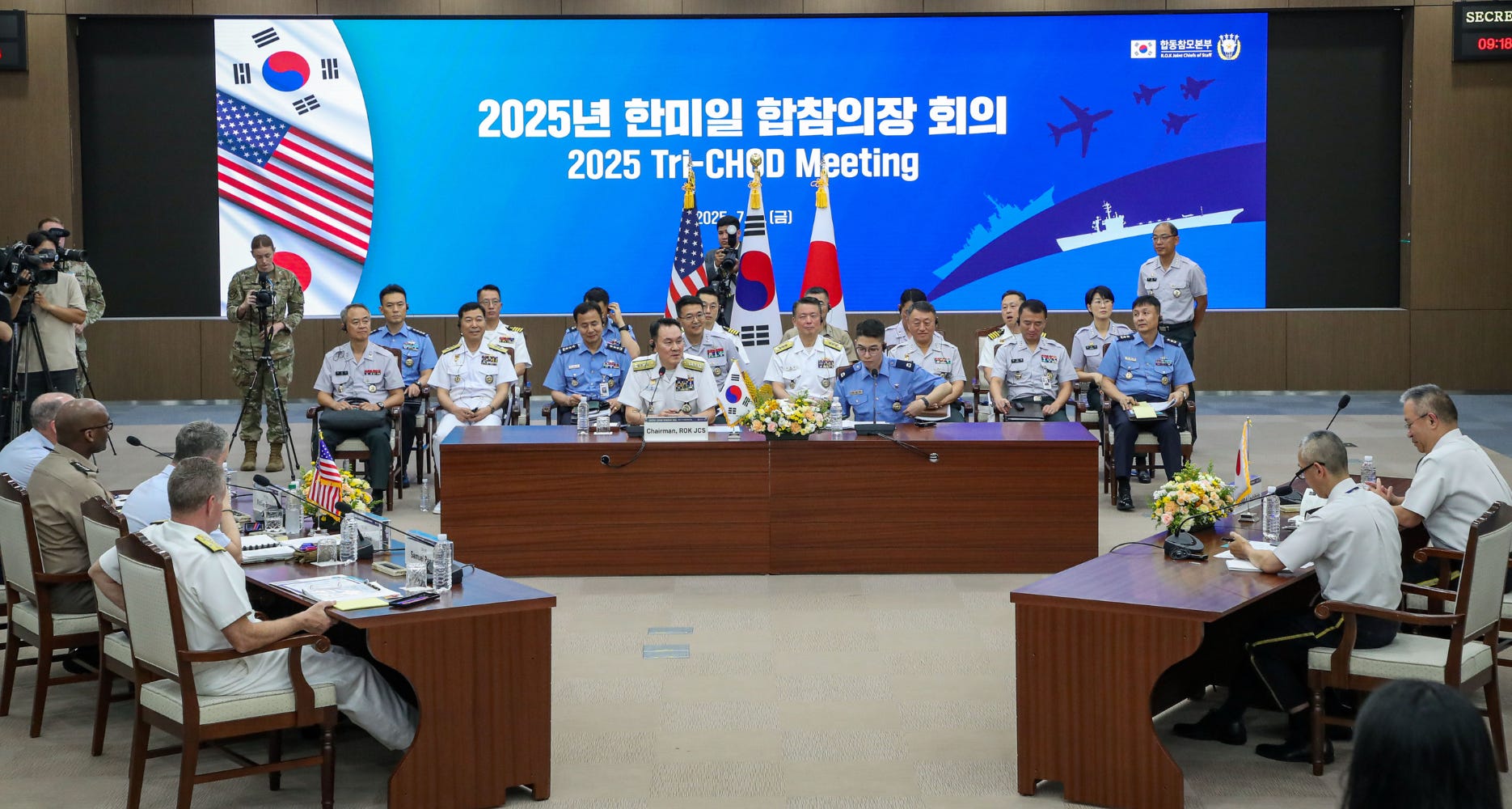
In a decisive demonstration of alliance cohesion, defense chiefs from the United States, South Korea, and Japan convened in Seoul on 11 July 2025, pledging deeper collaboration to counter North Korea’s mounting threats. During their 22nd Trilateral Chiefs of Defense (Tri‑CHOD) summit, the three nations reaffirmed their unified commitment to North Korea’s “complete denuclearization” and agreed to amplify joint defense coordination across political, strategic, and operational domains. Coinciding with this diplomatic milestone, they launched a trilateral aerial maneuver over international waters near Jeju Island, deploying U.S. B‑52H strategic bombers alongside South Korean KF‑16s and Japanese F‑2 fighters—a powerful symbol of deterrence and alliance synergy.
This move carries profound implications for regional and global security. Through the strategic placement of nuclear-capable bombers and combined air assets, the partnership publicly showcases its readiness to confront both immediate and long-term threats—from North Korea’s burgeoning nuclear-missile programs to its emerging strategic ties with Russia. Notably, U.S. General Dan Caine of the Joint Chiefs warned of “unprecedented military build‑ups” by both North Korea and China, emphasizing the need for robust, synchronized responses. Beyond deterrence, the joint drills support operational interoperability—critical in a high-threat environment where collective readiness and rapid, integrated command can define strategic resilience.
Amid growing concern over Pyongyang’s expanding arsenal and irregular military cooperation, including North Korean deployments and arms exchanges with Russia, the alliance’s unified exercises convey a clear deterrent message. The trilateral drills affirm not only technological readiness but shared political resolve—and signal to regional adversaries that any escalation would trigger a coordinated, multifaceted response . For investors and industry leaders, this signals both sustained demand for advanced air defense and strategic platforms across the region, and deepening integration among U.S. and allied defense procurement pipelines.
Strategically, this enhanced cooperation aligns with wider Indo‑Pacific doctrines, as highlighted by RAND’s recent air‑base defense review. That report warns of critical vulnerabilities in American air installations across the Pacific, emphasizing that increased allied cohesion is essential to offset evolving missile and drone threats. The Seoul summit thus reflects not only the immediate challenge—North Korean weaponry—but a broader paradigm where integrated defense architectures become essential in high-threat theaters. As we move deeper into an era of multi-domain deterrence and regional balancing, the ROK-US-Japan alliance emerges as a key bellwether of strategic adaptation.
References
NK News, “Defense chiefs of ROK, US, Japan vow deeper cooperation…” (11 July 2025)
Reuters, “South Korea, Japan and US conduct air drill…” (11 July 2025)
AP News, “South Korea, US and Japan hold aerial drill…” (11 July 2025)
RAND Corporation, Assessing Progress on Air Base Defense (June 2025)