

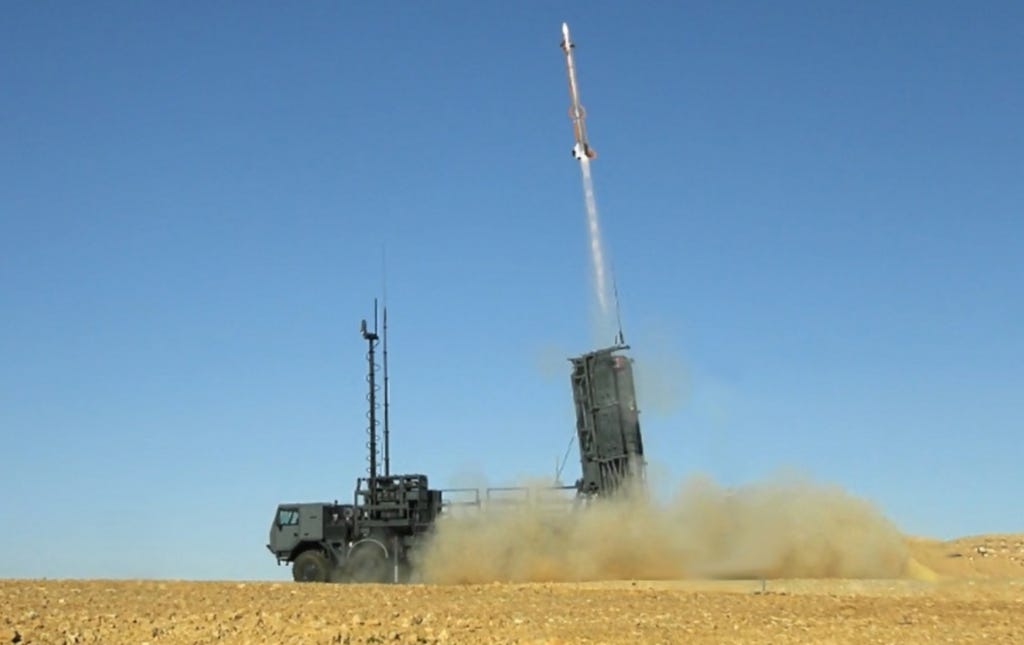
On 7 July 2025, the Romanian Ministry of National Defence confirmed the selection of Rafael Advanced Defense Systems for the country’s largest-ever air defense procurement. The €1.9 billion contract (exclusive of VAT) marks a major milestone in Romania’s military modernization strategy and significantly reinforces NATO’s eastern flank. The V/SHORAD (Very Short and Short Range Air Defense) program is designed to defend Romanian territory and allied forces against low- to medium-altitude threats, including cruise missiles, UAVs, helicopters, and tactical aircraft. Approved by the Romanian parliament in 2020 and launched in 2023, the program now enters its implementation phase with Rafael’s SPYDER system at the core.
SPYDER (Surface-to-air PYthon and DERby) is a fully mobile air defense system that integrates a 3D radar, electro-optical sensors, command and control units, and launchers on a single vehicle platform. It is capable of firing both Python-5 and Derby interceptor missiles, with effective ranges of approximately 40 km and 80 km respectively. The system is specifically optimized for intercepting fast, maneuvering aerial threats at low altitudes and can be deployed rapidly to cover mobile or fixed assets. Its integration into Romania’s force structure will complement the existing long-range Patriot batteries and the U.S.-operated Aegis Ashore site at Deveselu, creating a coherent, layered air defense architecture aligned with NATO standards.
The Romanian V/SHORAD contract aligns with EU strategic frameworks such as ASAP (Act in Support of Ammunition Production) and EDIRPA (European Defence Industry Reinforcement through the Common Procurement Act). These initiatives facilitate co-funding of member state procurement programs and mandate industrial return through European subcontracting. As part of the agreement, Rafael is required to allocate significant work packages to Romanian and EU firms. This approach mirrors Rafael’s involvement in the Eurospike joint venture, where industrial collaboration with German and Polish partners has enhanced supply chain resilience and technological diffusion within the EU. The Romanian government intends to maximize local industry participation to stimulate national capabilities and reduce external dependencies.
Operationally, the addition of SPYDER batteries will address critical capability gaps in Romania’s short-range air defense, particularly in countering high-density drone attacks and low-flying cruise missiles. The mobility and modularity of the system allow for rapid redeployment in response to emerging threats, making it suitable for both static infrastructure protection and manoeuvre force shielding. According to Romanian defence officials, SPYDER’s role is not to replace existing platforms such as the Patriot, but to complement them by defending against targets that evade high-altitude systems. Its NATO interoperability is also a key asset, enabling integration into regional air defense networks and joint operational frameworks.
Strategically, the contract reflects a broader recalibration of NATO's eastern defense posture. With the war in Ukraine reinforcing the vulnerability of critical infrastructure to air and missile threats, Romania is acting to strengthen its deterrence and resilience. The use of EU funds underscores the growing role of supranational defence financing in shaping national procurement strategies. Rafael’s growing European footprint—now including Romania, the Czech Republic, and soon others—demonstrates the increasing acceptance of non-European OEMs that offer scalable, combat-proven, and alliance-compatible solutions. This procurement, therefore, is not only a national milestone for Romania but also a signal of deeper NATO-EU industrial coordination in the face of persistent regional threats.