

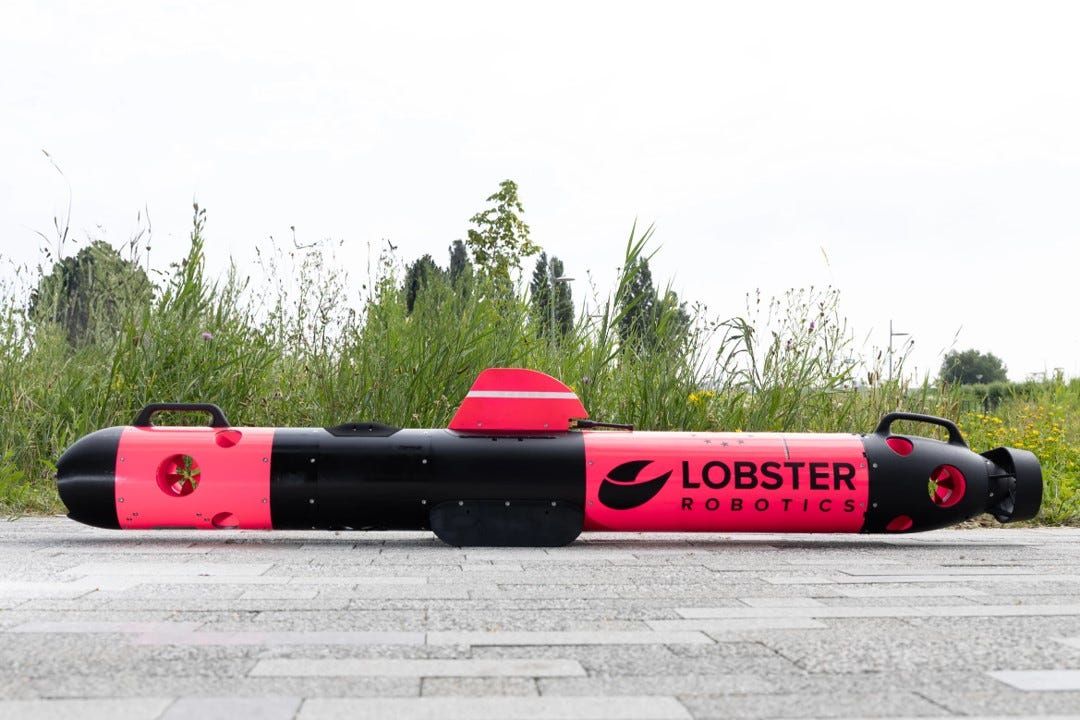
The Dutch Ministry of Defence is advancing the militarization of subsea technologies through a strategic partnership with Lobster Robotics, aimed at upgrading the Scout underwater drone for operational use. Originally built for commercial seafloor mapping, Scout is now being adapted to support mine countermeasures, subsea surveillance, and reconnaissance tasks in both national and NATO maritime domains. With its advanced optical sensors, adaptive lighting systems, and AI-driven data processing, the platform can autonomously detect and classify underwater anomalies, reducing operator workload and decision latency in mission-critical environments.
The collaboration reflects a deliberate push by the Netherlands to accelerate the adoption of dual-use technologies under NATO’s emerging Rapid Adoption Action Plan (RAAP). While RAAP is still pending formal approval, Dutch trials are already underway, with active participation from Lobster Robotics and Ministry of Defence engineers. These trials are not only refining Scout’s military-grade configuration but also generating technical data intended to be shared across allied defense networks. The aim is to establish Scout as a standardizable, low-signature UUV for seabed operations in both territorial waters and broader alliance missions.
Scout's selection into NATO’s DIANA accelerator—chosen from over 1,300 applicants—demonstrates its relevance within the alliance’s innovation framework. The platform’s adaptability and modular architecture make it suitable for rapid iteration based on field-user feedback, in line with the DIANA model of user-centered development. Dutch State Secretary for Defence Gijs Tuinman underscored the strategic rationale: dual-use systems like Scout “make us faster, smarter, and more effective,” while reinforcing NATO’s collective technological edge. In this light, Scout becomes more than a platform—it becomes a test case for the alliance’s ability to transition commercial innovation into operational readiness.
The Netherlands' approach is characterized by co-development cycles, field validation, and multi-domain applicability. Scout’s scalability and low acoustic signature make it particularly suitable for hybrid scenarios, such as infrastructure protection, mine clearance, and grey-zone presence missions. Unlike larger UUVs, it can operate in shallow littoral zones, navigate complex seafloor topographies, and be deployed without significant logistical overhead. This supports a wider NATO interest in autonomous systems that are deployable, resilient, and interoperable across varied command structures and mission profiles.
With global interest growing in seabed warfare and subsea infrastructure security, the Scout project signals a practical shift in defense innovation—away from top-down procurement and toward iterative, field-based integration of commercially proven technologies. If successful, it may pave the way for a broader class of NATO-certified, multi-role UUVs capable of scaling across geographies and mission types. In the era of asymmetric threats and contested undersea domains, systems like Scout offer a low-risk, high-agility path to enhance maritime situational awareness and operational autonomy.