

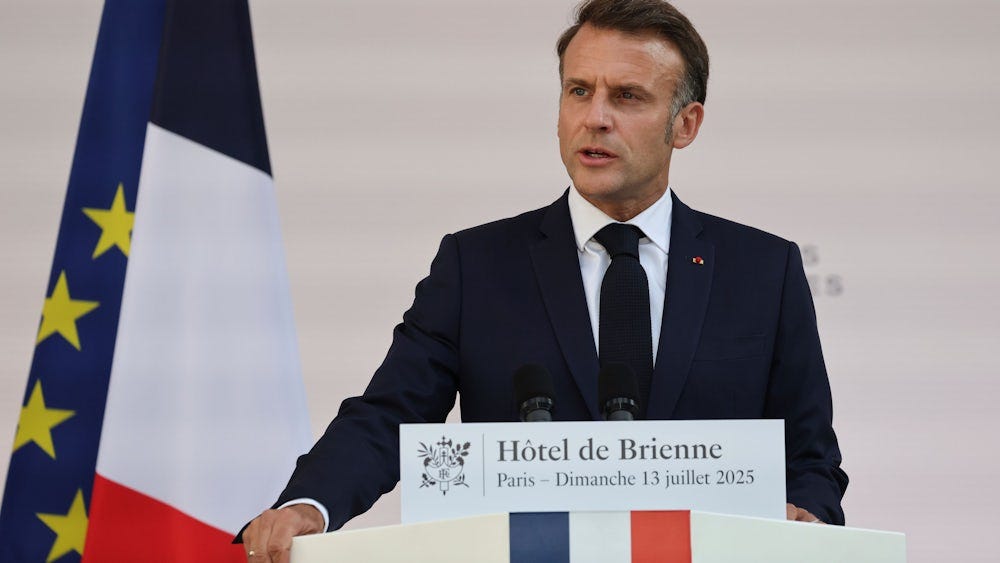
In a solemn and urgent speech on the eve of France’s national holiday, President Emmanuel Macron announced a substantial increase in military spending, pledging to double the defense budget to €64 billion by 2027. Speaking from the courtyard of the Hôtel de Brienne, home to the French Ministry of the Armed Forces, Macron warned of mounting geopolitical threats facing Europe and declared that “our freedom has never been more threatened since 1945.” Stressing France’s role as the EU’s only nuclear power, he underscored the need for strategic autonomy should the U.S. withdraw from European security commitments.
Macron acknowledged critical gaps in French military readiness, including understocked ammunition depots, insufficient drone capabilities, and weak air defense systems. “We have a solid army, but we also have vulnerabilities,” he said. The accelerated funding timeline, originally planned for 2030, reflects France’s response to the escalating risks of conventional and hybrid warfare. Macron also announced plans to expand France’s reservist forces, currently numbering 47,000, with a new mobilization program to be unveiled this autumn. “Young people must again have the opportunity to serve,” he said.
The unusually assertive speech followed a carefully staged communications campaign by senior French officials. Intelligence chief Nicolas Lerner warned of renewed Islamist threats, while Armed Forces Chief of Staff General Thierry Burkhard stated that France is now perceived by the Kremlin as “Europe’s primary adversary.” Defense Minister Sébastien Lecornu declared in a newspaper interview that “France must remain a global power.” These public interventions were designed to prepare the ground for Macron’s announcement and rally national support for an ambitious and costly military build-up.
Macron, who had no prior military service and initially showed limited interest in defense policy, has since undergone a notable transformation. Since taking office in 2017, he has increased defense spending from €32.3 billion to €50.5 billion annually, reversing sharp budget cuts enacted by previous administrations. Under Presidents Sarkozy and Hollande, austerity measures had led to the closure of over 20 regiments and 10 air bases. Today, defense spending accounts for approximately 2.1 percent of France’s GDP, and Macron now frames rearmament as a cornerstone of national sovereignty.
France remains the world’s second-largest arms exporter after the United States, with strong international demand for platforms such as the Dassault Rafale fighter jet. Macron has increasingly positioned himself as the chief promoter of French defense exports, using state visits and multilateral summits to expand France’s role on the global stage. Yet questions remain about how the new defense commitments will be funded. With national debt reaching a record €3.3 trillion, Prime Minister François Bayrou had planned to unveil a €40 billion austerity package—prior to Macron’s speech. Reports suggest tension between the two leaders over fiscal priorities, though both agree on the strategic necessity of military readiness.
With this speech, Macron has taken a decisive step in redefining France’s defense posture. By framing the defense budget not only as a security issue but as a national duty, he seeks to anchor France’s leadership in a rapidly changing world. Whether the country can meet these ambitious goals without deepening its fiscal challenges remains to be seen, but Macron has made clear that inaction is no longer an option: “Only those who are feared remain free. And to be feared, one must be strong.”