

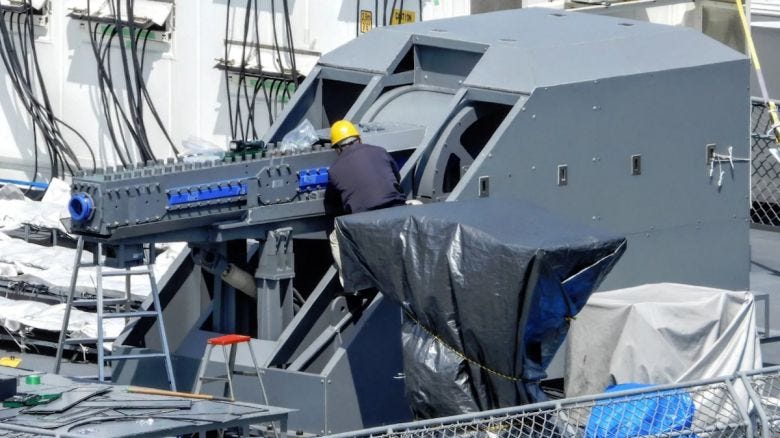
Japan has taken a significant step toward operationalising electromagnetic railgun technology with the installation of a prototype turret system aboard the test ship JS Asuka. Recently published images, taken at Yokosuka on 30 June 2025, confirm the active modification and integration of the system, which has been developed by the Acquisition, Technology & Logistics Agency (ATLA). This marks the first time Japan’s railgun has moved from land-based testing to realistic sea-based trials—offering the Japan Maritime Self-Defense Force (JMSDF) a platform for validating its future role in naval warfare.
The railgun, which uses electromagnetic force rather than chemical propellants to fire projectiles at extreme velocity, represents a major technological ambition: it promises high-rate, low-cost intercept capability against cruise missiles, hypersonic threats, and surface targets. In recent years, ATLA has demonstrated launch velocities of up to Mach 6.5 (around 2,230 m/s) with 5 MJ of energy—placing it within the realm of strategic missile defence applications. The choice to place the weapon on Asuka’s flight deck is pragmatic: the 6,200-ton testbed offers the space and modularity required to test power generation and cooling systems without major hull modifications.
The move contrasts starkly with the U.S. Navy’s decision to halt its own railgun programme in 2022 after over a decade of development, citing technical complexity and competing priorities. Japan, however, has persisted—driven by mounting threats from regional adversaries and a desire to strengthen its sovereign technology base. Notably, Tokyo has recently sought cooperation with France and Germany on next-generation railgun research, and informal dialogues have continued with U.S. defence entities to exchange technical insights. ATLA’s principal director, Kazumi Ito, speaking at DSEI Japan 2025, confirmed that railgun development is "progressing," despite acknowledged engineering hurdles.
Operational integration remains a longer-term challenge. Railguns are notoriously difficult to adapt to existing warships, due to their high power requirements, thermal load, and barrel degradation during sustained firing. However, Japan’s defence planners are already laying the groundwork: future destroyer classes such as the 13DDX have been identified as potential hosts, and design studies have depicted a Maya-class destroyer equipped with a railgun. According to ATLA, design refinements are also underway to produce a more compact, integrated turret than the one now aboard JS Asuka—suggesting an eventual transition from prototype to tactical configuration.
Strategically, the railgun fits into Japan’s broader efforts to modernise its layered missile defence system and harden it against saturation and hypersonic threats. Unlike interceptor missiles, railgun munitions are smaller, cheaper, and reloadable at sea—solving several logistical issues associated with vertical launch systems. Their versatility, including surface, land-attack and anti-air roles, enhances Japan’s ability to engage high-volume threats within its near seas. As regional adversaries such as China and North Korea expand their own missile and drone capabilities, Japan is moving to diversify its response options beyond legacy systems.
In conclusion, the deployment of a functional prototype railgun at sea places Japan at the forefront of electromagnetic weapons development globally. While technical and operational hurdles remain, Tokyo’s incremental, engineering-driven approach—anchored by ATLA and supported by cross-ministerial investment—suggests a serious intent to field railguns as deployable capabilities within the next decade. In doing so, Japan is quietly redefining its naval doctrine, shifting from passive defence to multi-layered, active interception—built on indigenous innovation, tested platforms, and a steadily expanding industrial base. The railgun aboard JS Asuka is not just an experiment—it is a signal of what comes next.