

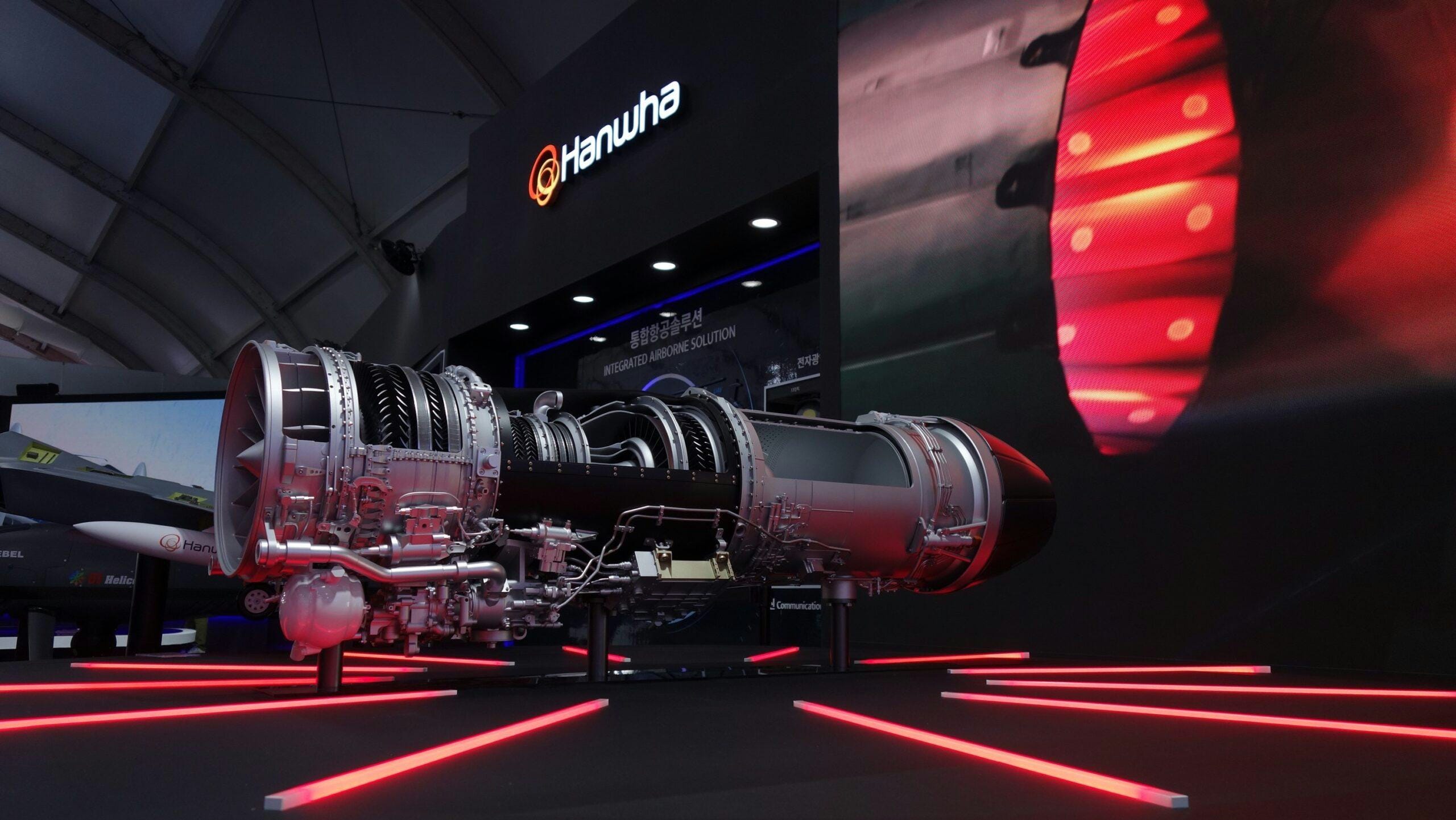
Hanwha Aerospace has solidified its position at the core of South Korea’s defence-industrial base with a second engine supply contract for the KF-21 Boramae programme, valued at 623.2 billion won ($459 million). This latest agreement brings the total value of KF-21 engine contracts awarded to Hanwha to approximately 1.18 trillion won, covering the production and delivery of 80 General Electric F414 engines by December 2028. What distinguishes this second tranche is its explicit inclusion of full lifecycle support: Hanwha will provide maintenance parts, technical documentation, and on-site technical assistance to ensure engine availability and fleet sustainment.
To meet rising production demands and improve output quality, Hanwha has invested 40 billion won in a smart manufacturing facility dedicated to advanced jet engine production. This new site is designed to support not only the KF-21’s engine delivery schedule but also broader ambitions for indigenous propulsion systems and international engine contracts. The facility’s digital infrastructure enables predictive quality control, real-time production monitoring, and a higher degree of automation—key capabilities for scaling up defence exports and reducing reliance on imported aerospace components.
Although Hanwha Aerospace remains a licensee of GE’s F414 design, the company’s growing manufacturing autonomy and technical maturity position it to serve as a platform for future co-development or derivative engine programmes. The integration of smart factory technology reinforces this trajectory, potentially enabling South Korea to develop its own military engine design capability within the next decade—an objective already outlined in government R&D roadmaps. The current contract serves not only as a deliverable commitment, but also as a vehicle to build the domestic skills, tooling, and systems integration expertise necessary for next-generation propulsion.
The timeline to 2028 is tight, given the scale of the programme and the need for synchronization with KAI’s airframe production and Hanwha Systems’ radar integration. Any delays in engine delivery would have cascading effects on rollout and operational readiness, making the logistical components of this contract critical to its success. By including technical manuals, in-country maintenance support, and training elements, the contract seeks to anticipate and mitigate such risks.
In sum, while the basic contours of Hanwha Aerospace’s involvement in the KF-21 programme were already known, this second contract reveals deeper strategic layering: a deliberate effort to scale production, build sovereign industrial capacity, and transition from licensed manufacturing to smart, data-driven propulsion systems development. As the Boramae project moves from prototype to mass production, Hanwha’s engine programme will serve as both a performance benchmark and a strategic enabler of South Korea’s aerospace ambitions.