

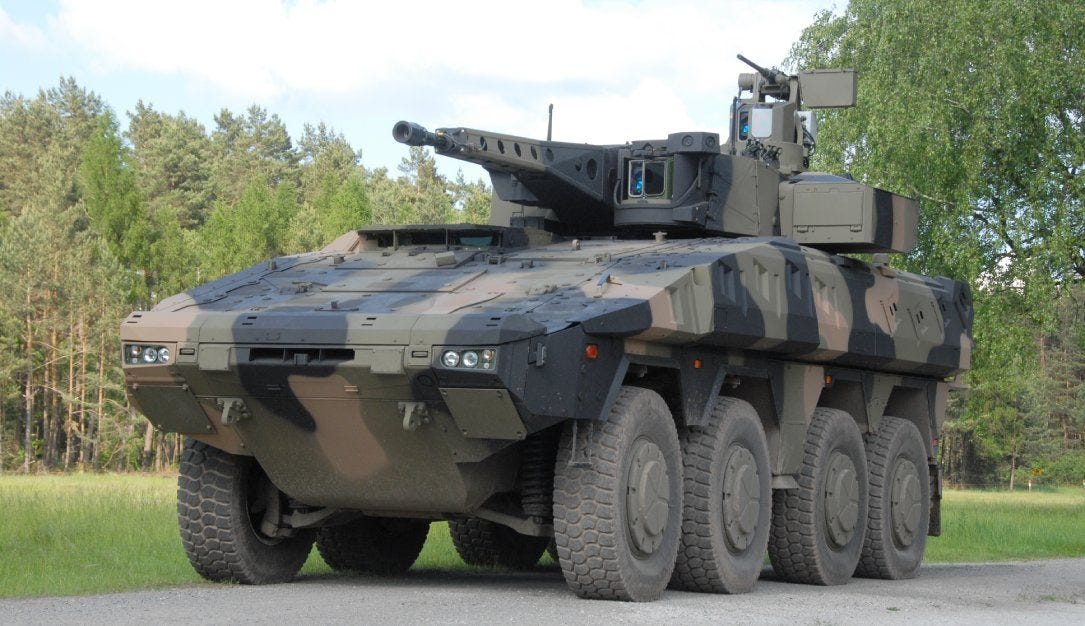
According to a report published by the German newspaper Bild on July 13, 2025, Rheinmetall AG is in advanced negotiations with the German government for the delivery of between 6,000 and 7,000 combat vehicles. Confirmed by CEO Armin Papperger, the agreement forms the core of a comprehensive restructuring plan to modernize the German Army (Bundeswehr) and enhance its combat readiness. If finalized, the order could generate up to €70 billion in defense contracts over the next twelve months from Germany alone.
The new procurement strategy includes key armored platforms such as the Leopard 2 main battle tank, the Puma tracked infantry fighting vehicle, and the Boxer 8x8 wheeled armored personnel carrier. The goal is to upgrade Germany’s land forces and establish new rapid deployment brigades capable of sustained operations in high-intensity environments, particularly along NATO’s eastern flank. The decision comes in response to a shifting security landscape triggered by Russia’s full-scale invasion of Ukraine in 2022 and represents a decisive break from Germany’s post–Cold War policy of restraint.
Currently, Germany’s ground vehicle inventory includes 313 main battle tanks, 680 infantry fighting vehicles, and 802 armored personnel carriers. The new procurement plan is expected not only to replace aging systems but also to expand the force to meet NATO force generation targets. Rheinmetall, already a key supplier to NATO allies, is positioned to play a central industrial role in rebuilding Germany’s conventional land power.
The Leopard 2A8 is the most advanced variant of the proven Leopard 2 platform. It features state-of-the-art protection, including the Israeli-designed Trophy active protection system, enhanced resistance to mines and IEDs, upgraded optics, and improved battlefield survivability. Armed with a 120mm smoothbore cannon, the Leopard 2A8 is designed for high-intensity peer warfare and optimized for mobility, protection, and firepower.
The Puma IFV, jointly developed by Rheinmetall and Krauss-Maffei Wegmann, represents the latest generation of tracked infantry vehicles in the German Army. It provides high crew protection, modular armor configurations, advanced network integration, and a stabilized 30mm MK30-2/ABM autocannon with airburst capability. The vehicle is intended to transport mechanized infantry while offering direct fire support in both conventional and asymmetric scenarios.
The Boxer 8x8 is a modular wheeled platform produced by the ARTEC consortium, with Rheinmetall as a principal partner. Its interchangeable mission modules enable rapid adaptation to various roles, including troop transport, command and control, medevac, or fire support. With a strong track record in multiple operational theaters and widespread use among NATO members, the Boxer offers a balance of tactical flexibility, protection, and mobility.
This historic procurement initiative comes as Germany significantly increases defense spending. Since 2022, Berlin has established a €100 billion special fund to modernize the Bundeswehr. By 2025, the national defense budget is expected to reach €85 billion, with official plans to gradually raise military expenditure to 5% of GDP over the coming years. This shift would position Germany not only as NATO’s largest economic contributor in Europe but also as its foremost land-based conventional military power.
Alongside armored vehicle procurement, the German government plans to increase active-duty personnel from 180,000 to over 200,000 by 2030, while also expanding investment in ammunition production, missile defense, logistics, and cyber capabilities. In light of the ongoing threat from Russia, German defense officials now consider a potential direct military confrontation with NATO territory within the next five to eight years as a credible risk. The rapid rearmament of the Bundeswehr is therefore regarded as a strategic imperative to deter aggression and ensure operational readiness. As Europe’s largest economy reasserts its military leadership, this unprecedented deal with Rheinmetall marks a defining moment in Germany’s defense policy.