

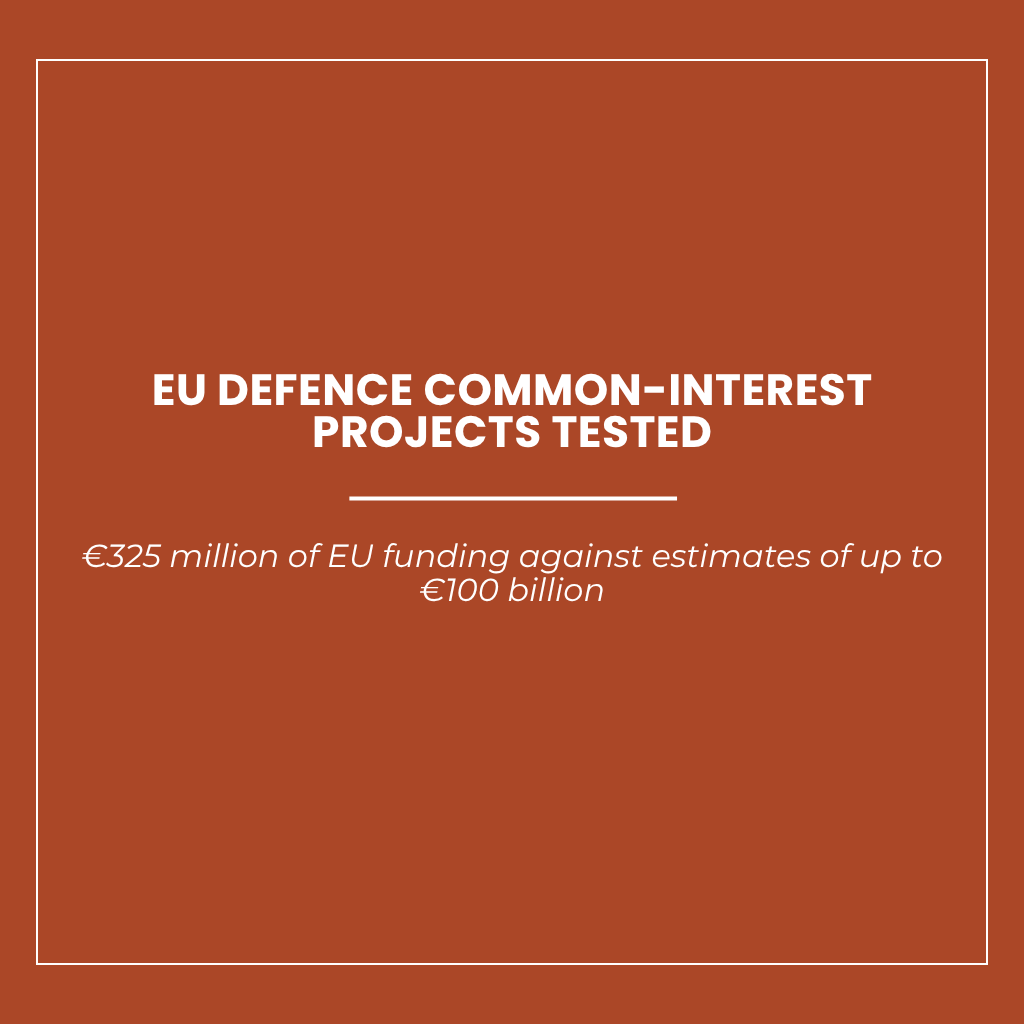
At the end of September 2026 the European Union gave legal form to a new category of defence cooperation. Five large projects, covering drones, the maritime and seabed domain, space, air and missile defence, and the security of the Union’s eastern border, were formally identified as European Defence Projects of Common Interest. The Council’s own estimates of what these projects might eventually cost run from a few billion euros for the smallest to as much as €100 billion for the largest, over horizons that stretch into the 2040s. Against those figures, the money that the European Union has so far set aside for the projects from its own budget is €325 million, most of it entered under 2027 appropriations whose availability depends on the adoption of the Union’s budget for that year. The gap between the scale of the ambition and the scale of the money is the first thing a reader notices, but it is not the most important question. A designation of common interest could matter even if the Union pays for very little, provided it binds governments to common requirements, joint orders or shared production. It could equally matter very little even if the money grew, if each participating state remained free to buy what it wanted from whom it wanted. The question, then, is what the designation actually obliges, what it funds, and what it leaves to national choice, and whether, on the record available today, it is enough to turn a declared common interest into commitments that shape what Europe’s armed forces buy and what its industry builds.