

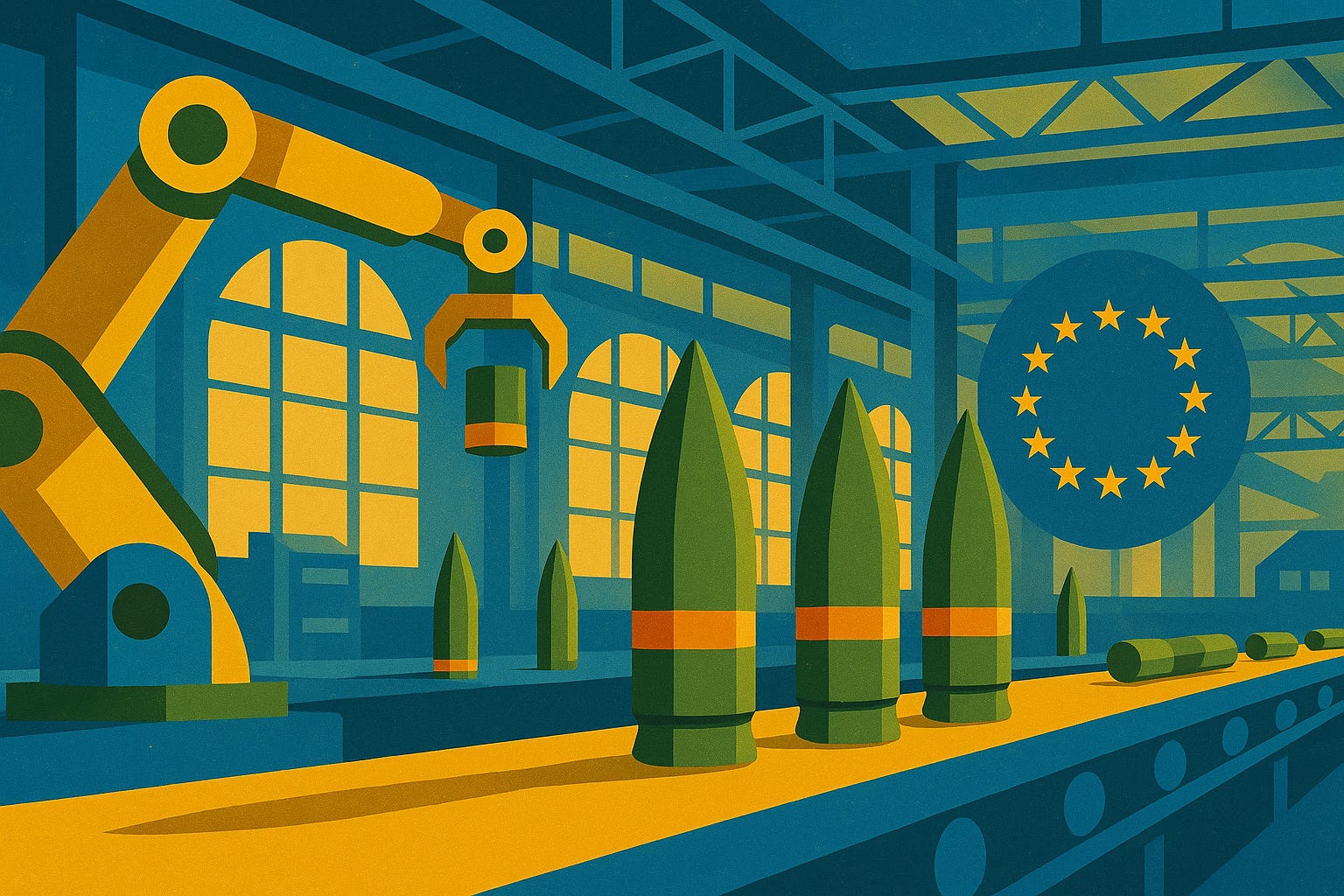
At Defence Finance Monitor we analyse how strategic priorities and security requirements evolve into European, NATO and national programmes, and how defence regulations translate into concrete funding flows, procurement opportunities and industrial consequences. The launch of the European Defence Industry Programme is a development we have followed closely, because it redefines the environment in which companies, investors and institutions will operate. For those active in the sector, this is not a routine policy adjustment. It is the beginning of a binding framework that determines access to resources, sets eligibility conditions and shapes competitive positioning.
DFM’s role is to provide the tools needed to access these mechanisms and funding lines through continuous, precise and document-based analysis, offering a stable reference point for operational clarity.
The programme consolidates, for the first time, initiatives previously dispersed across multiple instruments. Its objective is to strengthen Europe’s industrial readiness by supporting joint procurement, expanding manufacturing capacity and reinforcing supply-chain resilience. At the core of the programme lie clear rules, dedicated budgets and mechanisms designed to accelerate the production of essential equipment, from ammunition to components and major systems. What distinguishes this phase is the shift from temporary measures to a lasting regulatory foundation capable of sustaining deterrence and readiness.
The debate surrounding the programme reflects a shared understanding: Europe’s security now depends on its capacity to produce, replenish and maintain an industrial rhythm consistent with strategic demands. In this environment, DFM provides a continuous analytical vantage point to monitor, interpret and translate regulatory developments into operational implications. For enterprises, institutions and investors, the value lies in having a system that connects strategic priorities with funding instruments, procurement programmes, industrial initiatives, dual-use opportunities and the requirements of civil-infrastructure resilience.
Subscribing to Defence Finance Monitor offers a real advantage: we are the only platform that connects all sides of the equation and provides the instruments needed to navigate funding lines, procurement opportunities, industrial programmes, dual-use initiatives and the resilience requirements of critical civil infrastructures.
Europe Moves to Industrial Readiness: New Pathways to Funding Under the Defence Industry Programme
The European Defence Industry Programme is the first comprehensive regulatory instrument through which the European Union seeks to bring coherence to a decade of fragmented defence-industrial initiatives, consolidating them into a single framework designed to rebuild industrial readiness. It aims to strengthen the European defence technological and industrial base by supporting joint procurement, expanding manufacturing capacity, improving supply-chain resilience and integrating Ukraine into selected industrial projects. The programme establishes clear eligibility rules, allocates dedicated funding and introduces mechanisms to accelerate the production of critical equipment, including ammunition, components and major systems.
Integrating EDIP, SAFE and EIB/EIF: The EU’s Defence Financial-Industrial Architecture
The European Union has accelerated its efforts to construct a cohesive and resilient defence industrial base in response to rising geopolitical instability, supply chain disruptions, and critical capability gaps. The fragmentation of national procurement programmes, limited scale of production capacities, and dependence on non-EU suppliers have highlighted the structural weaknesses of the European Defence Technological and Industrial Base. In this context, the Union has adopted a set of coordinated instruments—EDIP, SAFE and EIB/EIF support mechanisms—designed to address strategic, financial and industrial constraints through a unified regulatory and investment architecture.
This report examines in detail how these three instruments operate individually and in coordination. It analyses the legal and operational foundations of EDIP, SAFE and EIB/EIF, their internal mechanisms and eligibility criteria, and how they cumulatively affect procurement planning, industrial capacity, and financial mobilisation. The report assesses how the integration of Ukraine’s defence industry is operationalised across all instruments, the degree of compatibility with NATO frameworks, and the risks arising from implementation constraints, governance asymmetries and geopolitical exposure. The objective is to clarify the strategic rationale underpinning the EU’s defence financial architecture and its implications for long-term industrial and security policy.
The New Geography of European Defense Procurement Hubs
Europe’s security establishment has designated a high strategic priority to reshaping the geography of defense procurement and industrial capacity in light of Russia’s war against Ukraine and related threats. The NATO Strategic Concept (2022) and EU Strategic Compass (2022) both emphasized that the return of high-intensity war on the continent requires a rapid strengthening of allied defense-industrial bases and supply lines. Russia’s unprovoked invasion shattered European security assumptions, making the Russian Federation “the most significant and direct threat” to Allied peace and stability. It also depleted Western stockpiles as Allies rushed to arm Ukraine, exposing dangerous shortfalls in munitions and equipment availability across NATO. The credibility of NATO’s deterrence now hinges not only on forces and budgets, but on the capacity to arm and sustain those forces at wartime rates[4]. Allied leaders have therefore elevated defense-industrial resilience as a core pillar of collective defense and deterrence credibility.
European Signals on C-UAS and Air Defence: Funding Frameworks and Danish NASAMS Procurement
The European defence and security ecosystem is undergoing a phase of significant structural change. This transition is driven by a dual momentum: the formulation of new EU-level funding instruments targeting dual-use and defence technologies, and active procurement initiatives by EU and NATO states responding to an evolving threat environment. Two developments stand out. The European Commission has proposed that the European Competitiveness Fund (ECF) should, as of 2028, support the development and deployment of European-based counter-UAS and unmanned aerial systems. At the same time, Denmark has signed a major contract with Kongsberg Defence & Aerospace for the acquisition of the NASAMS medium-range air-defence system. Together, these signals point to a broader redefinition of the financial, industrial and operational frameworks within which Europe is seeking to modernise its air-defence and drone-countering capabilities. This redefinition carries implications for industrial strategy, capability development, procurement and technological investment.