

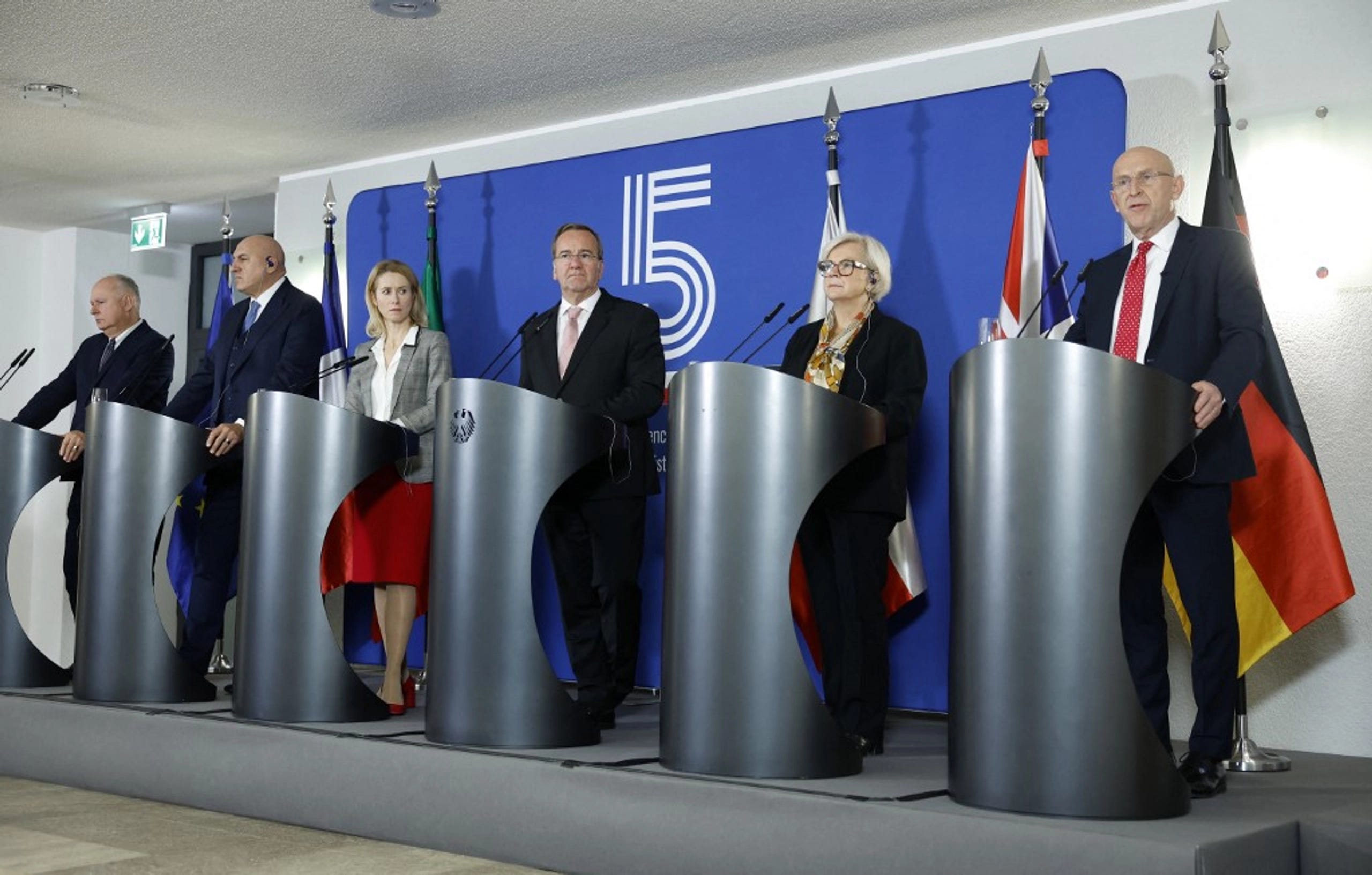
Europe is entering a new phase in the development of counter-drone capabilities, driven by the convergence of operational experience, hybrid pressure along the eastern flank and a growing number of incursions into civilian and military infrastructure. The Berlin meeting of 14 November 2025, which brought together the defence ministers of Germany, France, Italy, the United Kingdom and Poland alongside representatives of the European Union, has formalised a shift from reactive measures to the construction of a coordinated and permanent defensive architecture. The lessons of Ukraine, combined with repeated episodes involving unidentified unmanned platforms over sensitive European sites, have demonstrated that low-altitude airspace has become a permanent vulnerability. As drones evolve into instruments of reconnaissance, coercion and disruption, European governments have recognised the need to define a common framework capable of integrating detection, data fusion and neutralisation across national boundaries.
A central development emerging from the Berlin discussions is the deployment of dedicated counter-UAS units to Finland and Belgium. The rationale reflects two different but complementary threat environments. Finland, positioned along a long border with the Russian Federation, faces continuous hybrid pressure and incursions designed to test European resolve and situational awareness. Belgium, by contrast, has experienced a pattern of drone intrusions over airports, military sites and even nuclear facilities, suggesting that critical infrastructure deep inside Europe is increasingly exposed to probing activities. These two cases illustrate the strategic logic behind a European response: isolated national measures are insufficient when threats operate across borders, exploit technical gaps and target both civilian systems and defence assets. The deployments therefore represent an initial step toward a more integrated network linking sensors, command structures and rapid-response units.
NATO’s recent exercises in Alexandroupolis, Greece, have confirmed that the nature of the threat is evolving more rapidly than existing defensive structures. The use of drone swarms, autonomous ground systems and experimental platforms able to operate in confined environments demonstrates that hostile actors increasingly rely on saturation, manoeuvre and distributed intelligence to overcome traditional air-defence layouts. These demonstrations show that unmanned platforms are no longer limited to simple reconnaissance or harassment tasks; they now incorporate advanced navigation, coordinated behaviour and modular payloads capable of undermining logistical nodes and communication routes. For Europe, the implications are significant: counter-drone systems can no longer rely on a single technology but must integrate electronic warfare, kinetic interceptors, passive sensors and predictive analytics within a coherent operational framework.
The political dimension of the counter-drone effort has also become more explicit. The European Union is evaluating the establishment of a continent-wide protection network connecting national systems through shared standards, common operational protocols and joint procurement mechanisms. This initiative intersects with broader programmes such as the European Defence Fund, EDIP and ASAP, which aim to support the emergence of an industrial base capable of meeting Europe’s requirements without relying excessively on external suppliers. The debate within the EU suggests that counter-drone defence may become one of the first sectors in which Europe tests a structured industrial strategy aligned with its security priorities. This would require not only investment and coordination but also the ability to accelerate certification, interoperability and the adoption of emerging technologies.
Civilian infrastructure has become an increasingly prominent component of the debate. Airports, seaports, logistics hubs, power plants and dense urban environments form a network of potential targets whose protection can no longer be delegated solely to military authorities. National governments are therefore considering governance models that distribute responsibilities across civilian agencies, armed forces, law-enforcement bodies and private operators. Such arrangements imply new regulatory frameworks, clearer definitions of engagement thresholds and continuous information-sharing. The growing interconnection between security and daily economic activity indicates that counter-drone defence will evolve into an essential component of national resilience rather than a purely military task.
The greatest challenge lies in transforming political declarations into interoperable capabilities. Shared data environments, cross-border detection networks and harmonised engagement procedures require long-term planning and institutional alignment. The Berlin summit has established the intention to pursue common standards and to create an integrated framework for low-altitude airspace security, but the success of this effort depends on the willingness of member states to prioritise coordinated procurement, joint training and industrial convergence. Given the security dynamics on Europe’s eastern flank, there is an expectation that political pressure may accelerate these processes, making counter-drone defence a test case for Europe’s ability to operationalise collective security initiatives.
Europe’s acceleration in counter-drone defence marks a structural shift in its approach to emerging threats. What was once treated as an episodic problem is now recognised as a permanent dimension of strategic competition. The ability of European states to consolidate an operational and industrial response will shape the resilience of the continent over the coming decade. The developments observed in Berlin, in Finland and Belgium, and during NATO exercises in Greece indicate that Europe has begun to adapt. The effectiveness of this transition will depend on whether political resolve, industrial capability and technological innovation can converge into a coherent counter-drone architecture. The coming years will determine whether Europe can move from fragmented national initiatives to a genuine continental defensive system with clear operational value.
Sources
Defense News, EU nations boost drone defense, pledge more US weapons for Ukraine (14 November 2025) — https://www.defensenews.com/global/europe/2025/11/14/eu-nations-boost-drone-defense-pledge-more-us-weapons-for-ukraine/
Reuters, Belgium enlists foreign forces to combat drone incursions (10 November 2025) — https://www.reuters.com/world/belgium-enlists-foreign-forces-combat-drone-incursions-2025-11-10/
Associated Press, As NATO pushes for faster innovation, drones flood a test battlefield in Greece (14 November 2025) — https://apnews.com/article/2eda83d3a96178fb71f8b8ba33a1b289
AFP/SpaceWar, Five European NATO powers vow to tackle “hybrid threats” (14 November 2025) — https://www.spacewar.com/afp/251114151723.8nrovzmt.html
intriguing