

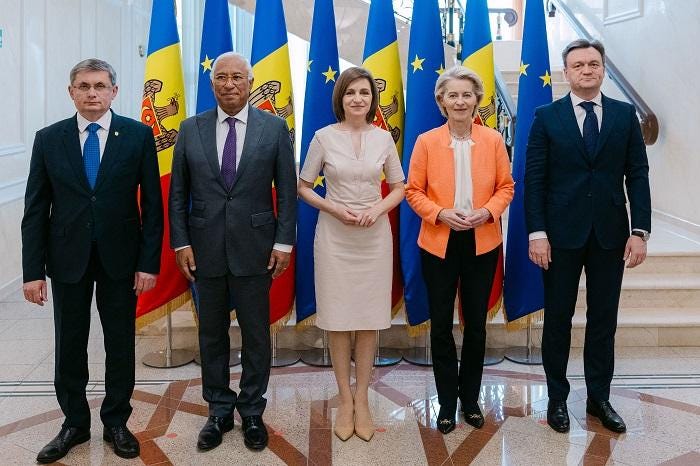
On 4 July 2025, the first-ever EU-Moldova Summit took place in Chișinău, marking a significant milestone in Moldova’s path toward European integration. European Commission President Ursula von der Leyen, European Council President António Costa, and President of the Republic of Moldova Maia Sandu reaffirmed their shared commitment to deepen cooperation on security, economic reform, and institutional transformation. The summit comes at a time of unprecedented progress in EU-Moldova relations, with Moldova having received candidate status in June 2022 and formally opening accession negotiations in June 2024.
During the summit, President von der Leyen announced the release of €270 million in pre-financing as part of the €1.9 billion EU Growth Plan for Moldova. These funds are intended to support Moldova’s reform agenda and facilitate closer integration with the EU Single Market. Initial investments will include the construction of a new regional hospital in Bălți, the modernization of Chișinău’s district heating system, and reductions in electricity and gas bills for Moldovan citizens. The broader Growth Plan covers road infrastructure, education, healthcare, support for SMEs, and the protection of Moldova’s cultural heritage. It is the largest financial support package the EU has granted Moldova since its independence.
In addition to economic measures, the Commission announced Moldova’s inclusion in the Single Euro Payments Area (SEPA), effective from 5 October 2025, and proposed to integrate the country into the EU’s "Roam Like at Home" area starting 1 January 2026. This initiative will allow Moldovan citizens to use their mobile phones across all 27 EU Member States without incurring roaming charges. These steps, both symbolic and practical, strengthen everyday ties between Moldovan citizens and the European Union, especially for mobile workers and export-oriented businesses.
On the security front, the three leaders agreed to intensify cooperation to counter hybrid and cyber threats in the run-up to Moldova’s parliamentary elections scheduled for September. The EU will continue supporting Moldova’s resilience through the EU Partnership Mission and assist the country’s Strategic Communications Centre in monitoring and countering Russian disinformation. The final Joint Declaration emphasized the importance of clear communication on the benefits of EU integration and of reinforcing anti-corruption efforts to ensure the integrity of the upcoming elections.
Earlier in 2025, the European Commission and the Moldovan government agreed on a two-year Comprehensive Strategy for Energy Independence and Resilience, backed by €250 million in EU funding. The strategy aims to fully decouple Moldova from Russian energy supplies and integrate it into the European energy market. If fully implemented, the EU estimates that the Growth Plan and accompanying reforms could double Moldova’s GDP over the next decade, transforming the country’s economic and social fabric.
The Chișinău Summit represents a pivotal moment, both symbolically and operationally. For Moldova, it marks the beginning of a more concrete pre-accession phase; for the European Union, it affirms the strategic objective of expanding stability, security, and prosperity in the eastern neighbourhood. The deepening EU-Moldova partnership fits into a broader European strategy to counter Russian influence in the post-Soviet space by supporting those countries that have chosen to align with European values, institutions, and standards.