

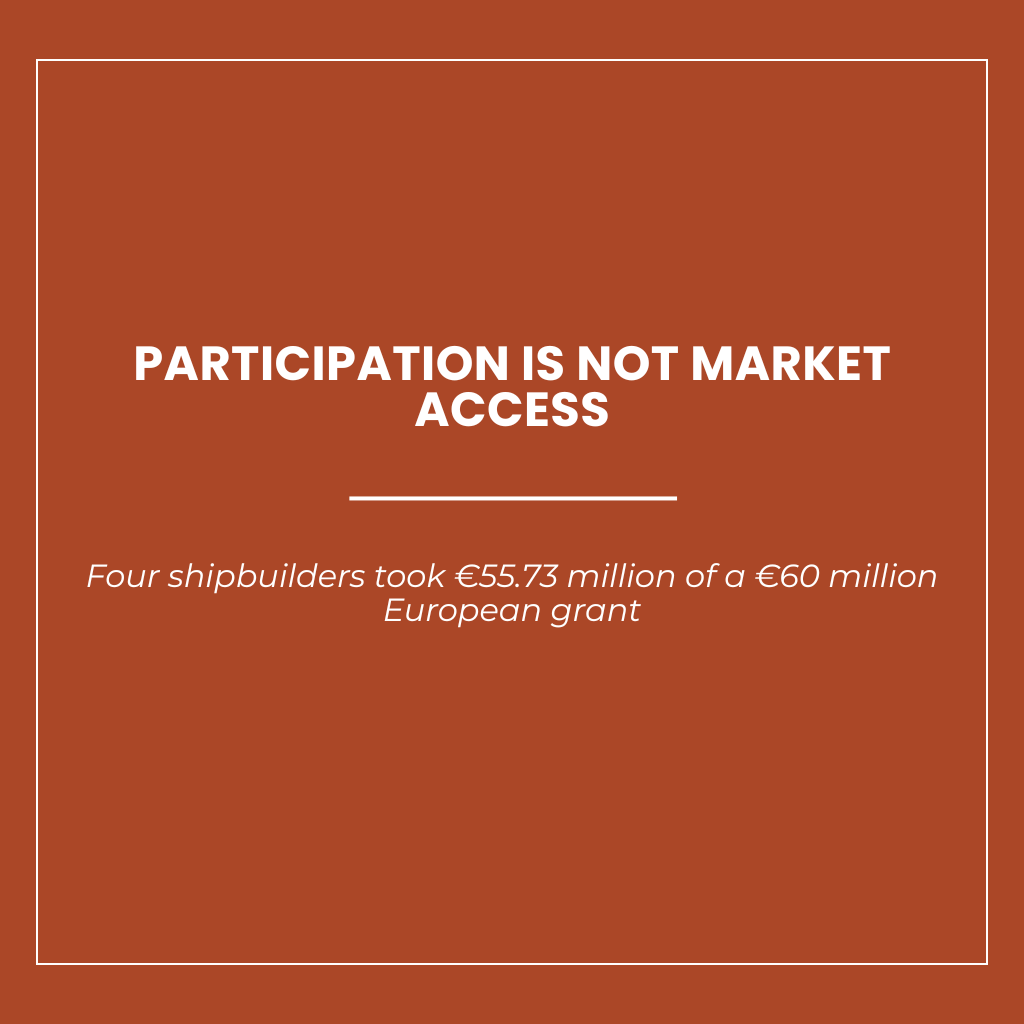
On 16 July 2026 the European Commission adopted award decision C(2026) 4923 final, selecting 58 proposals under the European Defence Fund with maximum grants totalling €1,011,022,885.59. That single annual figure sits inside two larger perimeters drawn from the governing acts: the €7.953 billion financial envelope fixed by Article 4 of the founding Regulation for the whole 2021–2027 period, and the €1,005,978,500 maximum Union contribution authorised by the 2026 work programme for the year. Around those perimeters the Commission publishes a participation statistic — small and medium-sized enterprises as a share of entities involved in funded actions — that is read across the sector as a measure of how far the Fund has opened European defence supply chains. The statistic is accurate. It is also constructed from a population that mixes signatories of the grant agreement with entities that never sign one. Beneath a single percentage sit at least six legally distinct positions, each with a different relationship to money, to technology and to the military customer. The structural constraint is that no published indicator follows a participant past the grant into qualification, production or an order. The unresolved question is therefore not how many smaller firms the Fund has admitted, but which of them hold something a buyer must come back for.