

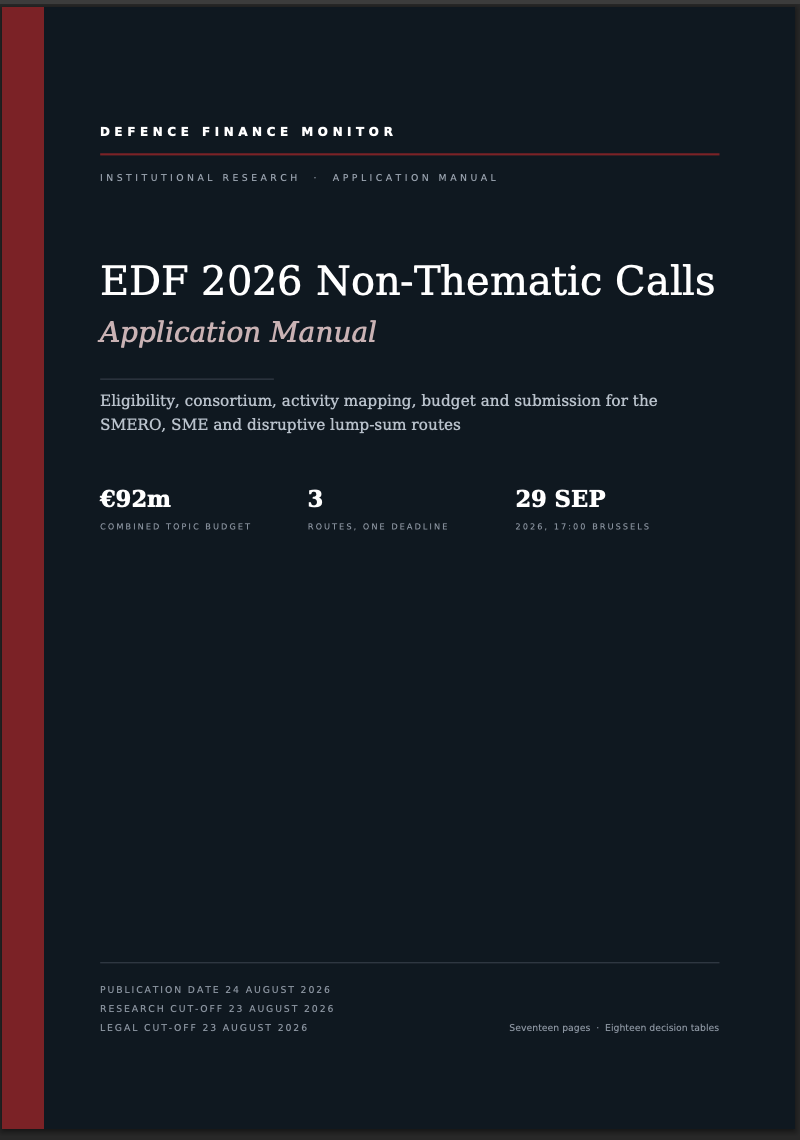
Three European Defence Fund calls close at the same moment — 29 September 2026, 17:00:00 Brussels time — and share a combined published budget of €92 million. They look interchangeable. They are not.
SMERO-NT will not fund a prototype. DIS-NT will not fund a test campaign. SME-NT will not admit a non-SME beneficiary, and will not fund design at all without harmonised capability requirements jointly agreed by two Member States. A consortium that selects its route by comparing the €5 million, €6 million and €3 million ceilings has already made the wrong decision, because the ceilings describe the outer boundary of an admissible request rather than the shape of a typical award.
This manual is built for the decision that comes before the drafting: which of the three routes can lawfully carry a given project’s critical path.
What it does
It maps the nine statutory activity categories against each of the three topics, sets out the funding rate for every activity together with the statutory caps that bound it, works the SME test through Commission Recommendation 2003/361/EC article by article, and traces the ownership-control regime of Article 9 — including the two distinct derogations that are routinely conflated in practice.
It reconstructs the document baseline from the adopting act rather than from the publication page, identifying both amendments to the 2026 work programme and what each of them changed. It flags where the governing documents contradict one another, including a technology-readiness formulation that differs between the work programme and the topic descriptions within a single implementing decision adopted on the same day.
And it does the arithmetic the call documents leave out: €92 million against a €1 006 million programme; award counts by topic across two published rounds — eleven, eight and six in 2024, nine, eight and five in 2025 — read against ceilings that the resulting averages do not approach.
Contents
Current identifiers and document baseline. The three operative topic identifiers and the February 2026 title correction. Both 2026 work-programme amendments and their substance. Where each topic sits within the categories of actions, and the budgetary consequence of that placement. The Ukraine position, sequenced correctly against the call documents rather than assumed from them. A fifteen-variable comparative table verified line by line against the three call documents.
Eligibility, SME status and consortium architecture. Enterprise status, headcount in annual work units, the two financial ceilings and how they interact. Autonomous, partner and linked enterprises, the four exempt investor categories, public participation, the two-consecutive-periods rule and the 31 December 2024 reference condition imposed by the calls. Article 9 establishment, executive management and territorial conditions; the guarantee route and what a competent authority actually assesses; the subcontractor perimeter. Consortium counting, and why affiliated entities and associated partners do not repair a minimum. An eight-line company-level go/no-go matrix.
Project fit, activities and technical proposal design. The activity-eligibility matrix across all nine categories and three topics. The Member-State evidence architecture for design and for prototyping, testing, qualification and certification. Technology readiness, evidenced rather than asserted. Proposal architecture element by element, with the binding lump-sum rules on work-package composition that are commonly treated as guidance. A nine-line project-level go/no-go matrix.
Budget, lump-sum mechanics and funding rates. The complete SME-NT rate table, baseline and maximum, for all eight funded activities. The PESCO, SME and mid-cap bonuses, the 35-percentage-point aggregate cap and the statutory activity ceilings that explain every figure in the maximum column. A worked budget example, and the reason it cannot be carried across to the other two routes. Financial support to third parties: the 5% and €60 000 conditions and the scope requirement that most applicants miss. Ten cost areas with call-specific treatment, including the equipment condition that applies to one activity only.
Evaluation, intellectual property, security and compliance. The three-criterion cascade and its derivation in Article 12. The eight-criterion development framework with weights. Ownership of research and development results, transfer and access controls, and what the consortium agreement must settle before expenditure begins. Information classification, clearance lead times and the absolute prohibition on the ordinary submission channel. The ethics gate and the autonomy analysis. Published results of the 2024 and 2025 rounds, with the denominators stated honestly.
Submission, documentary controls and deadline calendar. Registration, validation and the difference between them. A thirteen-row mandatory and conditional annex architecture, call by call. The encrypted-archive procedure and the separate password transmission. A fifteen-block documentary dossier. A ten-stage calendar to the deadline with a practical stop condition at each stage. A twenty-line error register classified as fatal, correctable or competitive. Ten drafted questions for the granting authority, each with its correct routing.
The regime behind the three routes. Why the Fund selects industrial configurations before it selects technologies, what would falsify that reading, and the time constants that make the arrangement reproduce itself from round to round.
Who it is for
Small and medium-sized enterprises and start-ups preparing a first or repeat EDF application. Grant and bid consultancies working to a fixed deadline. Research organisations assessing a funded beneficiary role under the 40% ceiling. Legal advisers running eligibility, ownership-control or consortium-agreement work. Investors and boards testing whether a portfolio company’s EDF plan is buildable before capital is committed against it.
What it does not do
It does not calculate success rates by topic. The Commission does not publish the number of proposals received per topic, and the manual states that rather than manufacturing a denominator from non-equivalent call structures.
It does not resolve the technology-readiness divergence between the governing documents. It identifies the divergence, explains which reading each formulation supports, and drafts the question to put to the granting authority.
It does not substitute for legal advice, a national ownership-control determination, or a binding interpretation by the European Commission.
Sourcing standard
Sixteen primary sources: the three call documents in their current versions, the EDF Regulation in both operative consolidations, the amending Regulation, Commission Recommendation 2003/361/EC, the implementing decision and amended topic descriptions, and the Commission’s published statements and round results. Every source opened and read, every web source carrying its consultation date, every citation resolving to the passage that supports the claim. Eighteen decision tables. No numbered footnotes, no orphaned references.
Currency
The manual states the position as at its research and legal cut-off of 23 August 2026, and its submission calendar is built backwards from the 29 September deadline. The closing section on the underlying regime — how the Fund selects consortium configurations through activity categories and funding rates — is the part that carries beyond this round and into the 2027 cycle. Subscribers receive each edition as it is issued.
Access
The full manual is available to subscribers.
If you are a subscriber, sign in to download the complete twenty-page PDF. If you are not, a subscription gives you this manual and the full Defence Finance Monitor archive, together with each new edition on publication.