

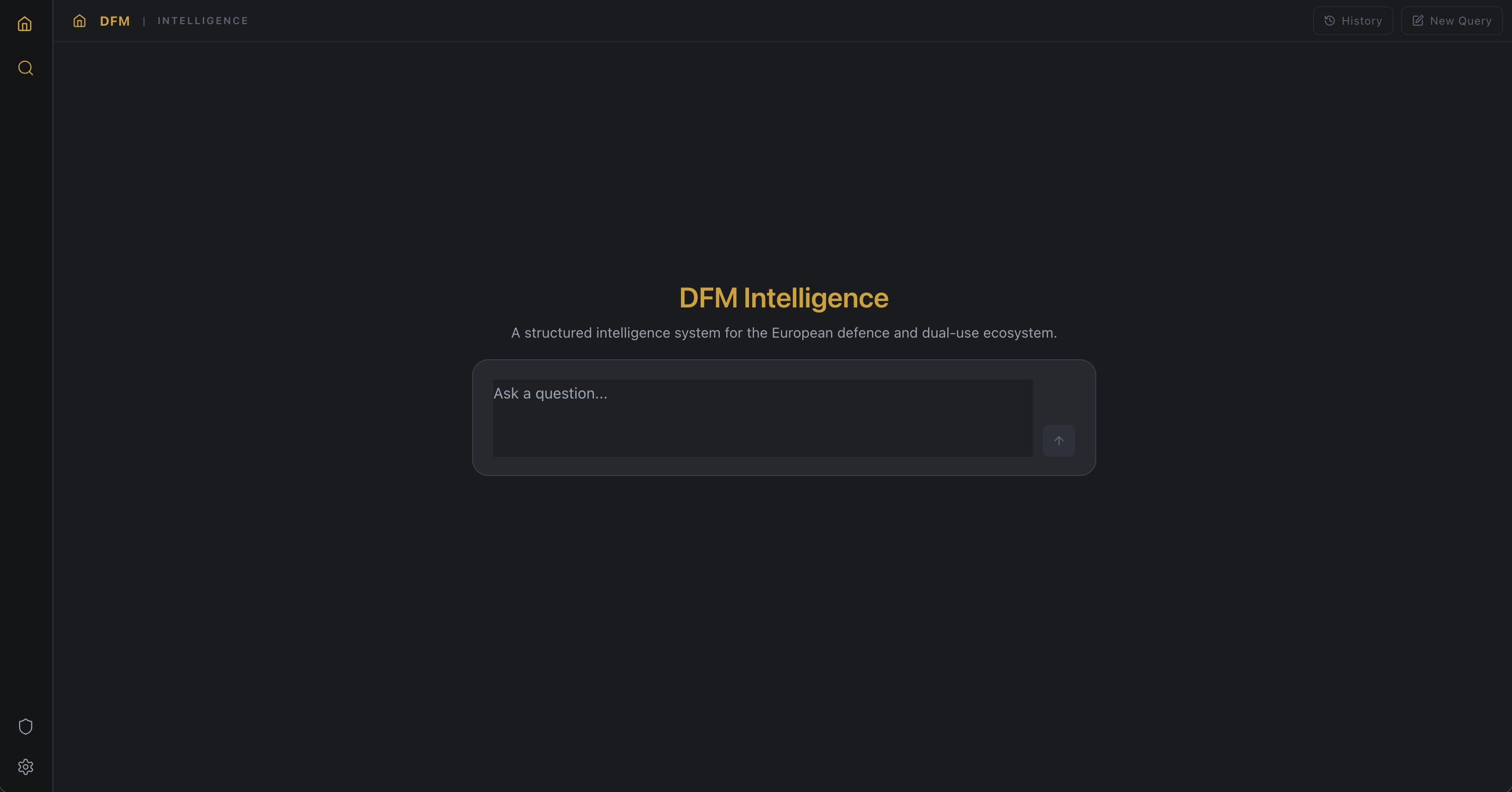
One year after the launch of Defence Finance Monitor, we are introducing DFM Intelligence alongside DFM Analysis.
DFM Analysis remains the editorial and analytical layer of Defence Finance Monitor: in-depth reports, company profiles, regulatory analyses and strategic briefings on the European defence and dual-use ecosystem. DFM Intelligence adds a second layer: a structured intelligence system that allows subscribers to interrogate the data, classifications, documents and relationships behind that analytical work.
DFM Intelligence is a structured intelligence infrastructure for the European defence and dual-use domain. It brings strategic priorities, industrial capability, regulatory instruments, funding programmes, procurement records, ownership structures, export-control signals, patents and market data into one controlled analytical environment.
Its purpose is not to provide generic commentary on the defence market. Its purpose is to make heterogeneous institutional material comparable, retrievable, ranked and traceable.
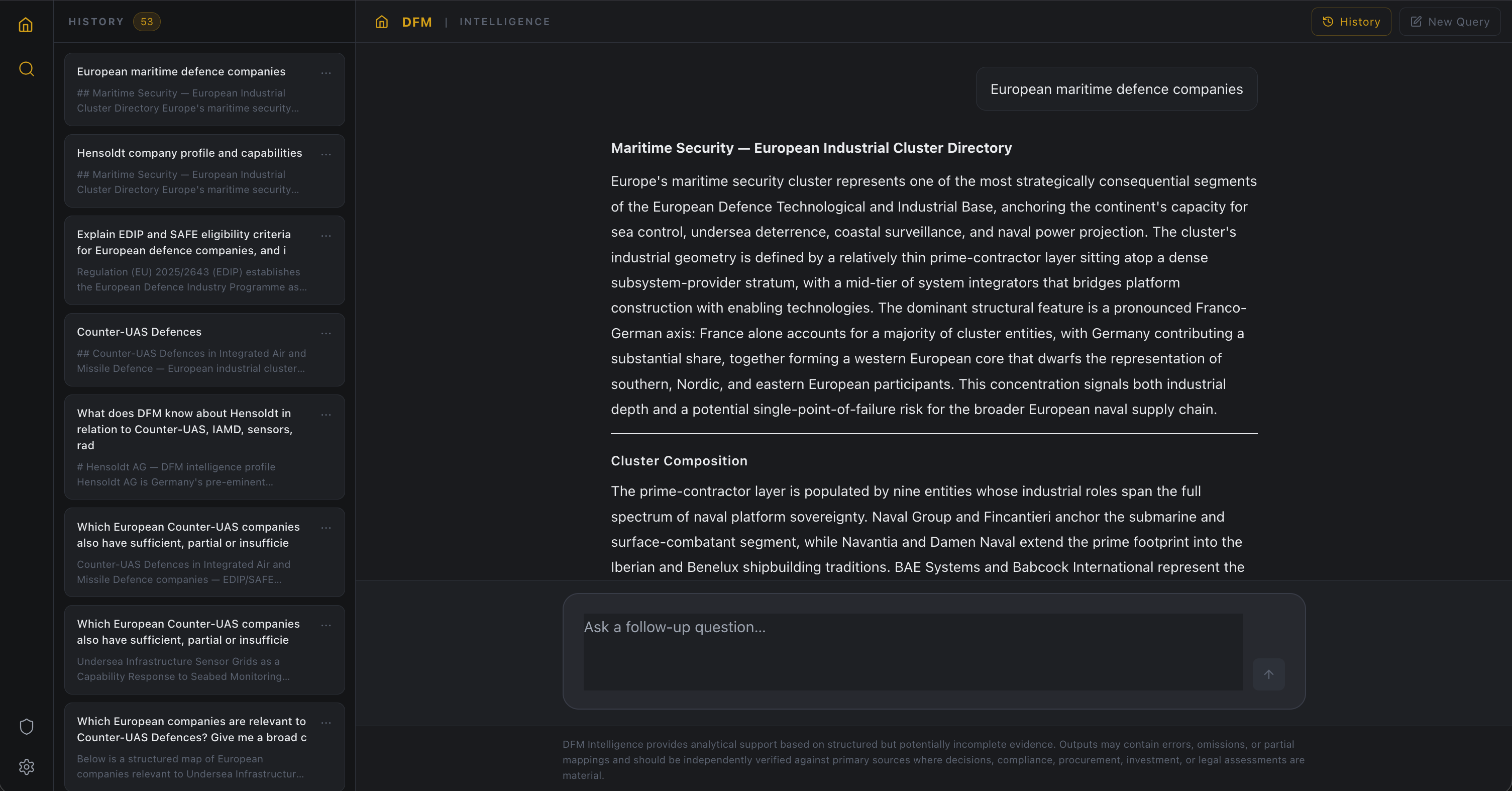
The visible interface is called Live Query. A user submits a structured question in natural language. The system resolves that question against the DFM ontology, retrieves evidence from classified knowledge layers, ranks the relevant entities or documents, and returns a source-grounded response. The access layer is natural language; the system beneath is constrained, domain-specific and source-based.
What distinguishes DFM Intelligence is that the analytical work does not begin at the moment of the query. The relevant material has already been classified, normalised and mapped before any question is asked.
The system is governed by a closed ontology and controlled vocabularies covering Strategic Priorities, Operational Priorities, Tactical Capabilities and technology clusters. No object enters the knowledge base as undifferentiated text. Entities, documents, contracts, technologies, regulations and signals are classified before they reach the analytical layer.
Normative and documentary material is treated in the same way. Regulations, strategic documents, programme guidelines and institutional sources are decomposed into structured units and linked to the entities, capabilities and regulatory conditions they affect. The current system includes 2,246 classified entities, 159,308 structured relations, 1,336 normative documents, 27,440 normative atoms, 26,284 export-control licences and 1,802,619 trade-signal records.
This architecture matters because DFM Intelligence is not a general-purpose language model. A generic LLM generates plausible language from training data. DFM Intelligence retrieves structured evidence from a controlled corpus and presents it through a traceable analytical surface. Every element of a response is intended to be linked to an institutional source: a normative atom, a procurement record, a corporate filing, a strategic document, a trade signal or an entity record. No generic LLM speculation. No invented sources.
The analytical logic of the system follows the core proposition behind Defence Finance Monitor: in European defence and dual-use markets, strategic relevance and regulatory relevance increasingly converge. EU and NATO priorities shape regulatory instruments. Regulatory instruments define eligibility conditions, capability perimeters and funding channels. Those perimeters then influence procurement, industrial cooperation, ownership relevance and capital allocation.
DFM Intelligence is built to observe that translation. It allows users to move from a strategic priority to relevant companies and technologies; from a regulation to eligibility and exposure; from an entity to ownership, programme participation and supply-chain position; from a capability area to the industrial segments that appear well-covered or under-served.
The system is designed for institutional users who need structured answers to precise questions: investors and capital-market professionals assessing exposure to the European defence industrial base; industrial companies identifying capability alignment, partners and eligibility conditions; public institutions observing industrial, technological and financial capacity; legal and compliance professionals working on export control, EDIP, SAFE, EDF and dual-use issues; research organisations aligning technological capabilities with recognised strategic priorities and funding windows.
DFM Intelligence is reserved for annual subscribers to Defence Finance Monitor. Annual subscribers receive access both to DFM Analysis, which includes the reports and analytical publications of Defence Finance Monitor, and to DFM Intelligence, the structured intelligence platform built around Live Query.
The annual subscription can be purchased through the link below or arranged by bank transfer.
For further information about DFM Intelligence, access conditions or payment by bank transfer, please contact: mastrolia@stroncature.com