

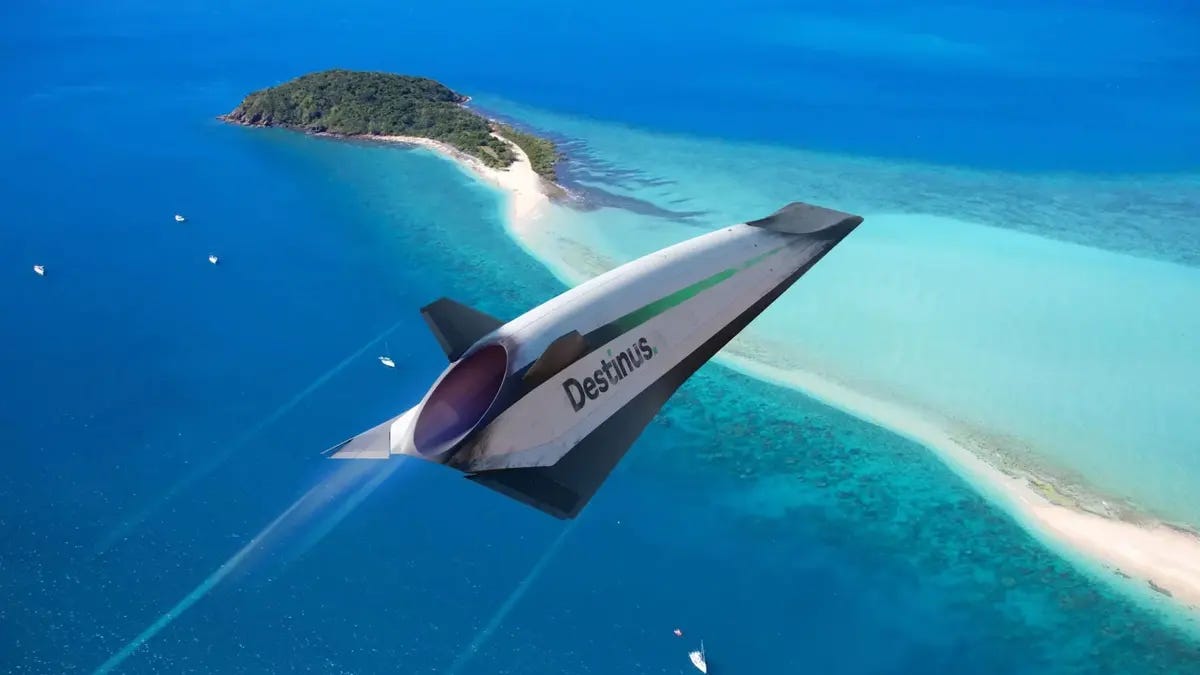
Twenty years after Concorde’s final flight ushered out the first era of supersonic travel, a new European contender is reviving the dream of high-speed aviation. Destinus, a Swiss-founded aerospace start-up, is developing unmanned “hyperplanes” powered by liquid hydrogen fuel – futuristic aircraft aiming to carry passengers from Europe to Australia in a matter of hours. The company’s ambitious vision includes a 400-seat hypersonic airliner capable of reaching any point on the globe within half a day. A direct flight from London to Sydney, for example, could take as little as four hours under Destinus’s 2040s timeline. By marrying rocket-like speeds with clean fuel, Destinus promises a leap in mobility: its planned Mach 5+ cruisers would fly five times faster than today’s jets while emitting only water vapor as exhaust. This bold approach taps into Europe’s twin aspirations of technological innovation and climate-conscious transportation, positioning hydrogen as the key to sustainable hypersonic flight.
But Destinus’s significance extends far beyond luxury travel or cutting transcontinental business trips short. By designing autonomous high-speed aircraft and drones on European soil, the company is cultivating strategic capabilities that could bolster Europe’s defense autonomy. Hypersonic platforms, once the realm of superpower militaries, are now being pursued by this private European venture – a development not lost on policymakers looking to close the gap with U.S., Chinese, and Russian advances in next-generation aerospace. Destinus prototypes have already flown, and the company has established a dedicated hydrogen propulsion test facility in Switzerland. European governments are taking notice: Spain’s science ministry recently backed Destinus with €26.7 million in grants to accelerate hydrogen engine development. Such support underscores the strategic interest in a homegrown hypersonic program. The road ahead is undoubtedly long and technically challenging – developing a viable Mach 5 aircraft requires breakthroughs in propulsion, materials, and control – yet the stakes for Europe are high. If Destinus succeeds, it could deliver not only ultra-fast green air travel, but also a sovereign strategic asset strengthening Europe’s defense posture. This report examines Destinus through a strategic-technological lens, assessing how this emerging company fits into Europe’s quest for greater autonomy, deterrence and resilience in the 21st-century security landscape.