

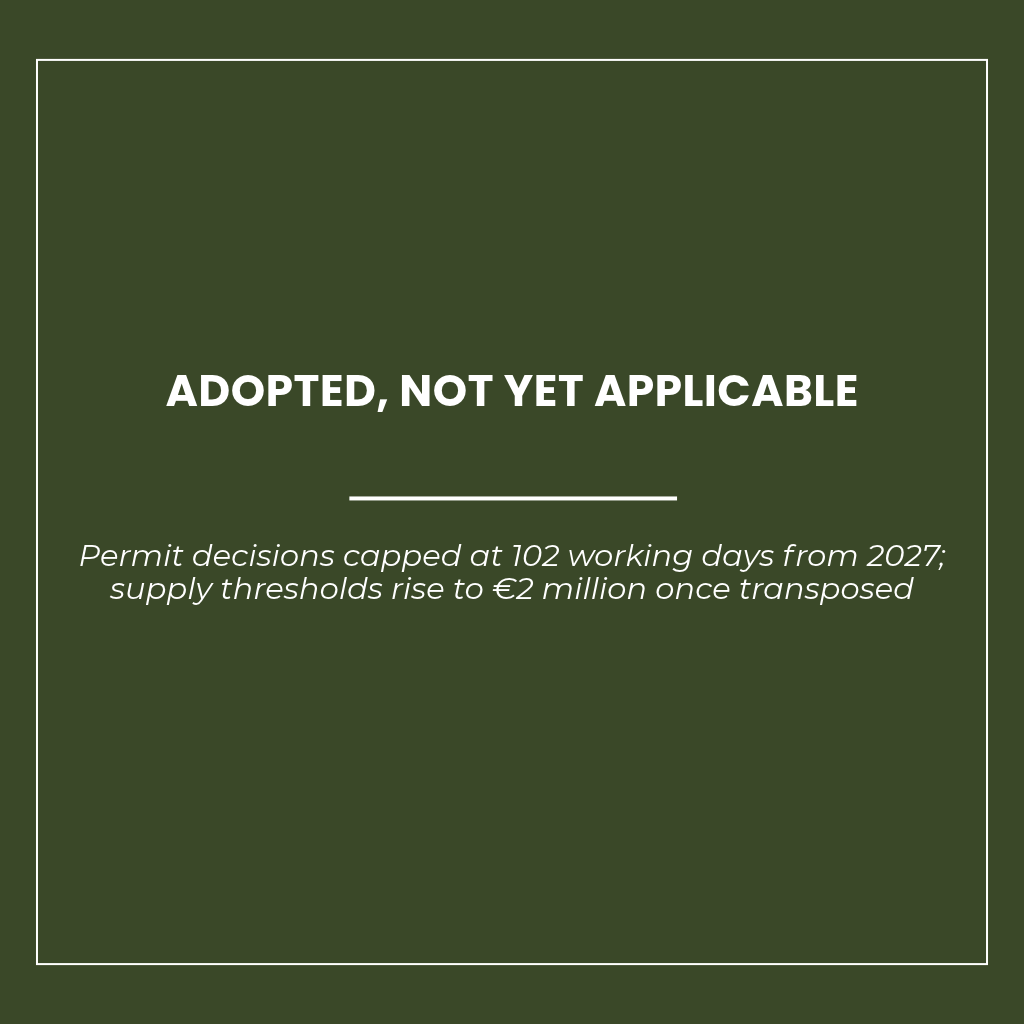
Europe’s defence-industrial problem is no longer defined only by the amount of public money available for rearmament. It also lies in the interval between a military requirement and the moment at which industry can turn finance, engineering work, permits, controlled inputs, cross-border transfers and procurement decisions into qualified output. The Defence Readiness Omnibus, a package of three European Union acts published in the Official Journal in November 2026, addresses several of those intervals at once, but through instruments with different legal effects, different calendars and different national gatekeepers. A regulation on permit-granting, a regulation amending chemicals legislation and the European Defence Fund, and a directive amending the rules on intra-EU transfers and defence procurement do not become usable on the same day, and none of them replaces the national decisions on which industrial investment ultimately depends. The significance of the package therefore cannot be judged by asking whether “the Omnibus” has entered into force as a single policy event. The more demanding question is which legal frictions the enacted texts actually remove, from what date firms and contracting authorities can rely on each new rule, and which steps on the path to usable capacity remain dependent on national law, administrative action, funding conditions, intellectual-property rights, industrial investment and customer orders.
