

Defence Finance Monitor is a specialised source of analysis for professionals who seek to anticipate how strategic priorities shape investment patterns in the defence sector. In a landscape shaped by high-stakes political choices and rapid technological shifts, understanding the link between military doctrine, operational requirements, and industrial policy is not a competitive edge—it is a prerequisite.
We analyse how strategic imperatives set by NATO, the European Union, allied Indo-Pacific democracies, and national Ministries of Defence translate into procurement programmes, innovation roadmaps, and long-term industrial priorities. Rather than listing individual companies, we track how clearly defined strategic challenges—such as deterrence gaps, technological dependencies, or capability shortfalls—are converted into funding schemes and institutional demand. Only companies that respond to these challenges become relevant to institutional buyers and, by extension, to investors. This framework has already enabled a growing community of analysts and financial professionals to make more consistent, risk-aware decisions and to avoid costly misalignments.
Building on this methodology, we are developing a structured database of companies analysed and classified according to the strategic-technological criteria set out in our framework. Subscribing to Defence Finance Monitor therefore provides not only access to in-depth reports, but also to a continuously expanding database of European and allied defence firms assessed against clear benchmarks. Each company is positioned according to its alignment with EU and NATO priority capability areas, its contribution to European strategic autonomy, its level of interoperability and deterrence value, and its role in reducing dependencies on non-allied suppliers. Classification also covers technology readiness levels, participation in EU and NATO programmes, intellectual property assets, and dual-use applications. This allows subscribers to compare, benchmark, and identify the most strategically relevant actors within a coherent, transparent, and decision-oriented taxonomy.
Subscribing to Defence Finance Monitor means gaining access to a strategic intelligence service that connects financial decisions with defence priorities. At the core of our work is a structured database of European and allied defence companies, classified according to strategic-technological criteria such as autonomy, interoperability, deterrence, and supply chain resilience. In today’s environment, profitable investment requires more than market data: it requires understanding how limited public resources are channelled toward specific capability gaps, sovereign technologies, and the reduction of non-allied dependencies. By combining in-depth reports with a continuously expanding company database, Defence Finance Monitor enables investors to anticipate demand, benchmark firms against institutional priorities, and avoid costly misalignments.

European Space Shield (ESS): Extending Europe’s Defence Architecture into Orbit
The European Space Shield (ESS) represents the space-based pillar of Europe’s emerging system of defence and deterrence, conceived under the Defence Readiness Roadmap 2030 as the logical culmination of the Union’s multi-domain integration strategy. Its creation responds to a rapidly evolving threat environment in which the boundaries between earth, air, and orbit have dissolved. The war in Ukraine has made visible the centrality of space to modern warfare — from satellite navigation and encrypted communication to real-time intelligence and targeting support. It has also shown that space infrastructures, once perceived as neutral enablers of civilian progress, are now strategic assets subject to kinetic attacks, cyber intrusions, and electronic interference. The White Paper for European Defence – Readiness 2030 defines the ESS as an initiative to guarantee the continuity and protection of Europe’s critical systems, including Galileo, Copernicus, and IRIS², while strengthening Europe’s capacity to act autonomously in defence, intelligence, and crisis response. By extending deterrence into the orbital domain, the ESS ensures that the stability of Europe’s political and military decision-making no longer depends on external providers or unsecured commercial networks. It transforms space from a service infrastructure into a domain of strategic resilience, establishing the institutional and industrial foundations for Europe’s security in the 21st century.
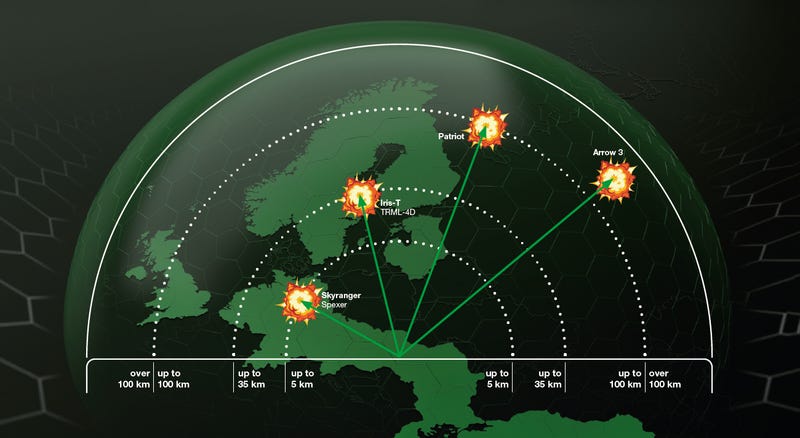
European Air Shield (EAS): Rebuilding Europe’s Multilayered Architecture of Deterrence
The European Air Shield (EAS) was conceived as one of the central pillars of the Defence Readiness Roadmap 2030, emerging from the political and strategic momentum created by the White Paper for European Defence – Readiness 2030. Its creation reflects a profound redefinition of the European Union’s role in collective deterrence, shaped by the lessons of the war in Ukraine and the rapid transformation of the aerial threat landscape. The conflict demonstrated that airspace is now a domain of permanent vulnerability: drones, cruise missiles, and hypersonic weapons can strike deep into national territories with little warning, targeting infrastructure and civilian populations as part of an integrated strategy of coercion. Europe’s historical reliance on external systems for high-end air and missile defence—particularly US-made platforms—has exposed structural dependencies and political risks. The EAS is therefore intended not only as a military initiative but as a strategic assertion of autonomy. It seeks to guarantee that deterrence in the air domain is sustained by European capabilities, produced within Europe’s own industrial ecosystem, and aligned with the long-term objective of achieving full defence readiness by 2030. In this sense, the EAS is both a technological and political response to a new phase of strategic competition in which control of the skies defines the credibility of power on the ground.

Eastern Flank Watch (EFW): Building Europe’s Integrated Frontier of Deterrence
The Eastern Flank Watch (EFW) arises from the institutional and strategic framework established in the Defence Readiness Roadmap 2030 as a direct response to Russia’s sustained aggression and the structural militarisation of Europe’s eastern neighbourhood. It represents the territorial dimension of the European Union’s transformation from a coordination actor into a defence system with tangible operational capacity. Conceived in parallel with the ReArm Europe plan, EFW embodies the shift from reactive assistance to forward deterrence, combining surveillance, infrastructure, and command integration. The White Paper for European Defence – Readiness 2030 describes the eastern border as the decisive frontier of European security, where deterrence must be visible, continuous, and technologically autonomous. The initiative’s rationale is rooted in the need to protect the Union’s territory against hybrid and kinetic threats, ensure freedom of movement for NATO and EU forces, and consolidate Europe’s role as a credible security provider. By fusing defence planning with industrial, infrastructural, and regulatory instruments, EFW symbolises the institutionalisation of European deterrence — transforming the Union’s periphery into a structured operational theatre that links national armed forces, common surveillance networks, and multinational logistics into one interoperable architecture of readiness.