

Defence Finance Monitor is a specialised source of analysis for professionals who seek to anticipate how strategic priorities shape investment patterns in the defence sector. In a landscape shaped by high-stakes political choices and rapid technological shifts, understanding the link between military doctrine, operational requirements, and industrial policy is not a competitive edge—it is a prerequisite.
We analyse how strategic imperatives set by NATO, the European Union, allied Indo-Pacific democracies, and national Ministries of Defence translate into procurement programmes, innovation roadmaps, and long-term industrial priorities. Rather than listing individual companies, we track how clearly defined strategic challenges—such as deterrence gaps, technological dependencies, or capability shortfalls—are converted into funding schemes and institutional demand. Only companies that respond to these challenges become relevant to institutional buyers and, by extension, to investors. This framework has already enabled a growing community of analysts and financial professionals to make more consistent, risk-aware decisions and to avoid costly misalignments.
Building on this methodology, we are developing a structured database of companies analysed and classified according to the strategic-technological criteria set out in our framework. Subscribing to Defence Finance Monitor therefore provides not only access to in-depth reports, but also to a continuously expanding database of European and allied defence firms assessed against clear benchmarks. Each company is positioned according to its alignment with EU and NATO priority capability areas, its contribution to European strategic autonomy, its level of interoperability and deterrence value, and its role in reducing dependencies on non-allied suppliers. Classification also covers technology readiness levels, participation in EU and NATO programmes, intellectual property assets, and dual-use applications. This allows subscribers to compare, benchmark, and identify the most strategically relevant actors within a coherent, transparent, and decision-oriented taxonomy.
Subscribing to Defence Finance Monitor means gaining access to a strategic intelligence service that connects financial decisions with defence priorities. At the core of our work is a structured database of European and allied defence companies, classified according to strategic-technological criteria such as autonomy, interoperability, deterrence, and supply chain resilience. In today’s environment, profitable investment requires more than market data: it requires understanding how limited public resources are channelled toward specific capability gaps, sovereign technologies, and the reduction of non-allied dependencies. By combining in-depth reports with a continuously expanding company database, Defence Finance Monitor enables investors to anticipate demand, benchmark firms against institutional priorities, and avoid costly misalignments.

Strategic Manufacturing: How the Control of Defence Supply Chains Redefines Power in the Twenty-First Century
The war in Ukraine has accelerated a structural transformation in the logic of power, revealing that military capability now depends as much on industrial resilience as on tactical or technological sophistication. The conflict has demonstrated that superiority on the battlefield cannot be separated from the integrity and responsiveness of the underlying production chains that sustain it. At the same time, the growing rivalry between the United States and China has turned supply chains into a strategic frontier, where control over semiconductors, critical materials, and dual-use technologies determines the balance of power. Economic security has thus become inseparable from national security: it is no longer a question of who invents first, but who can produce continuously and independently. As supply chains become arenas of geopolitical competition, the global economy is fragmenting into competing industrial blocs, each seeking to reduce dependencies and reinforce domestic capacity. This re-industrialisation of security, triggered by war and rivalry, is redefining deterrence itself, translating strategic stability into the language of production, logistics, and technological sovereignty.
Company Profiles & Industrial Intelligence
Bohemia Interactive Simulations (BISim) – Strategic-Technological Analysis
Bohemia Interactive Simulations (BISim) is a specialized software developer delivering high-fidelity training and simulation environments for defense and civilian organizations. Founded in 2001 and now a wholly-owned subsidiary of BAE Systems Inc., BISim builds on game-engine technology to create virtual battlefields where land, air, maritime and space scenarios can be rehearsed. Its flagship suite (Virtual Battlespace/VBS and related image-generation and terrain tools) is widely used by Western militaries: more than 60 NATO and partner nations leverage BISim’s products to train hundreds of thousands of soldiers annually. This analysis examines BISim’s strategic-technological profile through the lens of European defense objectives: training sovereignty, interoperability, deterrence and resilience. BISim’s virtual training tools contribute to allied readiness and decision advantage, and the company has recently moved to deepen ties with European primes (e.g. Rheinmetall) and advanced visualization partners (Varjo, blackshark.ai).
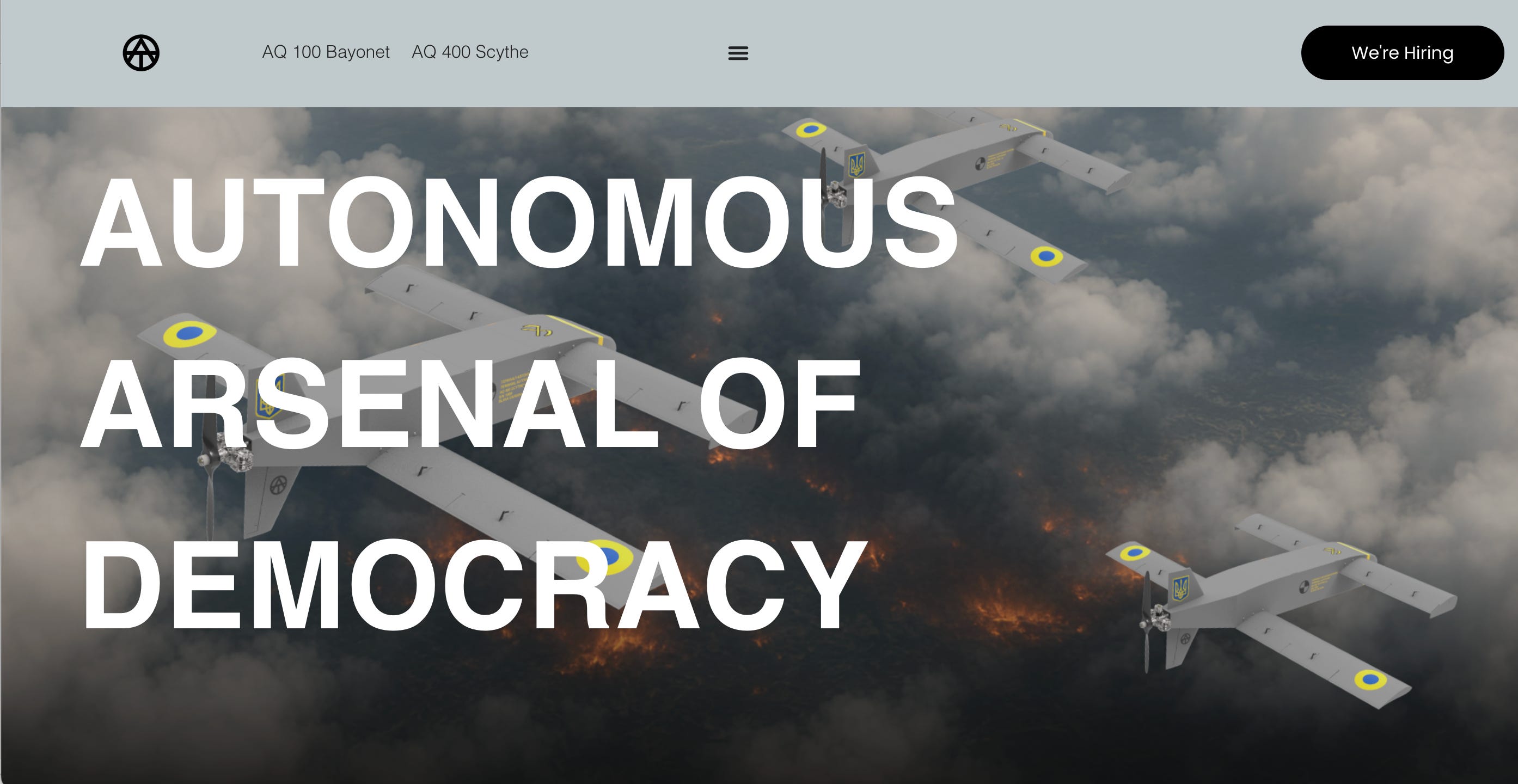
Terminal Autonomy: Strategic-Technological Analysis
Terminal Autonomy Inc. is a young deep‐tech start-up specializing in low-cost, autonomous unmanned aerial systems for precision strike. It was founded in 2022 by a team of defense veterans and technologists to meet urgent battlefield needs in Ukraine. The company’s mission — “to change how democracies defend themselves” — reflects its goal of mass-producing disposable loitering munitions and strike drones using simple materials and AI for guidance. Headquartered in Menlo Park, California[2], Terminal Autonomy operates design and control centers in the U.S. and leverages manufacturing capacity in Ukraine. Although not a European company by domicile, it has quickly integrated into the Western defense ecosystem through partnerships with NATO allies and U.S. programs. Its latest product, the AQ-400 Scythe, is in service with Ukraine and exemplifies the firm’s approach: a long-range, one-way “kamikaze” drone with a ~900 km range, 42–43 kg warhead, and autonomous navigation able to cope with GPS jamming. This analysis examines Terminal Autonomy’s role relative to European strategic autonomy goals, NATO interoperability, deterrence capability, transatlantic alignment, and supply-chain resilience.

Dedrone – Strategic & Technological Analysis for European Defense
In an era where small, inexpensive drones can threaten critical assets, Dedrone’s advanced counter-UAS systems illustrate the evolving landscape of airspace security. Founded in Germany and now operating globally under U.S. ownership, Dedrone combines AI-driven sensor networks with electronic warfare to detect and mitigate drone incursions. Its platforms—ranging from fixed-site radars and cameras to portable jammers and cloud-based C2 software—address threats from hobbyist hobby-quads to weaponized UAVs. European policymakers view counter-drone capability as a pressing priority: the EU’s recent Strategic Compass and the defence “Re-Arm” agenda explicitly highlight unmanned systems and C‑UAS as areas needing urgent investment. Dedrone’s footprint in Europe (including deployments on a German Army Puma IFV and at major airports) makes it a company of high interest. This analysis examines Dedrone’s organization, technologies, and strategic role in reducing reliance on non-allied suppliers and enhancing NATO interoperability, providing European defense planners with a data-driven view of its contributions and constraints.

Viasat, Inc. (USA): Strategic-Technological Analysis for European Defense Autonomy
Viasat, Inc. is a global communications company (Nasdaq: VSAT) founded in 1986 in Carlsbad, California[1][2]. As a publicly traded mid-cap corporation, Viasat has grown into a leading provider of high-speed satellite broadband and secure networking solutions for both commercial and military markets. Its mission is to connect “everyone and everything in the world” through an integrated space-terrestrial network[2]. While headquartered in the USA, Viasat now operates worldwide (with offices in 24 countries[2], including a growing R&D presence in Europe[3]) and serves as a critical enabler of coalition communications. The company’s activities range from high-capacity GEO and LEO satellites to tactical data links and advanced encryption. Under the lens of European strategic autonomy and allied deterrence, Viasat’s technologies promise new capabilities for Europe’s defense networks – but also raise questions about supply-chain sovereignty and transatlantic alignment. This analysis examines Viasat’s strategic-technical profile relative to EU and NATO priorities in connectivity, interoperability, and resilience, highlighting where its contributions can bolster Europe’s defense-industrial base and where gaps remain.