

Defence Finance Monitor is a specialised source of analysis for professionals who seek to anticipate how strategic priorities shape investment patterns in the defence sector. In a landscape shaped by high-stakes political choices and rapid technological shifts, understanding the link between military doctrine, operational requirements, and industrial policy is not a competitive edge—it is a prerequisite.
We analyse how strategic imperatives set by NATO, the European Union, allied Indo-Pacific democracies, and national Ministries of Defence translate into procurement programmes, innovation roadmaps, and long-term industrial priorities. Rather than listing individual companies, we track how clearly defined strategic challenges—such as deterrence gaps, technological dependencies, or capability shortfalls—are converted into funding schemes and institutional demand. Only companies that respond to these challenges become relevant to institutional buyers and, by extension, to investors. This framework has already enabled a growing community of analysts and financial professionals to make more consistent, risk-aware decisions and to avoid costly misalignments.
Subscribing to Defence Finance Monitor means gaining access to a strategic intelligence service designed to support financial decisions in the defence sector. Our work is based on a clear method and principle: In today’s environment, there is no profitable investment without strategic understanding. Resources are limited. Knowing where public money is going—and why—makes the difference between reacting to the market and making informed decisions ahead of time.

Militarization of Space: Technologies, Key Players, and Investment Landscape
The militarization of space has become a top strategic priority for NATO allies and partners. Space-based capabilities are now essential to defense and deterrence, underpinning activities from precision navigation and timing to intelligence gathering and secure communications. At the same time, the space domain is increasingly contested and congested, with adversaries developing counterspace weapons and proliferating dual-use satellites. In response, allied governments – including the United States, Canada, and European nations – have defined new strategies to protect their space assets and leverage commercial innovation. NATO, for example, officially recognized space as an operational domain and is improving space domain awareness and information-sharing across the alliance. The European Union likewise launched its first-ever Space Strategy for Security and Defence in 2023, emphasizing resilience of satellites, autonomous access to space, and development of dual-use capabilities. Across these policies, there is a common thrust to maximize use of commercial space tech while securing space systems. As one NATO official summarized, “space technology is essential to the alliance’s deterrence and defense” – enabling navigation, force tracking, communications, missile launch detection, and more.
Hanwha Ocean Targets Canadian Submarine Deal with New Overseas Office
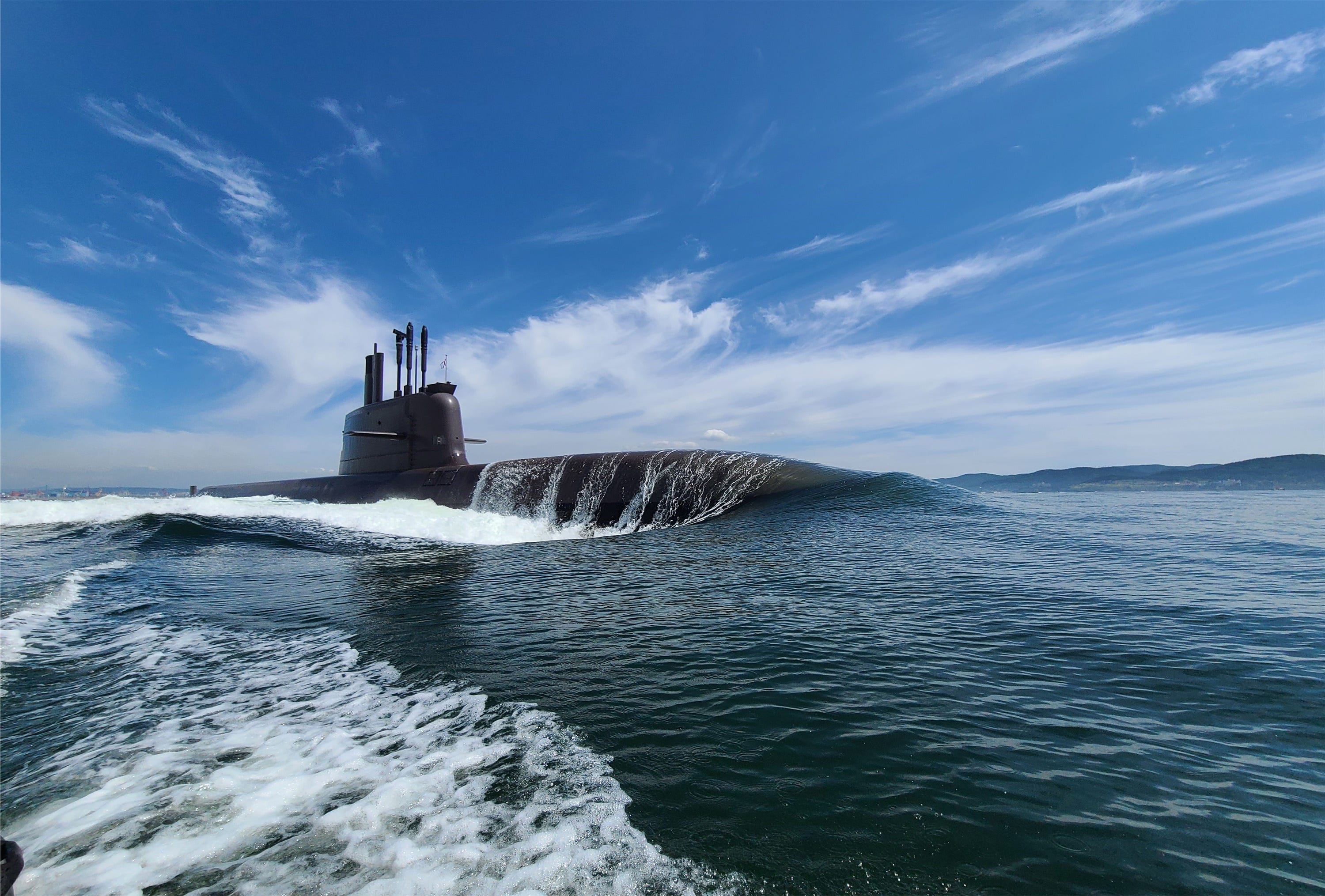
South Korean shipbuilder Hanwha Ocean has announced plans to open a new office in Canada as part of its strategic expansion into the North American defense sector. The decision, approved by the board on June 23, reflects the company’s ambition to position itself as a serious contender for the Canadian Patrol Submarine Project (CPSP). Once operational, the Canadian branch will become the seventh international office operated by Hanwha Ocean, joining existing locations in the United States, Japan, Singapore, and Norway. The move signals an intensification of Hanwha’s efforts to win high-profile naval contracts in advanced markets.
Airbus and Kratos Partner to Supply Combat Drones to German Air Force by 2029

Airbus and U.S.-based Kratos Defense have announced a strategic transatlantic partnership aimed at delivering collaborative combat drones to the German Air Force by 2029. The programme will be centred on Kratos’ XQ-58A Valkyrie, an unmanned aircraft system designed for high-risk and high-intensity missions. The drones will be equipped with mission systems developed by Airbus, marking a significant milestone in the integration of European command architectures with advanced American airframe platforms. The deal confirms Germany's intention to modernise its aerial combat capabilities through unmanned, cost-effective, and attritable systems.
AI at War: Google, OpenAI, Anthropic, and xAI Secure $200M DoD Contracts to Reshape U.S. Defense Capabilities

In mid-July 2025, the U.S. Department of Defense’s Chief Digital and Artificial Intelligence Office (CDAO) awarded four major contracts to leading commercial AI firms—Google, OpenAI, Anthropic, and xAI—marking a decisive shift toward the large-scale integration of frontier AI technologies across military, intelligence, and enterprise systems. Google Public Sector alone secured a contract worth up to $200 million, which will grant the DoD access to its secure AI cloud infrastructure, including Tensor Processing Units (TPUs) and the full CONUS-based AI framework¹. The partnership aims to accelerate the adoption of agentic AI and large-scale analytics to support warfighting, logistics, and strategic planning functions.
Europe's Tactical Innovation Surge: EUDIS Hackathon Spring Edition Finalists Announced

The Spring 2025 edition of the EU Defence Innovation Scheme (EUDIS) Hackathon concluded with the announcement of eight winning teams and three overall finalists whose battlefield-ready technologies could soon bolster both Ukrainian and European defence capabilities. Held simultaneously across eight EU countries—Poland, Lithuania, Latvia, Germany, Denmark, Czechia, Spain, and Italy—from 9 to 11 May 2025, the event gathered 478 participants who developed 119 defence-focused prototypes in just three days. For the first time, Ukrainian innovators joined their European counterparts, marking a new phase of operational and technological cooperation between Ukraine and the European Union.