

Defence Finance Monitor is a specialised analysis and intelligence platform focused on the nexus between European defence policy, strategic industries, and public investment. Each issue provides in-depth, carefully considered assessments designed to offer maximum strategic insight to subscribers.
Far from superficial or rapid commentary, DFM delivers structured and rigorous analysis based on primary sources, official documents, and sectoral data. The aim is to support professionals—investors, policymakers, industry leaders, and analysts—with the depth and clarity needed to understand how defence funding and procurement decisions are reshaping markets, capabilities, and geopolitical balances in Europe and beyond.

NATO’s Role in Advancing Emerging Technologies: DIANA and the NATO Innovation Fund
NATO has increasingly recognized that maintaining its strategic edge in an era of great‐power competition requires harnessing advances in emerging and disruptive technologies. Alliance leaders and analysts emphasize that technologies such as artificial intelligence, autonomy, quantum computing and biotechnology promise to reshape warfare and power projection. In response, NATO has set up new innovation instruments to bring civilian innovation into the defence sphere. One senior NATO official described these efforts as creating an “innovation engine” to keep pace with adversaries’ technological advances. The Defence Innovation Accelerator for the North Atlantic (DIANA) and the NATO Innovation Fund (NIF) are the Alliance’s flagship initiatives for dual‐use technology. Both are explicitly aimed at bridging the gap between commercial deep tech and military needs, leveraging civilian R&D to enhance deterrence and defence. These measures align with NATO’s 2022 Strategic Concept and subsequent policy work, which underscored the need for an “innovation accelerator” as an opt‐in, nationally funded instrument to incentivize transatlantic cooperation on emerging technologies. The creation of DIANA and the NIF thus reflects a concerted effort by Allies to strengthen collective innovation capacity, ensuring that Europe and North America can develop shared platforms and interoperability in fields where rivals like China and Russia are aggressively investing.
European Semiconductor Sector: Institutional Context and Value‑Chain Control
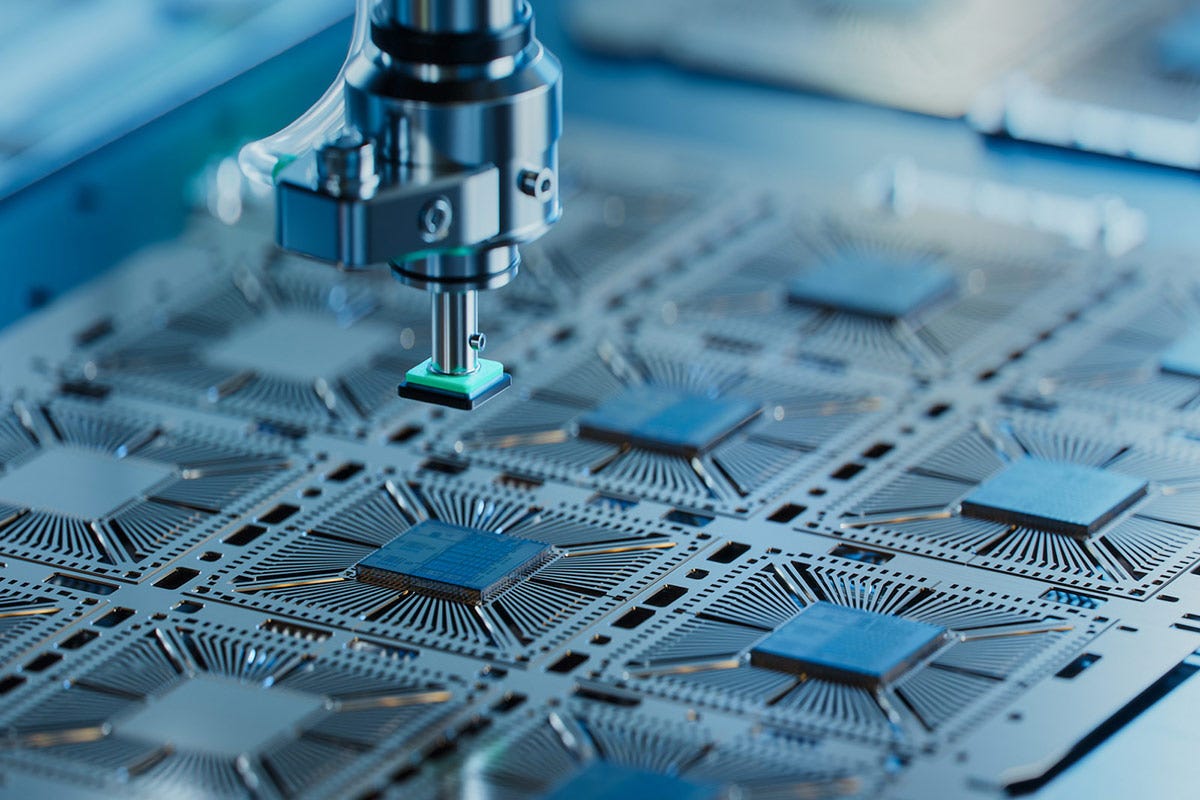
The European Union now treats semiconductors as critical to economic and security policy. In 2020 the world produced roughly 1 trillion chips, but EU firms accounted for only about 10 % of global production. EU policymakers responded with the European Chips Act (Sept. 2023) to mobilize some €43 billion and other support measures by 2030. The Act explicitly aims to reverse decades of decline in EU chip capacity, target a 20 % global market share by 2030 (up from ≈10 % today), and bolster EU research, design and fabrication. The Chips Act’s advocates note it marks a “major policy shift” by allowing subsidies to strengthen supply‑chain security and technological sovereignty in an industry long dominated by US and East Asian companies. In this context of heightened strategic awareness (driven by recent shortages, geopolitical rivalry, and Europe’s heavy import dependence), it is essential to examine which actors control the EU semiconductor ecosystem across R&D, chip design, manufacturing and materials.

Quantum Enablers for Strategic Advantage (QUEST) – Corporate Participation
On 27 May 2025, the Council of the European Union approved the launch of the sixth wave of projects under the Permanent Structured Cooperation (PESCO), the EU’s primary framework for collaborative defence capability development. With the addition of 11 new initiatives, the total number of PESCO projects rises to 75, marking a continued commitment by Member States to strengthen Europe’s defence readiness. This wave reflects strategic guidance adopted by the European Council in March 2025 and addresses pressing capability gaps. The new projects span multiple domains, including land, maritime, air, and cutting-edge technologies such as directed energy weapons and quantum systems. Among them is the project “Quantum Enablers for Strategic Advantage” (QUEST), focused on the integration of quantum technologies into European defence infrastructures. These efforts reinforce interoperability, investment coordination, and the EU’s strategic autonomy, while supporting the European Defence Technological and Industrial Base.