


Defence Finance Monitor applies a top–down method that traces how NATO, EU and allied strategic priorities are translated into regulations, funding lines and procurement programmes, and then into demand for specific capabilities, technologies and companies. We use official doctrine as the organising frame to identify where strategic relevance is being institutionally defined and where it is materialising in concrete budgets, acquisition pathways and industrial capacity.
Our working assumption is that what becomes structurally relevant in NATO/EU strategy tends, over time, to become relevant also from a financial and industrial point of view. In the European context, this includes the progressive operationalisation of strategic autonomy: the effort to reduce critical dependencies, secure supply chains, strengthen the European defence technological and industrial base, and align regulatory, financial and procurement instruments with long-term security objectives. On this basis, DFM operates as a decision-support tool: it benchmarks investment and industrial choices against institutional demand, clarifies which capabilities are rising on the spending agenda, and maps the funding instruments, eligibility constraints and supply-chain factors that shape real-world feasibility across investors, industry, public authorities and research organisations.
Defence Finance Monitor rests on a single analytical premise: within the Euro-Atlantic security architecture, strategic doctrine precedes regulation and capability planning, regulation precedes budgets, and budgets shape markets.
US Strategy · Alliance Architecture
The Storm That Won’t Pass
A reassuring conviction circulates in Europe’s chancelleries: the real problem is one administration, and once the storm passes things return to what they were. This report shows why that is the most dangerous of illusions. The American disengagement from Europe is not a presidential temper but a fifteen-year structural reorientation, codified across four consecutive administrations — from Obama’s 2012 Defense Strategic Guidance through the 2017 NSS and 2018 NDS to the 2025 NSS and the January 2026 NDS, which downgrades Russia to a “manageable” threat, makes Ukraine Europe’s responsibility, and redirects American forces to the homeland and the Indo-Pacific. What is being revoked is not a policy but a bargain. The analysis reads the founding strategy documents of both parties to demonstrate that the disengagement is architecture rather than mood — and why waiting for the past to return is the one course that guarantees Europe ends as an object of the history to come, not a subject of it.
The full analysis is reserved for DFM paid subscribers.
Energy Security · Industrial Autonomy
Energy Security, Grids and Electrification
Strategic autonomy is debated through defence budgets, semiconductors, batteries and AI compute. That framing misses the deeper constraint, which is electrical: none of those sectors scales unless electricity is physically deliverable, at the right voltage, at acceptable cost, and with resilience against congestion and cyber-physical failure. Grids have become the binding constraint on European reindustrialisation. The scale is unforgiving — 40% of EU distribution grids are more than 40 years old, roughly €584 billion of network investment is needed by 2030, and large power transformers now take up to four years to secure, while HVDC converter supply concentrates in a handful of qualified manufacturers. This report treats grids as a defence-finance question, mapping eight company categories where strategic demand meets physical constraint and identifying the choke points — converters, transformers, cables, electrical steel, connection queues — that will decide whether Europe’s industrial ambitions are buildable or merely declared.
The complete company map is available to DFM subscribers.
Energy Security · Strategic Baseload
Nuclear, SMRs and Strategic Baseload Power
Data centres, AI infrastructure, defence production, hydrogen, chemicals and steel all require the same thing: large volumes of reliable, low-carbon, price-secure power. Nuclear sits at the centre of that question, but the debate routinely collapses distinct assets into one word. This report keeps them separate. It shows that the cheapest strategic megawatt for Europe over the next decade is usually the one already on the grid — nuclear supplied 23.3% of EU electricity in 2024, and lifetime extension costs a fraction of new large-scale build — while SMRs are a medium-term industrial option rather than a single bankable product class, with first European units realistically targeted for the early 2030s and a HALEU fuel bottleneck that many advanced-reactor business cases quietly assume away. The analysis distinguishes lifetime extension, large reactors, SMRs, AMRs and microreactors, separates regulatory progress from investable certainty, and maps the four company groups and fuel-cycle choke points where real pricing power lies.
The full report — and the choke points to watch — is reserved for DFM paid subscribers.
Energy Resilience · Strategic Storage
Batteries, Storage and Electric Mobility
Batteries are no longer a component of the EV transition. They have become strategic storage infrastructure, linking automotive competitiveness, grid stability, critical raw materials, data-centre resilience and deployable defence energy inside a single chain. Europe’s exposure is structural: it holds a large downstream demand base but a weak materials base, against a China that controls roughly 90% of graphite mining, around 85% of cell manufacturing and some 98% of anode active-material capacity. Northvolt’s March 2025 bankruptcy reset the financing assumptions for every European challenger, forcing a hard separation between announced capacity and operational credibility. Meanwhile the Batteries Regulation turns the battery passport, carbon-footprint and recycled-content rules from compliance overhead into strategic infrastructure. This report maps the investability archetypes — upstream materials, cells, recycling, passport and data, grid and defence-energy suppliers — and the signals, from funding awards to gigafactory status changes to CRMA designations, that separate strategic relevance from political prominence.
The complete monitoring architecture is available to DFM subscribers.
DFM Intelligence · Platform Capability
From Weeks of Research to a Single Query
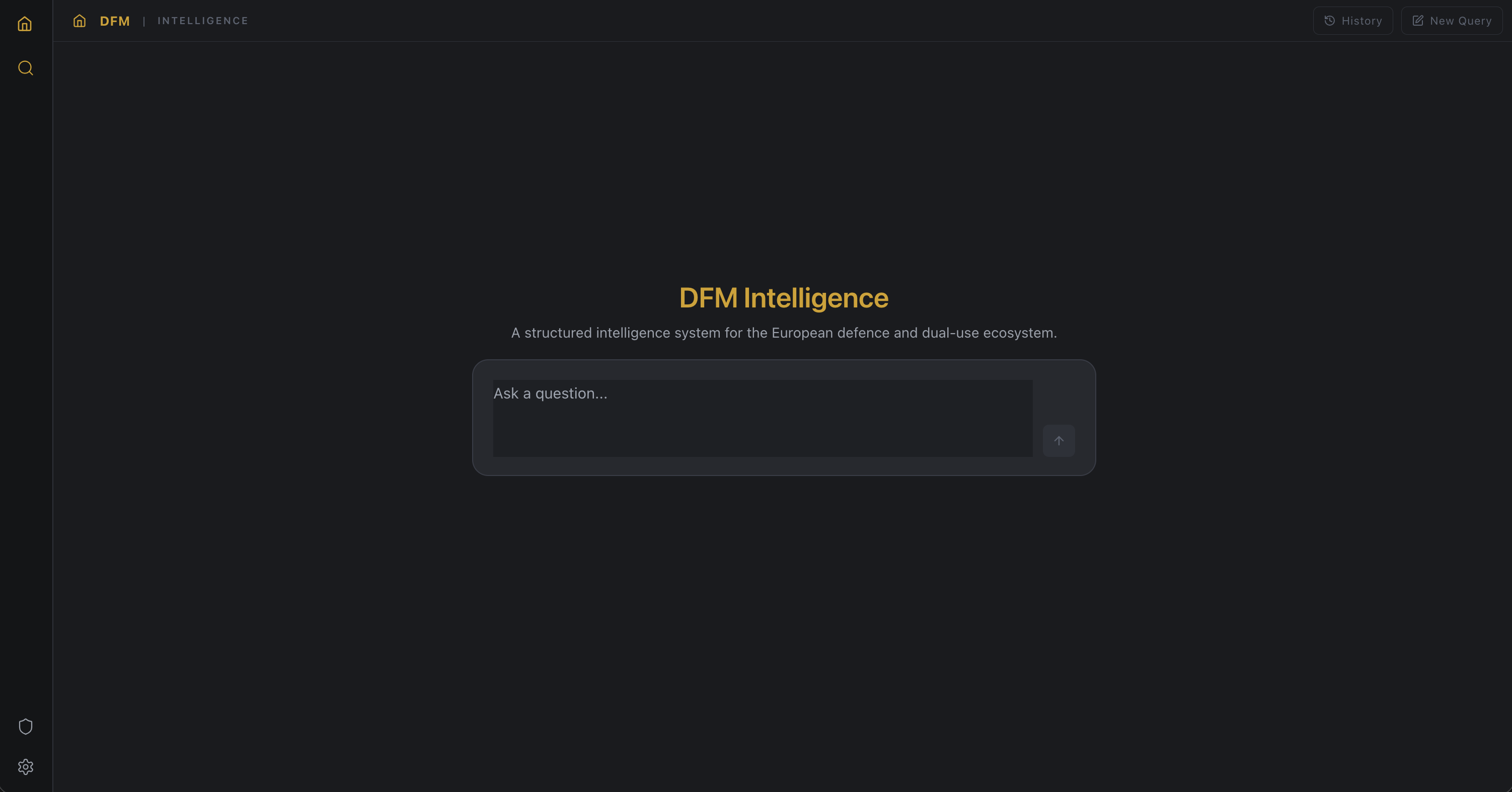
Defence Finance Monitor is an intelligence platform for the European defence-industrial base. It runs on a verified database of more than 2,000 European defence and dual-use enterprises, each mapped against the strategic priorities defined by EU and NATO policy, and maintained as the perimeter evolves through procurement awards, ownership changes, regulatory notifications and programme participation.
Work that has traditionally taken weeks of analyst effort is resolved in a single structured query: identifying the Tier-2 and Tier-3 suppliers behind a prime contractor, determining which firms are exposed to EDIP origin rules or Golden Power notifications, reconstructing contract awards under EDF, EDIRPA and ASAP, tracing the ownership chain behind a strategic asset. Every statement carries a stated confidence level and a citation to the official institutional source it rests on. Where a fact cannot be verified against source, it is marked as such rather than asserted.
The platform also opens a second analytical surface: the full corpus of analysis and publications produced by Defence Finance Monitor over the past year. Sector reports, regulatory readings, deep-research dossiers on industrial inversion and joint-venture architectures, weekly mappings of normative, industrial, financial and technological developments, thematic analyses on SAFE, EDIP, EDF and the Ukraine Support Loan, country dossiers and capability assessments — all are normalised against the same closed ontology that governs the entity layer. The same natural-language query that retrieves a supplier list also retrieves every internal analytical position taken on a given priority code, capability area, regulatory instrument or strategic document, with full source traceability. Institutional users no longer navigate a year of editorial output by date or title; they interrogate it as a structured analytical layer, cross-referenced with the entity, normative and procurement data of the underlying database.
For a law firm, a corporate-development team, a sovereign fund or a procurement office, the consequence is direct: institutional research that once defined the cost and timing of a deliverable now defines where the analysis begins.
DFM Intelligence is reserved for subscribers to the DFM annual programme.
For further information about DFM Intelligence, access conditions or payment by bank transfer, please contact: mastrolia@stroncature.com