


Defence Finance Monitor applies a top–down method that traces how NATO, EU and allied strategic priorities are translated into regulations, funding lines and procurement programmes, and then into demand for specific capabilities, technologies and companies. We use official doctrine as the organising frame to identify where strategic relevance is being institutionally defined and where it is materialising in concrete budgets, acquisition pathways and industrial capacity.
Our working assumption is that what becomes structurally relevant in NATO/EU strategy tends, over time, to become relevant also from a financial and industrial point of view. In the European context, this includes the progressive operationalisation of strategic autonomy: the effort to reduce critical dependencies, secure supply chains, strengthen the European defence technological and industrial base, and align regulatory, financial and procurement instruments with long-term security objectives. On this basis, DFM operates as a decision-support tool: it benchmarks investment and industrial choices against institutional demand, clarifies which capabilities are rising on the spending agenda, and maps the funding instruments, eligibility constraints and supply-chain factors that shape real-world feasibility across investors, industry, public authorities and research organisations.
Defence Finance Monitor rests on a single analytical premise: within the Euro-Atlantic security architecture, strategic doctrine precedes regulation and capability planning, regulation precedes budgets, and budgets shape markets.
Ammunition, Missiles and Air Defence
Europe’s defence budgets have risen sharply, but higher spending is budget authority, not delivered mass — and the gap between the two is where readiness is actually decided. This report tests that conversion in the categories that consume fastest in crisis and take longest to replenish: artillery rounds, interceptors, missile stocks. It works from the real bottlenecks the ASAP implementation report identified — energetic nitrocellulose, explosives, filling and finishing, missile motors, seekers, radars — rather than headline capacity claims, distinguishing nominal from deliverable output throughout, and maps where the scarcest and most investable industrial layers sit, from the energetic-materials base to the integrated firing chain.
The full report is reserved for paid subscribers.
From Naval Orders to Cash Flow
Europe’s naval cycle is producing record order books and renewed investor attention, but a large sovereign backlog is not the same thing as revenue, margin or free cash flow — and the two are routinely confused. This report treats naval backlog as a financial object rather than a political signal, separating announcements, selections and framework intent from signed, funded, cash-convertible contracts. It runs the company universe — TKMS, Fincantieri, Naval Group, BAE, Saab, Navantia, Kongsberg and the systems suppliers — through six filters of contract status, phasing, margin quality, cash conversion, capital intensity and ownership, and draws the line between backlog that is strategically important and backlog that is financially investible.
The full report is reserved for paid subscribers.
Military Mobility and Continental Logistics
Europe can raise spending, expand forces and adopt new defence plans, but none of it is credible if forces, armour, ammunition and fuel cannot move across the continent at speed under crisis conditions — and the problem is not a lack of transport, but the gap between a dense civilian network and a militarily usable one. This report examines that gap as an industrial and financial pillar: the bridge that cannot take a 130-tonne load, the corridor without the axle load or train paths, the port without the berth. It separates binding law from the pending Military Mobility Regulation, works through the physical and administrative bottlenecks, and maps the distributed value chain — infrastructure, rail, ports, fuel logistics, digital permitting — where readiness spending will actually land.
The full report is reserved for paid subscribers.
DFM Intelligence · Platform Capability
From Weeks of Research to a Single Query
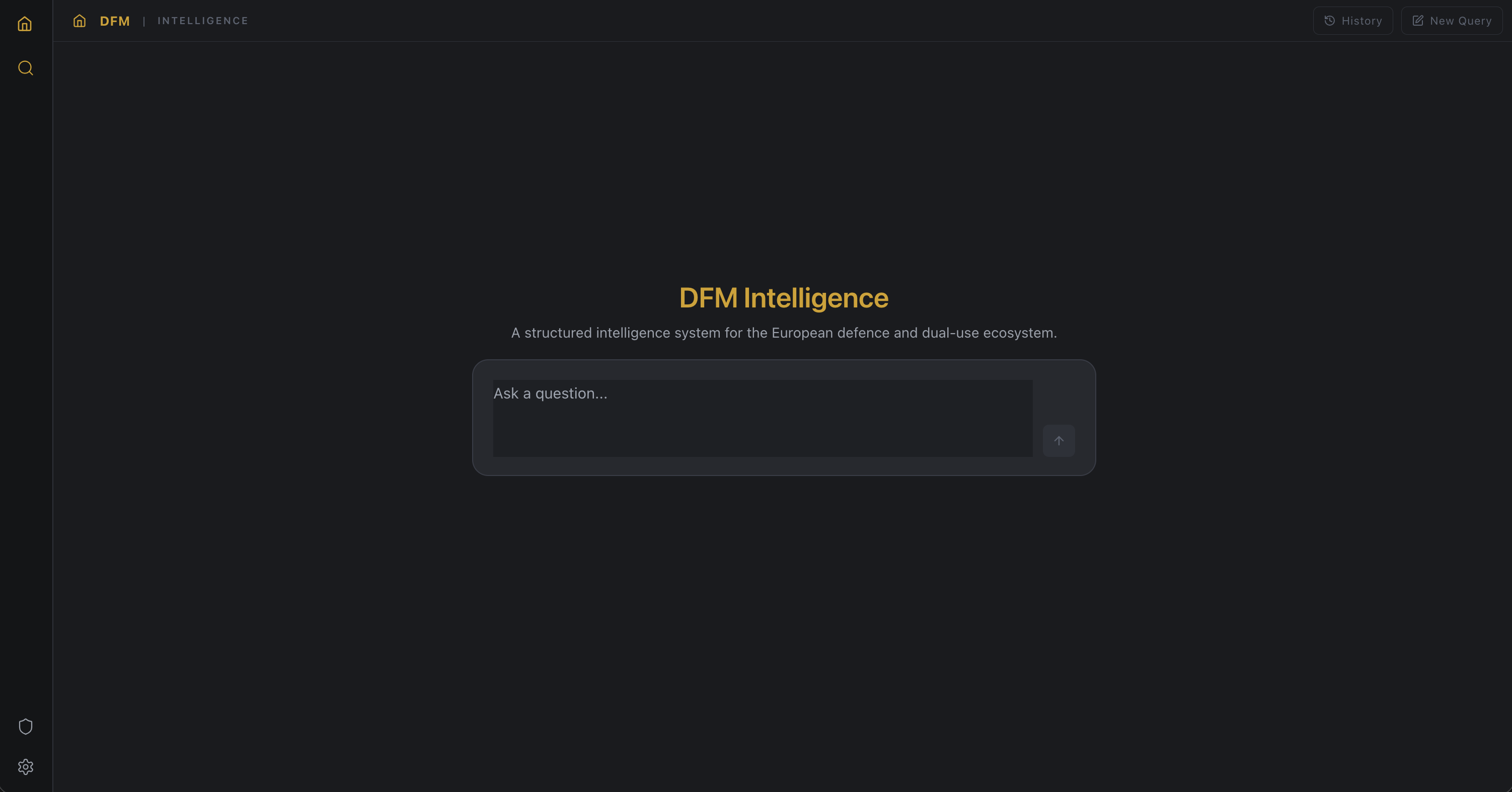
Defence Finance Monitor is an intelligence platform for the European defence-industrial base. It runs on a verified database of more than 2,000 European defence and dual-use enterprises, each mapped against the strategic priorities defined by EU and NATO policy, and maintained as the perimeter evolves through procurement awards, ownership changes, regulatory notifications and programme participation.
Work that has traditionally taken weeks of analyst effort is resolved in a single structured query: identifying the Tier-2 and Tier-3 suppliers behind a prime contractor, determining which firms are exposed to EDIP origin rules or Golden Power notifications, reconstructing contract awards under EDF, EDIRPA and ASAP, tracing the ownership chain behind a strategic asset. Every statement carries a stated confidence level and a citation to the official institutional source it rests on. Where a fact cannot be verified against source, it is marked as such rather than asserted.
The platform also opens a second analytical surface: the full corpus of analysis and publications produced by Defence Finance Monitor over the past year. Sector reports, regulatory readings, deep-research dossiers on industrial inversion and joint-venture architectures, weekly mappings of normative, industrial, financial and technological developments, thematic analyses on SAFE, EDIP, EDF and the Ukraine Support Loan, country dossiers and capability assessments — all are normalised against the same closed ontology that governs the entity layer. The same natural-language query that retrieves a supplier list also retrieves every internal analytical position taken on a given priority code, capability area, regulatory instrument or strategic document, with full source traceability. Institutional users no longer navigate a year of editorial output by date or title; they interrogate it as a structured analytical layer, cross-referenced with the entity, normative and procurement data of the underlying database.
For a law firm, a corporate-development team, a sovereign fund or a procurement office, the consequence is direct: institutional research that once defined the cost and timing of a deliverable now defines where the analysis begins.
DFM Intelligence is reserved for subscribers to the DFM annual programme.
For further information about DFM Intelligence, access conditions or payment by bank transfer, please contact: mastrolia@stroncature.com