


Defence Finance Monitor applies a top–down method that traces how NATO, EU and allied strategic priorities are translated into regulations, funding lines and procurement programmes, and then into demand for specific capabilities, technologies and companies. We use official doctrine as the organising frame to identify where strategic relevance is being institutionally defined and where it is materialising in concrete budgets, acquisition pathways and industrial capacity.
Our working assumption is that what becomes structurally relevant in NATO/EU strategy tends, over time, to become relevant also from a financial and industrial point of view. In the European context, this includes the progressive operationalisation of strategic autonomy: the effort to reduce critical dependencies, secure supply chains, strengthen the European defence technological and industrial base, and align regulatory, financial and procurement instruments with long-term security objectives. On this basis, DFM operates as a decision-support tool: it benchmarks investment and industrial choices against institutional demand, clarifies which capabilities are rising on the spending agenda, and maps the funding instruments, eligibility constraints and supply-chain factors that shape real-world feasibility across investors, industry, public authorities and research organisations.
Defence Finance Monitor rests on a single analytical premise: within the Euro-Atlantic security architecture, strategic doctrine precedes regulation and capability planning, regulation precedes budgets, and budgets shape markets.
The Use of Force as Strategic Failure
The West measures power on the battlefield: war is the moment of truth, and where there is no open war it tends to read stability. The classical Chinese tradition reverses that criterion entirely — battle is not where the outcome is decided but proof that strategy has already failed, since having to fight means having been unable to build, in advance, a position so dominant that the clash became unnecessary. This essay reconstructs that conception from the sources — Sun Tzu as read by Kissinger, Fayard’s economy of forces, with Johnston’s corrective that the restraint is calculation, not pacifism — and turns it on the present: Taiwan as “ripe fruit,” economic warfare as an attack on strategy, the primacy of information. The uncomfortable consequence it draws is methodological: if force is the failure of strategy, the absence of war may not be the absence of conflict but the sign that conflict is being waged, and won, where the West is not looking — in supply-chain nodes and constructed dependencies rather than troop movements.
The full essay is reserved for paid subscribers.
Europe’s Semiconductor Sovereignty
Europe cannot sustain credible autonomy in AI, defence, space or secure communications without reliable access to advanced and specialised chips — but the debate is dominated by political ambition, and the real task is to separate genuine industrial strength from rhetoric. This report disaggregates the value chain segment by segment, distinguishing three different things that “sovereignty” is made to mean: production capacity inside Europe, secure access to capacity outside it, and the legal and contractual control needed to avoid strategic paralysis. It maps where Europe is strong (lithography through ASML, Zeiss and Trumpf; power semiconductors; FD-SOI; engineered substrates), where its strength is fragile because research leads industrial scale (pilot lines, advanced packaging, photonics), and where dependencies remain unresolved (EDA, leading-edge foundry, memory, materials). It reads the Chips Act as binding law rather than aspiration, separates it carefully from the proposed successor, and closes with a company-and-node map of where the next phase of European chip sovereignty will actually be contested.
The full report is reserved for paid subscribers.
Europe’s Sovereign Compute Capacity
Europe’s AI position is usually argued in terms of models, talent and regulation, which misses the binding constraint: advanced AI depends on control over compute, data, energy, cloud and the secure software stack, and that control is where Europe is most exposed to non-European hyperscalers, external chip supply and scarce data-centre capacity. This report treats sovereign compute as an industrial-base question rather than a digital-policy theme. It sets out the European response now becoming operational — EuroHPC, AI Factories, the AI Gigafactories pipeline, sovereign-cloud procurement, the proposed Cloud and AI Development Act — distinguishing binding law from strategy and proposal throughout, and works through the industrial stack and its real bottlenecks, from accelerators and processors to grid access, permitting and SME access to compute. It then identifies where policy is most likely to convert into recurring demand between 2025 and 2030 — and why the durable beneficiaries are unlikely to be the most politically visible AI champions, but the firms controlling indispensable parts of the stack.
The full report is reserved for paid subscribers.
Telecommunications, 5G, 6G and Network Sovereignty
Telecommunications can no longer be analysed as a mature utility concerned with coverage and retail prices: it has become the transmission layer on which AI, sovereign cloud, defence logistics and critical-infrastructure continuity all depend. The starting problem is a gap between breadth and depth — basic 5G now reaches almost every European household, yet standalone 5G, deep fibre, edge capacity and hardened mission-critical service remain incomplete, and dependence on non-EU cloud, software and semiconductors persists above the access layer. This report reconstructs the full architecture: the legal framework (the Electronic Communications Code, the Gigabit Infrastructure Act, the proposed Digital Networks Act, NIS2, the 5G Toolbox), the technology stack from fibre and Open RAN to telco cloud and 6G standardisation, and the physical chokepoints of submarine cables and secure satellite connectivity through IRIS². It closes with a DFM assessment of which revenue models — neutral-host infrastructure, enterprise-deep operators, the major equipment vendors, secure-connectivity satellite operators — actually convert network-sovereignty policy into durable demand.
The full report is reserved for paid subscribers.
DFM Intelligence · Platform Capability
From Weeks of Research to a Single Query
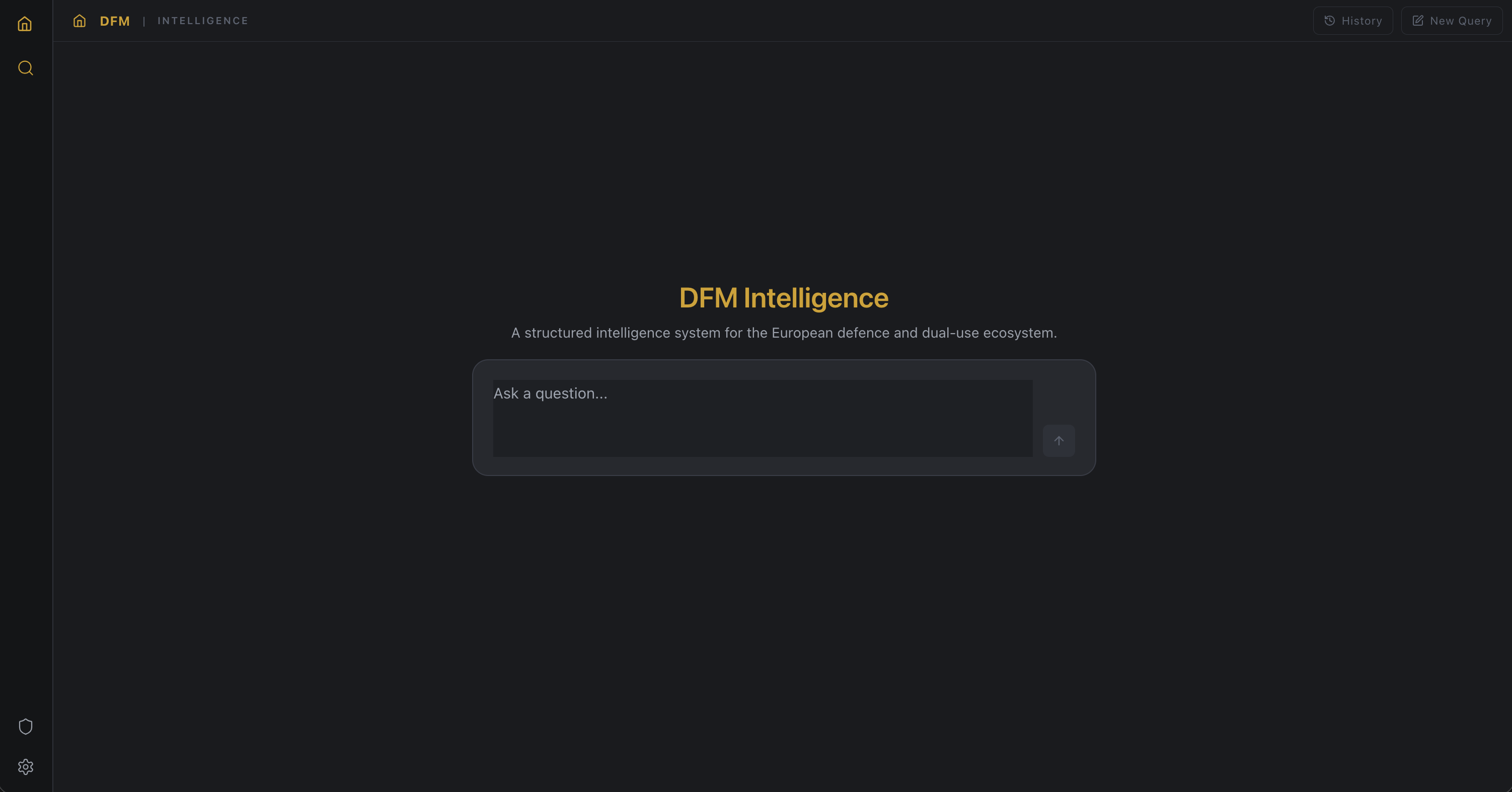
Defence Finance Monitor is an intelligence platform for the European defence-industrial base. It runs on a verified database of more than 2,000 European defence and dual-use enterprises, each mapped against the strategic priorities defined by EU and NATO policy, and maintained as the perimeter evolves through procurement awards, ownership changes, regulatory notifications and programme participation.
Work that has traditionally taken weeks of analyst effort is resolved in a single structured query: identifying the Tier-2 and Tier-3 suppliers behind a prime contractor, determining which firms are exposed to EDIP origin rules or Golden Power notifications, reconstructing contract awards under EDF, EDIRPA and ASAP, tracing the ownership chain behind a strategic asset. Every statement carries a stated confidence level and a citation to the official institutional source it rests on. Where a fact cannot be verified against source, it is marked as such rather than asserted.
The platform also opens a second analytical surface: the full corpus of analysis and publications produced by Defence Finance Monitor over the past year. Sector reports, regulatory readings, deep-research dossiers on industrial inversion and joint-venture architectures, weekly mappings of normative, industrial, financial and technological developments, thematic analyses on SAFE, EDIP, EDF and the Ukraine Support Loan, country dossiers and capability assessments — all are normalised against the same closed ontology that governs the entity layer. The same natural-language query that retrieves a supplier list also retrieves every internal analytical position taken on a given priority code, capability area, regulatory instrument or strategic document, with full source traceability. Institutional users no longer navigate a year of editorial output by date or title; they interrogate it as a structured analytical layer, cross-referenced with the entity, normative and procurement data of the underlying database.
For a law firm, a corporate-development team, a sovereign fund or a procurement office, the consequence is direct: institutional research that once defined the cost and timing of a deliverable now defines where the analysis begins.
DFM Intelligence is reserved for subscribers to the DFM annual programme.
For further information about DFM Intelligence, access conditions or payment by bank transfer, please contact: mastrolia@stroncature.com