


Defence Finance Monitor applies a top–down method that traces how NATO, EU and allied strategic priorities are translated into regulations, funding lines and procurement programmes, and then into demand for specific capabilities, technologies and companies. We use official doctrine as the organising frame to identify where strategic relevance is being institutionally defined and where it is materialising in concrete budgets, acquisition pathways and industrial capacity.
Our working assumption is that what becomes structurally relevant in NATO/EU strategy tends, over time, to become relevant also from a financial and industrial point of view. In the European context, this includes the progressive operationalisation of strategic autonomy: the effort to reduce critical dependencies, secure supply chains, strengthen the European defence technological and industrial base, and align regulatory, financial and procurement instruments with long-term security objectives. On this basis, DFM operates as a decision-support tool: it benchmarks investment and industrial choices against institutional demand, clarifies which capabilities are rising on the spending agenda, and maps the funding instruments, eligibility constraints and supply-chain factors that shape real-world feasibility across investors, industry, public authorities and research organisations.
Defence Finance Monitor rests on a single analytical premise: within the Euro-Atlantic security architecture, strategic doctrine precedes regulation and capability planning, regulation precedes budgets, and budgets shape markets.
The State-Criticality Residual
European defence equities have rerated since 2022. Higher budgets, larger order books and improved procurement visibility account for most of that movement on their own — which leaves open the question that matters to a fundamental investor: whether the market pays anything additional for strategic irreplaceability itself.
The difficulty is that the irreplaceability of an industrial asset and the protection of its shareholders are not the same thing. A state may be unable to lose a submarine-refit yard or a sovereign sensor capability, and may still cap its returns, redirect its cash flow into capacity and block its acquisition. The asset is defended; the equity need not be.
This report isolates that residual — the part of valuation, if any, that survives once backlog, margins, growth and programme access are removed — and tests whether it is being priced rationally across the European defence universe.
The full report is reserved for paid subscribers.
The Company-Relevance Evidence Standard
Defence-industrial relevance is routinely asserted before it is demonstrated. A company is treated as strategically important because it operates in defence, appears in a major programme, or publishes ambitious capability claims during a period of rising expenditure. None of that proves that the firm matters to the delivery of a military capability.
The distinction is not academic. It is where thematic exposure is mistaken for capability relevance — and where a genuinely irreplaceable lower-tier supplier can remain invisible while a diversified group attracts attention it does not warrant.
This report sets out the evidence standard Defence Finance Monitor applies to make that distinction: the chain of public, authoritative sources a company must satisfy before it can be classed as relevant, critical or essential, and the reason most strategic claims weaken or fail once that standard is imposed.
The full report is reserved for paid subscribers.
Data Sovereignty and Industrial Data Spaces
Europe’s investment in compute, semiconductors and cloud capacity addresses only part of its industrial and AI position. The remaining constraint is access to data that is reliable, interoperable and legally usable — and European data, though abundant, is fragmented across firms, hospitals, infrastructure operators and national systems, and frequently enclosed within proprietary interfaces.
Data sovereignty, properly understood, is not data localisation. It is the capacity to govern access, define lawful use and reduce dependence on entrenched platforms. An industrial base that cannot reach and govern its own operational data is exposed commercially, and in defence-adjacent sectors strategically.
This report reconstructs the European legal architecture now becoming operational — the Data Act, the Data Governance Act, the European Health Data Space and the related instruments — examines the sectoral data spaces built on it, and assesses where it creates industrial value and where Europe remains vulnerable.
The full report is reserved for paid subscribers.
DFM Intelligence · Platform Capability
From Weeks of Research to a Single Query
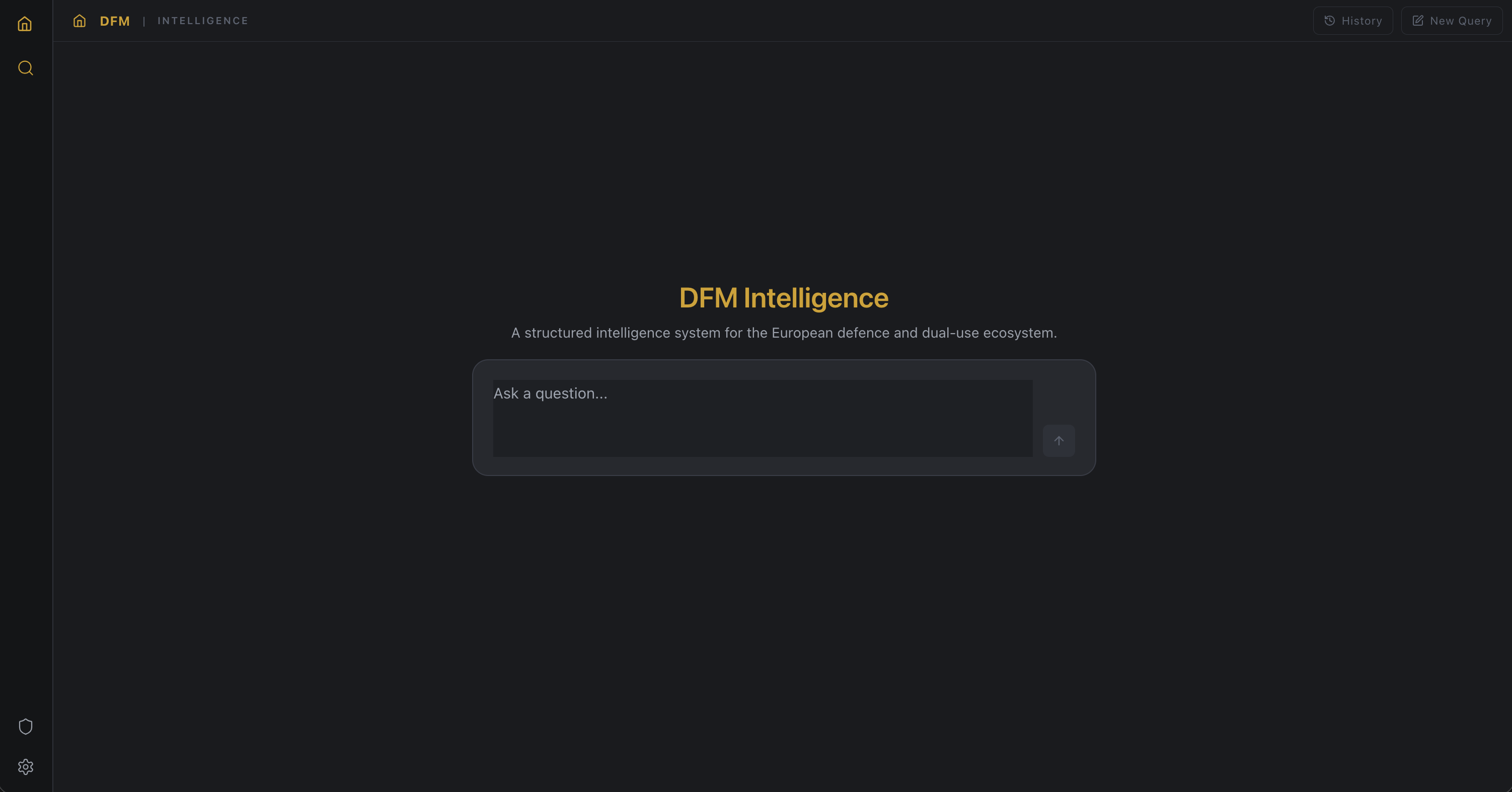
Defence Finance Monitor is an intelligence platform for the European defence-industrial base. It runs on a verified database of more than 2,000 European defence and dual-use enterprises, each mapped against the strategic priorities defined by EU and NATO policy, and maintained as the perimeter evolves through procurement awards, ownership changes, regulatory notifications and programme participation.
Work that has traditionally taken weeks of analyst effort is resolved in a single structured query: identifying the Tier-2 and Tier-3 suppliers behind a prime contractor, determining which firms are exposed to EDIP origin rules or Golden Power notifications, reconstructing contract awards under EDF, EDIRPA and ASAP, tracing the ownership chain behind a strategic asset. Every statement carries a stated confidence level and a citation to the official institutional source it rests on. Where a fact cannot be verified against source, it is marked as such rather than asserted.
The platform also opens a second analytical surface: the full corpus of analysis and publications produced by Defence Finance Monitor over the past year. Sector reports, regulatory readings, deep-research dossiers on industrial inversion and joint-venture architectures, weekly mappings of normative, industrial, financial and technological developments, thematic analyses on SAFE, EDIP, EDF and the Ukraine Support Loan, country dossiers and capability assessments — all are normalised against the same closed ontology that governs the entity layer. The same natural-language query that retrieves a supplier list also retrieves every internal analytical position taken on a given priority code, capability area, regulatory instrument or strategic document, with full source traceability. Institutional users no longer navigate a year of editorial output by date or title; they interrogate it as a structured analytical layer, cross-referenced with the entity, normative and procurement data of the underlying database.
For a law firm, a corporate-development team, a sovereign fund or a procurement office, the consequence is direct: institutional research that once defined the cost and timing of a deliverable now defines where the analysis begins.
DFM Intelligence is reserved for subscribers to the DFM annual programme.
For further information about DFM Intelligence, access conditions or payment by bank transfer, please contact: mastrolia@stroncature.com