


Defence Finance Monitor applies a top–down method that traces how NATO, EU and allied strategic priorities are translated into regulations, funding lines and procurement programmes, and then into demand for specific capabilities, technologies and companies. We use official doctrine as the organising frame to identify where strategic relevance is being institutionally defined and where it is materialising in concrete budgets, acquisition pathways and industrial capacity.
Our working assumption is that what becomes structurally relevant in NATO/EU strategy tends, over time, to become relevant also from a financial and industrial point of view. In the European context, this includes the progressive operationalisation of strategic autonomy: the effort to reduce critical dependencies, secure supply chains, strengthen the European defence technological and industrial base, and align regulatory, financial and procurement instruments with long-term security objectives. On this basis, DFM operates as a decision-support tool: it benchmarks investment and industrial choices against institutional demand, clarifies which capabilities are rising on the spending agenda, and maps the funding instruments, eligibility constraints and supply-chain factors that shape real-world feasibility across investors, industry, public authorities and research organisations.
Defence Finance Monitor rests on a single analytical premise: within the Euro-Atlantic security architecture, strategic doctrine precedes regulation and capability planning, regulation precedes budgets, and budgets shape markets.
The Art of Dividing the Barbarians
A recurring pattern in the Chinese strategic tradition is the management of frontier powers through division rather than conquest — a doctrine born of weakness, not ambition, in a sedentary empire that could not defeat the steppe but could keep it disunited.
This essay reconstructs that doctrine from the primary scholarship — Kissinger, Lattimore, Barfield, Johnston, Pines, Wang — and traces its instruments: the “loose rein,” the bribery of the frontier, the wei qi logic of encirclement against the chess logic of checkmate, the subordination of force to the political and psychological field in Sun Tzu.
It then sets that pattern, strictly as a hypothesis to be tested, against the present, and is candid about the limits: the most recent scholarship finds the China-Russia-Iran-North Korea grouping real but uneven and overwhelmingly bilateral, so the doctrine illuminates why a dispersion of Western force would be advantageous without establishing that it is centrally directed. It offers a grammar for interpretation; the evidence, not the grammar, carries the conclusions.
The full essay is reserved for paid subscribers.
The Cleared-Capacity Bottleneck
Europe’s defence expansion is debated through ammunition output, funding and workforce — but a large part of the most valuable market is closed to a company merely because it can manufacture, code or finance. It must also be able to operate inside classified programmes.
That requires cleared personnel, approved facilities, secure systems and a standing relationship with security authorities — a capability costly to build and slow to reproduce. This report treats cleared capacity not as a compliance overhead but as a hidden industrial balance sheet: a scarce productive asset that decides who can bid, execute and scale.
It uses the US system as the most explicit public benchmark, reads it against the EU, NATO, UK, French and German regimes, and shows how listed contractors disclose their dependence on cleared labour and accredited infrastructure. It then maps the supplier market that sells this capacity and draws the consequences for SME access, prime-contractor power, M&A diligence and any government trying to accelerate rearmament without first widening the cleared base.
The full report is reserved for paid subscribers.
The Regional Capture Index
Europe’s defence build-out is usually read through national budgets and prime backlogs. But new ammunition lines, propellant plants, missile facilities and shipyard workloads are concentrating in specific regions, not spreading evenly — and that turns rearmament into a territorial allocation process.
The decisive question is therefore not which countries spend more, but which regions convert the new cycle into local production capacity, skilled employment and supplier depth. This report builds a Regional Capture Index to find them, defining capture strictly: demand becomes local industrial stock — plant, lines, trained labour, localised value — not a headline contract signed by a company merely headquartered there.
Combining NUTS-2 data with verified site-level evidence, it separates absolute winners from intensity winners and works through the leading patterns across ammunition, propellants, missiles, aerospace, shipbuilding and the eastern flank. The conclusion redraws the map: the winners are rarely the richest capitals, but the regions where bottleneck capability, manufacturing depth and policy execution coincide.
The full report is reserved for paid subscribers.
The Research Security Layer
Universities are built around openness and international collaboration, yet they now produce and circulate knowledge that matters for defence, cyber, biotech, quantum and semiconductors. That makes advanced research a strategic access surface — and creates a problem: how to protect sensitive knowledge without turning research security into a blanket restriction on academic freedom.
This report traces the shift from open science to risk-managed collaboration across the EU, US, UK, Canada, the Netherlands, Germany, Australia and Italy. Its discipline is to work from the actual record — indictments, court orders and sentencing, including the failed prosecutions (Hu, Tao) that show why enforcement turns fragile when suspicion outruns evidence — rather than from “academic espionage” headlines.
It then moves from state policy to university procedure — partner screening, affiliation disclosure, visitor and data controls, contract clauses — and draws the consequences for defence primes scouting university technology, for investors diligencing university-origin IP, and for the law firms and funders now operating at this new governance layer.
The full report is reserved for paid subscribers.
DFM Intelligence · Platform Capability
From Weeks of Research to a Single Query
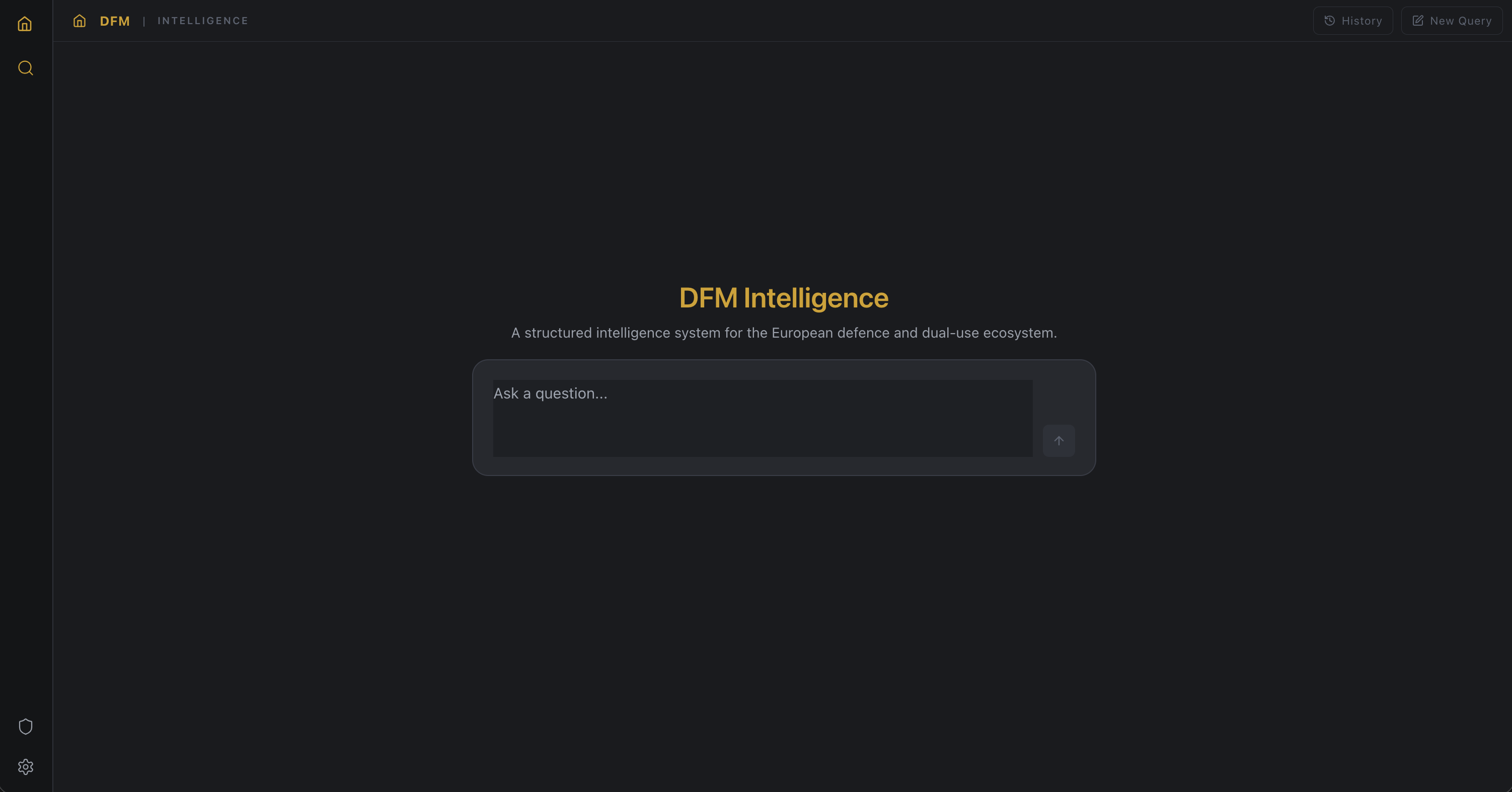
Defence Finance Monitor is an intelligence platform for the European defence-industrial base. It runs on a verified database of more than 2,000 European defence and dual-use enterprises, each mapped against the strategic priorities defined by EU and NATO policy, and maintained as the perimeter evolves through procurement awards, ownership changes, regulatory notifications and programme participation.
Work that has traditionally taken weeks of analyst effort is resolved in a single structured query: identifying the Tier-2 and Tier-3 suppliers behind a prime contractor, determining which firms are exposed to EDIP origin rules or Golden Power notifications, reconstructing contract awards under EDF, EDIRPA and ASAP, tracing the ownership chain behind a strategic asset. Every statement carries a stated confidence level and a citation to the official institutional source it rests on. Where a fact cannot be verified against source, it is marked as such rather than asserted.
The platform also opens a second analytical surface: the full corpus of analysis and publications produced by Defence Finance Monitor over the past year. Sector reports, regulatory readings, deep-research dossiers on industrial inversion and joint-venture architectures, weekly mappings of normative, industrial, financial and technological developments, thematic analyses on SAFE, EDIP, EDF and the Ukraine Support Loan, country dossiers and capability assessments — all are normalised against the same closed ontology that governs the entity layer. The same natural-language query that retrieves a supplier list also retrieves every internal analytical position taken on a given priority code, capability area, regulatory instrument or strategic document, with full source traceability. Institutional users no longer navigate a year of editorial output by date or title; they interrogate it as a structured analytical layer, cross-referenced with the entity, normative and procurement data of the underlying database.
For a law firm, a corporate-development team, a sovereign fund or a procurement office, the consequence is direct: institutional research that once defined the cost and timing of a deliverable now defines where the analysis begins.
DFM Intelligence is reserved for subscribers to the DFM annual programme.
For further information about DFM Intelligence, access conditions or payment by bank transfer, please contact: mastrolia@stroncature.com