


Defence Finance Monitor applies a top–down method that traces how NATO, EU and allied strategic priorities are translated into regulations, funding lines and procurement programmes, and then into demand for specific capabilities, technologies and companies. We use official doctrine as the organising frame to identify where strategic relevance is being institutionally defined and where it is materialising in concrete budgets, acquisition pathways and industrial capacity.
Our working assumption is that what becomes structurally relevant in NATO/EU strategy tends, over time, to become relevant also from a financial and industrial point of view. In the European context, this includes the progressive operationalisation of strategic autonomy: the effort to reduce critical dependencies, secure supply chains, strengthen the European defence technological and industrial base, and align regulatory, financial and procurement instruments with long-term security objectives. On this basis, DFM operates as a decision-support tool: it benchmarks investment and industrial choices against institutional demand, clarifies which capabilities are rising on the spending agenda, and maps the funding instruments, eligibility constraints and supply-chain factors that shape real-world feasibility across investors, industry, public authorities and research organisations.
Defence Finance Monitor rests on a single analytical premise: within the Euro-Atlantic security architecture, strategic doctrine precedes regulation and capability planning, regulation precedes budgets, and budgets shape markets.
The Naval Sustainment Premium
European naval equities are read almost entirely through new orders, shipyard capacity and headline backlog — and that is the wrong lens for an investor trying to find durable cash flows. A warship does not stop earning at delivery: submarines, frigates and destroyers generate decades of maintenance, refit, combat-system upgrades, software baselines, spares, dockyard work, training and availability contracts, and that recurring revenue is more protected, higher-margin and harder to contest than the build that precedes it. The problem this report addresses is that the market still prices visible construction more richly than protected sustainment, which means the most resilient earnings in the sector are systematically under-recognised. It is built to correct that asymmetry. It first separates newbuild economics from installed-base economics and explains why nuclear submarines, then conventional submarines, then complex frigates sit on a descending ladder of support moats. It then maps the demand being reset by NATO readiness, undersea-infrastructure protection and the regulatory architecture — Directive 2009/81, Article 346, SAFE’s component rules and design-authority conditions — that turns security-of-supply and sovereign control into pricing power and contract duration. It then works through the investible and strategic actors one by one, with figures from their own filings: Babcock’s nuclear and Devonport estate, BAE’s submarine lifecycle, Fincantieri’s underwater re-rating, TKMS’s scarcity, Saab’s Kockums, the systems recurrence of Thales and Leonardo, and the state benchmarks Naval Group and Navantia. It closes with a five-step framework for telling a structurally protected sustainment business from a company merely riding a temporary rise in shipbuilding orders.
The full report, including the company-by-company analysis and the investor framework, is reserved for paid subscribers.
From the Strategic Concept to Industrial Essentiality
NATO’s 2022 Strategic Concept is read everywhere as a statement of posture — Russia as the central threat, collective defence, resilience, technological edge. This report reads it as something the market has missed: an industrial demand map. The problem it solves is that screening for “defence exposure” identifies the wrong companies, because strategic indispensability in the NATO system does not coincide with being a large defence contractor — it belongs to whichever firm sits inside a doctrinally essential function and cannot be replaced at operational speed. To find those firms, the report builds a four-stage method and applies it rigorously: it extracts the operative formulations from the Strategic Concept and the Vilnius, Washington and Hague summit texts; it translates each into the military and systemic functions the Alliance must be able to perform; it maps those functions onto the industrial and commercial bases that sustain them; and it sorts those bases into company classes, asking which are non-substitutable once certification, interoperability, installed-base lock-in, scarce inputs and production lead times are taken into account. The answer repeatedly points below the visible prime — to the energetics and propellant chain behind the munition, the seeker and radar specialists inside the air-defence kill chain, the SATCOM and subsea-cable operators inside the resilience baseline, the encryption and secure-network layer inside cyber command, and the dual-use firms the Rapid Adoption Action Plan is designed to pull into procurement within 24 months. It closes by turning the method into a six-criterion essentiality screen for strategic capital — doctrinal centrality, replacement time, interoperability lock-in, surge elasticity, input criticality, cross-system dependence — and shows why, with the Hague 5% framework now routing money into infrastructure, networks and the industrial base, the firms that matter most may not appear in any defence sector code at all.
The full report, including the essentiality screen and the company-class map, is reserved for paid subscribers.
France’s Pre-Procurement Machine
In France, the decision that determines who wins a defence contract is usually taken before any tender is visible to the market — and a supplier who waits for the published notice has often already lost. By the time a procurement notice appears, operational need has been translated into a technical requirement, tested against budgetary programming, shaped by the Direction générale de l’armement, fitted to the Loi de programmation militaire, and routed toward a particular industrial architecture; the field of plausible suppliers has narrowed at each of those upstream steps. The problem this report solves is that the visible market is the last stage of a long state process, not the first, so reading tenders alone means reading the outcome after the decisive choices are made. It reconstructs that pre-procurement chain in four stages. It first explains how military need is formalised — the 2019 and 2024 DGA reforms, the document unique de besoin, the shift toward value analysis where cost and schedule now outrank performance. It then shows how the LPM, Programme 146 and annual budget execution decide which needs become durable, financeable demand, and why headline budget totals do not translate mechanically into fresh orders given functional tranches, carry-overs and the end-of-year contracting cycle. It then traces how a requirement is routed into an industrial pathway — incumbent prime, OCCAR cooperation, upgrade, MCO, demonstrator, or one of the legal routes that allow award without open competition. It concludes with the signals a supplier, investor or adviser can actually read before the market sees a tender, and why for a foreign supplier indirect entry through sub-supply or cooperation is often more realistic than a late prime bid.
The full report, including the pre-tender signal map, is reserved for paid subscribers.
When Biotech Becomes Defence-Finance Relevant
Not every advanced biotech belongs inside a defence-finance framework, and treating it as if it does wastes capital and credibility. A diagnostic platform, medical countermeasure or biomanufacturing capability becomes relevant to defence finance not because the science is sophisticated or can be called dual-use, but only when public institutions can recognise, fund, procure, stockpile or integrate it into a defined resilience function — biosecurity, force health, CBRN response, critical medical supply. The problem this report solves is classification: investors, universities and TTOs routinely attach a resilience narrative to assets that institutions will never validate, and the cost is misdirected diligence and inflated theses. It is built as a strict eligibility gate. It first draws the boundary between ordinary healthcare relevance and genuine defence-resilience relevance, then sets out the six tests a project must pass — recognised threat, resilience function, real funding or procurement pathway, regulatory compatibility, industrial readiness, and strategic-capital relevance — anchoring each in the actual scope of HERA, rescEU, NATO resilience and biotechnology policy, the EDF medical topics, DIANA and the NATO Innovation Fund. It then applies the gate across research domains, EU and Allied funding pathways, and the company types that matter, showing with institutional cases — EU FAB, HERA Invest, Fabentech, Leyden Labs — why a CDMO or a logistics firm with no scientific glamour can clear the gate while a brilliant platform company does not. The conclusion is deliberately restrictive: the perimeter is real, growing and commercially meaningful, but it remains a subset, and knowing which side of it an asset sits on is the diligence question.
The full report, including the eligibility gate and the research-to-resilience map, is reserved for paid subscribers.
DFM Intelligence · Platform Capability
From Weeks of Research to a Single Query
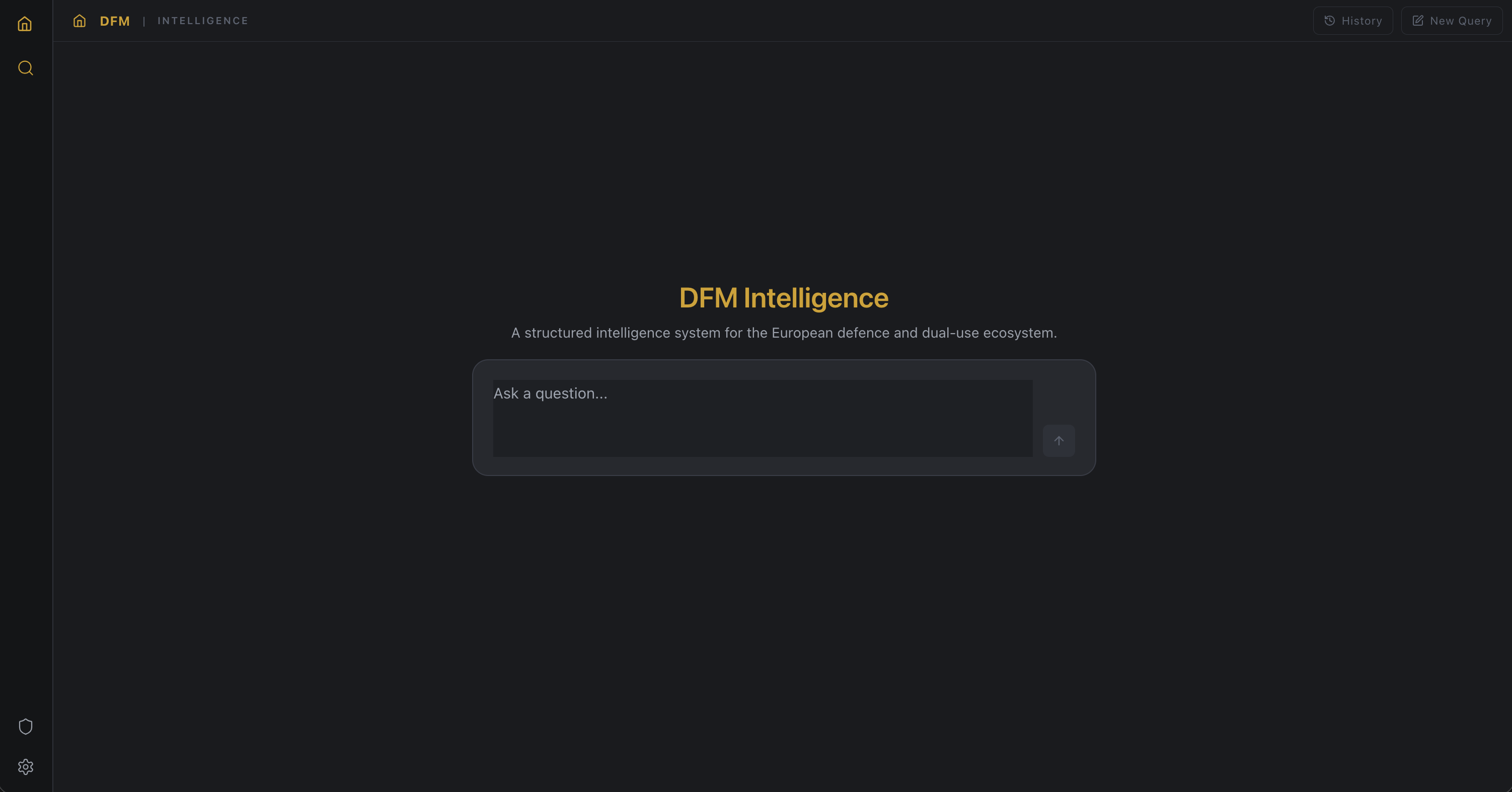
Defence Finance Monitor is an intelligence platform for the European defence-industrial base. It runs on a verified database of more than 2,000 European defence and dual-use enterprises, each mapped against the strategic priorities defined by EU and NATO policy, and maintained as the perimeter evolves through procurement awards, ownership changes, regulatory notifications and programme participation.
Work that has traditionally taken weeks of analyst effort is resolved in a single structured query: identifying the Tier-2 and Tier-3 suppliers behind a prime contractor, determining which firms are exposed to EDIP origin rules or Golden Power notifications, reconstructing contract awards under EDF, EDIRPA and ASAP, tracing the ownership chain behind a strategic asset. Every statement carries a stated confidence level and a citation to the official institutional source it rests on. Where a fact cannot be verified against source, it is marked as such rather than asserted.
The platform also opens a second analytical surface: the full corpus of analysis and publications produced by Defence Finance Monitor over the past year. Sector reports, regulatory readings, deep-research dossiers on industrial inversion and joint-venture architectures, weekly mappings of normative, industrial, financial and technological developments, thematic analyses on SAFE, EDIP, EDF and the Ukraine Support Loan, country dossiers and capability assessments — all are normalised against the same closed ontology that governs the entity layer. The same natural-language query that retrieves a supplier list also retrieves every internal analytical position taken on a given priority code, capability area, regulatory instrument or strategic document, with full source traceability. Institutional users no longer navigate a year of editorial output by date or title; they interrogate it as a structured analytical layer, cross-referenced with the entity, normative and procurement data of the underlying database.
For a law firm, a corporate-development team, a sovereign fund or a procurement office, the consequence is direct: institutional research that once defined the cost and timing of a deliverable now defines where the analysis begins.
DFM Intelligence is reserved for subscribers to the DFM annual programme.
For further information about DFM Intelligence, access conditions or payment by bank transfer, please contact: mastrolia@stroncature.com