


Defence Finance Monitor applies a top–down method that traces how NATO, EU and allied strategic priorities are translated into regulations, funding lines and procurement programmes, and then into demand for specific capabilities, technologies and companies. We use official doctrine as the organising frame to identify where strategic relevance is being institutionally defined and where it is materialising in concrete budgets, acquisition pathways and industrial capacity.
Our working assumption is that what becomes structurally relevant in NATO/EU strategy tends, over time, to become relevant also from a financial and industrial point of view. In the European context, this includes the progressive operationalisation of strategic autonomy: the effort to reduce critical dependencies, secure supply chains, strengthen the European defence technological and industrial base, and align regulatory, financial and procurement instruments with long-term security objectives. On this basis, DFM operates as a decision-support tool: it benchmarks investment and industrial choices against institutional demand, clarifies which capabilities are rising on the spending agenda, and maps the funding instruments, eligibility constraints and supply-chain factors that shape real-world feasibility across investors, industry, public authorities and research organisations.
Defence Finance Monitor rests on a single analytical premise: within the Euro-Atlantic security architecture, strategic doctrine precedes regulation and capability planning, regulation precedes budgets, and budgets shape markets.
Hensoldt, Nedinsco and the Consolidation of European Optronics
Hensoldt’s acquisition of Nedinsco, closed on 1 June 2026, should not be read as a marginal bolt-on. A target expected to add only lower double-digit million in revenue was bought for a high double-digit enterprise value and integrated immediately into a strategic division — the profile of a control-of-capability transaction, not a scale-for-scale one. This report reads the deal as a template for Tier-2 consolidation in European optronics, and the reading turns on a paradox: Hensoldt closed the acquisition while reporting record order intake and a 3.0x book-to-bill, but also a first quarter of negative free cash flow, as backlog conversion consumed cash through inventory, ramp-up and capex before deliveries could release it. Nedinsco fits that pressure precisely — a specialist whose periscopes and driver-vision systems sit inside Boxer, Lynx, CV90, Puma and Leopard 2A8, whose replacement is structurally difficult, and whose real value lies in becoming unavailable to disruption. The report is exact on the financing logic too: the customer advance payments that let Hensoldt raise its 2026 cash-conversion guidance are not equity or subsidy but contract-linked liabilities functioning as industrial bridge financing. It then sets the case against three adjacent models — Exosens’ platform-building, Lynred’s sovereign detector development, Theon’s outward broadening — to show why European optronics consolidation will stay selective and architecture-driven, and why the most credible targets are not the largest sensor companies but the qualified specialists quietly embedded in the bill of materials.
Subcontractor Flow-Down Obligations in Defence Supply Chains
European defence supply chains are formally opening to SMEs and non-traditional suppliers — and quietly closing through the obligations that flow down from public authorities to primes and from primes to lower tiers. This report shows how security, export-control, cyber, audit, traceability and continuity-of-supply clauses have stopped being peripheral contractual matters and become the operative filter that separates nominal supplier access from real eligibility. It works through the cumulative legal architecture — Directive 2009/81, the dual-use Regulation, NIS 2 and the Cyber Resilience Act, and the establishment-and-control conditions hardwired into SAFE and EDIP — and then reads the actual supplier terms of Airbus, Leonardo, BAE Systems, Saab and KNDS to demonstrate a convergent drafting pattern: the prime converts regulatory exposure into supplier warranties, audit rights, 180-day change notifications, lower-tier flow-down and continuity undertakings, externalising the compliance burden onto firms least equipped to carry it. The financial consequence is the analytical core: compliance capacity behaves not like a marginal cost but like an access infrastructure that must exist before award, be maintained across the contract, and be transmitted downward — which makes flow-down readiness simultaneously a procurability test and an investability test. The conclusion is the line that should reframe diligence: the decisive divide in the European defence-industrial base is no longer between firms with and without relevant technology, but between firms able and unable to absorb, evidence and transmit defence-grade compliance.
Defence-Tech Earn-Outs and the Price of Uncertainty
In defence-technology acquisitions, the headline number is almost never the price actually paid. A target may hold relevant technology, sensitive IP and a plausible position in future procurement, but its value depends on events that are external, delayed and regulated — export licences, cyber certification, programme eligibility, funded orders, accepted deliveries — and ordinary multiples cannot resolve that. This report analyses the contractual architecture through which defence-tech uncertainty is priced and allocated after closing, and its central finding is precise: the metric chosen for contingent consideration tells the reader exactly where the buyer believes the risk still sits. A bookings earn-out pays for order capture; a revenue earn-out for accounting recognition; a margin earn-out for successful execution; an integration milestone for technical assimilation — and each monetises a different stage of de-risking. Drawing on the actual deal documents of Red Cat/Quaze, Rocket Lab/GEOST, Cadre and Ocean Power, it shows that contingent consideration is rarely pure seller upside: holdbacks and set-off rights make it the first reservoir from which post-closing risk is recaptured, turning earn-outs into a negative contingent price. It also documents a striking pattern — export-control, government-contract and cyber risks are handled through representations, covenants and indemnities rather than stand-alone licence-based triggers — while EDIP eligibility, ITAR/EAR classification and CMMC award-gating push export-control maturity and design autonomy from peripheral compliance into the core of enterprise value. The practical question it leaves the reader is the right one: which portion of the price should be paid only after the technology has become legally exportable, programme-eligible, procurement-bankable and operationally integrated.
DFM Intelligence · Platform Capability
Problems DFM Intelligence Now Solves
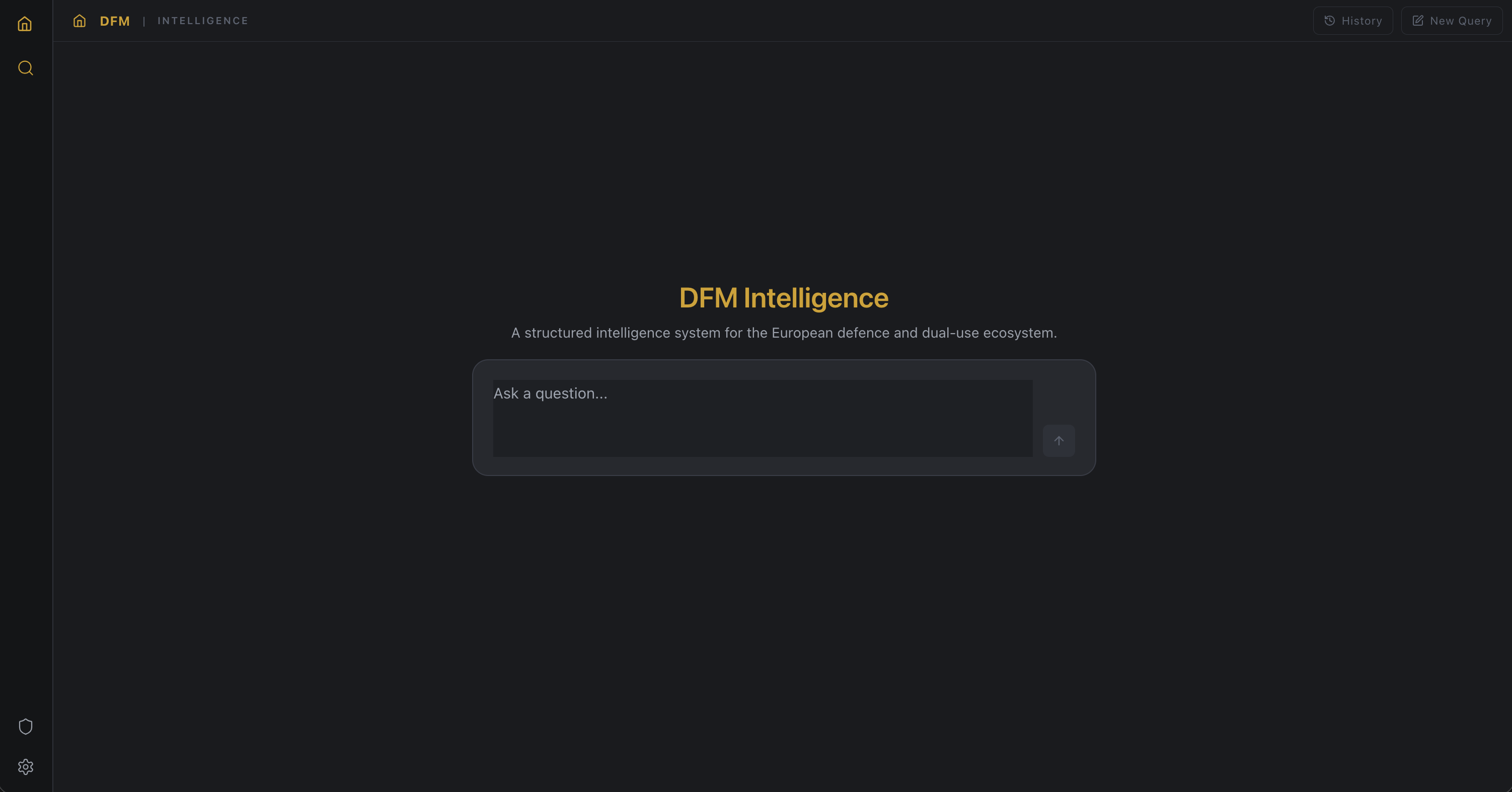
Defence Finance Monitor is an intelligence platform for the European defence-industrial base. It runs on a verified database of more than 2,000 European defence and dual-use enterprises, each mapped against the strategic priorities defined by EU and NATO policy, and maintained as the perimeter evolves through procurement awards, ownership changes, regulatory notifications and programme participation.
A single structured query resolves work that has traditionally required extended analyst effort: identifying the Tier-2 and Tier-3 suppliers behind a prime contractor, determining which firms are exposed to EDIP origin rules, Golden Power notifications or critical-raw-material dependencies, reconstructing contract awards under EDF, EDIRPA and ASAP, or tracing the ownership chain behind a strategic asset. Every statement carries a stated confidence level and a citation to the official institutional source it rests on. Where a fact cannot be verified against source, it is marked as such rather than asserted.
For a law firm, a corporate-development team, a sovereign fund or a procurement office, the consequence is direct: institutional research that once defined the cost and timing of a deliverable now defines where the analysis begins.
DFM Intelligence is reserved for subscribers to the DFM annual programme.
For further information about DFM Intelligence, access conditions or payment by bank transfer, please contact: mastrolia@stroncature.com