


Defence Finance Monitor applies a top–down method that traces how NATO, EU and allied strategic priorities are translated into regulations, funding lines and procurement programmes, and then into demand for specific capabilities, technologies and companies. We use official doctrine as the organising frame to identify where strategic relevance is being institutionally defined and where it is materialising in concrete budgets, acquisition pathways and industrial capacity.
Our working assumption is that what becomes structurally relevant in NATO/EU strategy tends, over time, to become relevant also from a financial and industrial point of view. In the European context, this includes the progressive operationalisation of strategic autonomy: the effort to reduce critical dependencies, secure supply chains, strengthen the European defence technological and industrial base, and align regulatory, financial and procurement instruments with long-term security objectives. On this basis, DFM operates as a decision-support tool: it benchmarks investment and industrial choices against institutional demand, clarifies which capabilities are rising on the spending agenda, and maps the funding instruments, eligibility constraints and supply-chain factors that shape real-world feasibility across investors, industry, public authorities and research organisations.
Defence Finance Monitor rests on a single analytical premise: within the Euro-Atlantic security architecture, strategic doctrine precedes regulation and capability planning, regulation precedes budgets, and budgets shape markets.
Public Funding as a Due Diligence Shortcut and Its Limits
A grant, a Seal, an EIB loan or an EDF award compresses the cost of screening a company — which is exactly why it is so often misread. Public validation confirms that a project has passed a structured public evaluation, but it does not transfer fiduciary responsibility, and the question a funding authority answers is not the one an investor, lender or acquirer needs answered. The authority asks whether a proposal deserves support within a regulated call perimeter; private capital asks whether the company is bankable, investable, exportable and scalable on a risk-adjusted basis. This report separates the two with a discipline rarely applied in the market: it distinguishes validation for programme purposes from validation for investment purposes, sorts each instrument — Horizon, the Seal of Excellence, the STEP Seal, EIC, EDF, EDIP, EIB, EIF, InvestEU — into what it actually verifies, and is precise about what stays outside the public screen entirely: beneficial ownership and cap-table architecture, chain-of-title on IP, export-control and sanctions exposure, industrial execution, and the gap between policy alignment and contracted demand. It draws the distinction that matters most for underwriting — a direct signal on a screened borrower (the EIB’s loan to Grupo Oesía) versus an indirect one on a fund manager (the EIF’s commitment to Join Capital Fund III) — and converts the whole toolkit into a usable rule: public funding is a document-request accelerator, not a waiver. Used well, it lowers the first-pass cost of diligence; used lazily, it becomes an expensive source of false comfort.
EDF Participation and the Procurement Signal
European Defence Fund participation is routinely treated as a shortcut for defence-market credibility. It should not be. EDF selection does not mean a company is procurement-ready, that its technology will be acquired, or that public demand is secured — the Fund is designed by law to support research and development up to, but not including, the procurement decision itself. This report reads EDF participation as a graded signal of procurability, and the grading is the value. A strong signal is a development action built around late-stage activities — prototyping, qualification, a real firing test — with documented Member State intent to procure, visible end-users and IP control retained inside the European base; the report anchors each level in actual projects, from iMUGS2, SPIRIT and ECC2 at the strong end to research-only actions like ORQESTRA at the weak end. It then does what the headlines cannot: it shows why a coordinator role is far more probative than an unnamed subcontractor position, why the public factsheets hide budget splits and affiliated entities, and how the signal strengthens materially once a project bridges into EDIP, SAFE, PESCO or an OCCAR-managed programme. The conclusion is exact rather than promotional — EDF can narrow the distance to procurement; it cannot, on its own, close it — and that precision is what separates a defensible investment read from a category error.
EU Funding for Quantum, Secure Communications and Resilient PNT
Quantum, secure communications and resilient positioning, navigation and timing are no longer funded through a single channel — and that is precisely what makes them legible. The same QKD stack, photonic component or PRS receiver can now enter the system through EDF, Digital Europe, EuroQCI, IRIS², Chips JU, Horizon Europe or a national programme, each validating a different part of the industrial pathway, and the strongest industrial signal is not success in any one of them but recurrence across several. This report maps that convergent architecture and ranks the channels by what they actually prove: Horizon validates scientific relevance and TRL progression, Chips JU validates manufacturability, Digital Europe and CEF validate deployability, EDF validates operational military relevance — and EUSPA, GOVSATCOM and IRIS² sit closest to procurement because they are tied to operational service delivery and, for IRIS², an anchor-customer structure under a twelve-year concession. It is specific where it counts: the €50 million EDF development action for Galileo PRS modules in NAVWAR conditions, qualified through a real firing test; the €30 million IRIS² call for security-certified terrestrial QKD; the PQC migration timetable that runs to 2030. The payoff for industrial and investment readers is a clear rule for reading the map: the most attractive positions are not “quantum” in the abstract, but the narrow bands where one product category satisfies cyber, space, defence and semiconductor policy at once — and movement from a research programme into a service architecture is more informative than any isolated award.
DFM Intelligence · Platform Capability
Problems DFM Intelligence Now Solves
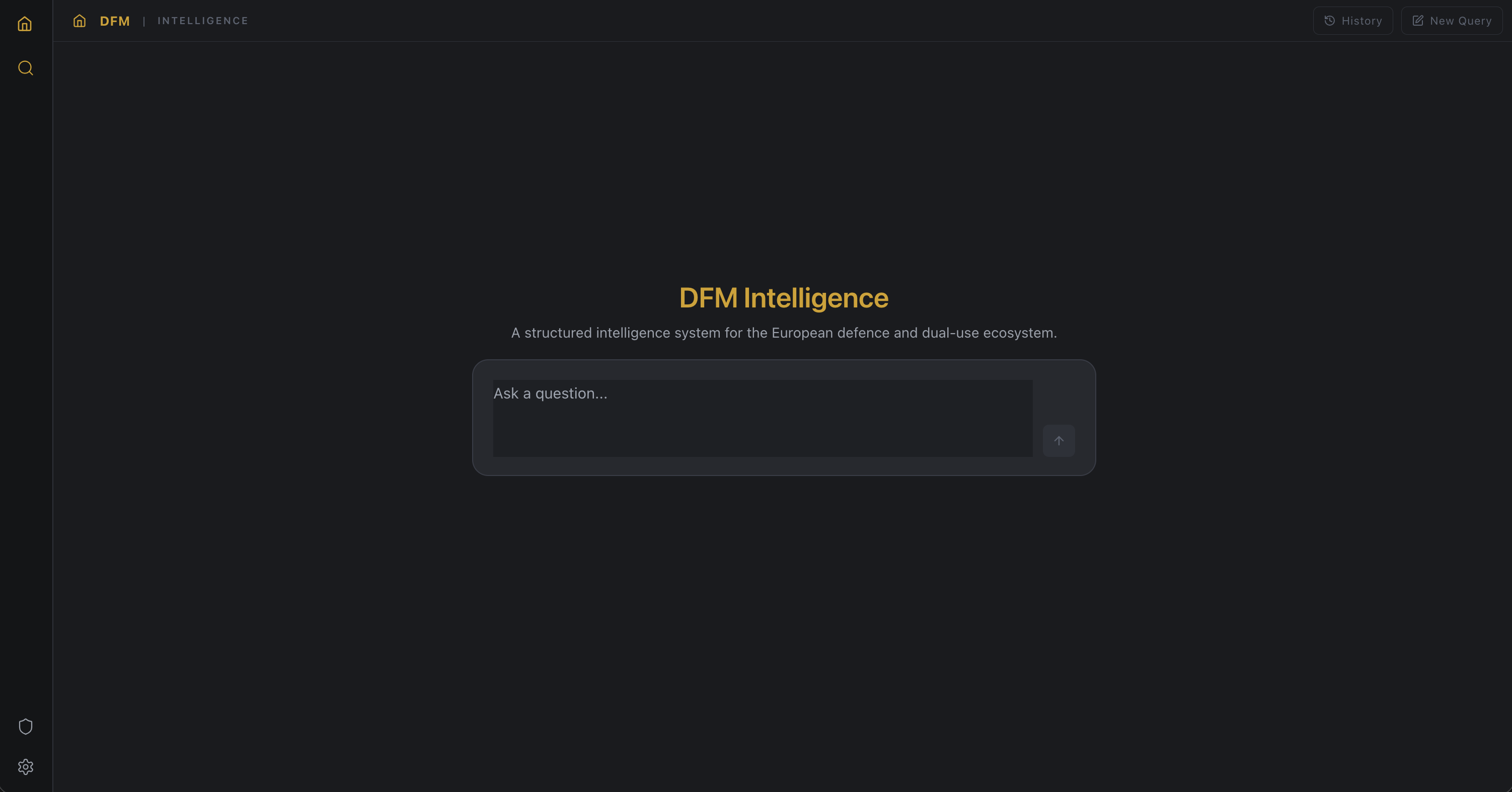
Defence Finance Monitor is an intelligence platform for the European defence-industrial base. It runs on a verified database of more than 2,000 European defence and dual-use enterprises, each mapped against the strategic priorities defined by EU and NATO policy, and maintained as the perimeter evolves through procurement awards, ownership changes, regulatory notifications and programme participation.
A single structured query resolves work that has traditionally required extended analyst effort: identifying the Tier-2 and Tier-3 suppliers behind a prime contractor, determining which firms are exposed to EDIP origin rules, Golden Power notifications or critical-raw-material dependencies, reconstructing contract awards under EDF, EDIRPA and ASAP, or tracing the ownership chain behind a strategic asset. Every statement carries a stated confidence level and a citation to the official institutional source it rests on. Where a fact cannot be verified against source, it is marked as such rather than asserted.
For a law firm, a corporate-development team, a sovereign fund or a procurement office, the consequence is direct: institutional research that once defined the cost and timing of a deliverable now defines where the analysis begins.
DFM Intelligence is reserved for subscribers to the DFM annual programme.
For further information about DFM Intelligence, access conditions or payment by bank transfer, please contact: mastrolia@stroncature.com