


Defence Finance Monitor applies a top–down method that traces how NATO, EU and allied strategic priorities are translated into regulations, funding lines and procurement programmes, and then into demand for specific capabilities, technologies and companies. We use official doctrine as the organising frame to identify where strategic relevance is being institutionally defined and where it is materialising in concrete budgets, acquisition pathways and industrial capacity.
Our working assumption is that what becomes structurally relevant in NATO/EU strategy tends, over time, to become relevant also from a financial and industrial point of view. In the European context, this includes the progressive operationalisation of strategic autonomy: the effort to reduce critical dependencies, secure supply chains, strengthen the European defence technological and industrial base, and align regulatory, financial and procurement instruments with long-term security objectives. On this basis, DFM operates as a decision-support tool: it benchmarks investment and industrial choices against institutional demand, clarifies which capabilities are rising on the spending agenda, and maps the funding instruments, eligibility constraints and supply-chain factors that shape real-world feasibility across investors, industry, public authorities and research organisations.
Defence Finance Monitor rests on a single analytical premise: within the Euro-Atlantic security architecture, strategic doctrine precedes regulation and capability planning, regulation precedes budgets, and budgets shape markets.
Defence Cascade Funding: Europe’s New Gatekeeping Layer for SMEs
The smallest cheques in European defence funding may be the most revealing. A cascade-funding award is capped at €60,000 and runs for six months — a figure that resembles nothing in procurement scale — yet winning one means a company has passed the ownership-and-control, territory and SME-priority screening of a defence consortium operating inside the EDF’s legal envelope. That is the distinction this report draws and holds throughout: cascade funding validates access, not conversion. The evidence is now concrete, not conceptual. The first MaJoR sub-call, open from January to March 2026, drew more than 200 proposals — over 70 per cent from companies entering an EU defence programme for the first time — and offered selected applicants prime-hosted bootcamps with Rheinmetall, Damen and Airbus, structured introductions, and a final demonstration day. But MaJoR also states plainly that demonstrator integration cannot be guaranteed, and no security clearance is required. The report reconstructs the legal architecture (Article 207 financial support to third parties, the flow-down obligations, the IP regime of the model sub-grant) and tells investors exactly how to read an award: as a layered validation signal across eligibility, consortium acceptance and early industrial exposure — never as booked revenue. Treating a sub-call win as quasi-revenue is a category error, and this report explains precisely why.
Consortium Eligibility: How to Build a Fundable Defence Partnership
European defence funding does not reward technology in isolation. Under EDF and EDIP a proposal is judged through the structure that carries it — the coordinator, the industrial anchor, the SMEs, the end-users, the ownership links, the route to testing and procurement — which means a technically excellent company can remain unfundable inside a weak consortium, while a narrower contribution becomes strategic inside a credible cross-border partnership. This report treats consortium design as the decisive test of fundability, and the distinction it draws is the one that matters most: a formally eligible consortium (right country count, registered participants) can still be strategically weak if the coordinator is nominal, the central work is parked in subcontracting, end-user participation is merely declaratory, or the geography was assembled only to clear thresholds. It works through the legal architecture — ownership-control assessment, the beneficiary/affiliated/associated/subcontractor taxonomy, the EDIP fifteen-entity cap on industrial-reinforcement consortia, the 30 per cent subcontracting justification line — and then offers the DFM five-perimeter assessment model: legal, control, delivery, demand and value-capture. The payoff for investors is a graded reading of what participation actually signals: a small company is materially more investable as a beneficiary holding an indispensable module with protected design authority than as a marginal associated partner selling a replaceable service. The map may look European; the question is whether effective control sits inside the lawful perimeter.
Funding Eligibility and Export-Control Compliance
A company can be technologically credible and still be fragile as a funding candidate — because in European defence and dual-use programmes, eligibility no longer turns only on technical merit. It turns on whether the underlying technology can be classified, transferred, licensed and exploited without triggering export-control, sanctions, third-country-control or technology-transfer risk. This report’s central claim is that export-control maturity is an upstream condition of fundability, not a downstream commercial afterthought, and the legislative evidence is striking: EDIP ties the subsidy rate itself to the absence of third-country dependence, raising common-procurement support from 15 to 25 per cent for “restriction-free end products”; SAFE inherits the same 35 per cent component cap and design-autonomy test; and the EDF Model Grant Agreement requires controlled background IP to be excluded outright before the action begins. The report reconstructs the full architecture — dual-use catch-all and cyber-surveillance controls, intangible and technical-assistance transfers (a planned publication does not place controlled technology in the public domain), the separation of dual-use from military-list regimes, and the persistence of national licensing discretion that EU funding never displaces. For investors the reframing is sharp: the question is not “who owns the IP?” but “who can veto or condition its transfer, exclusivity and export?” A firm that cannot evidence classification discipline, screening and clean rights chains carries a latent funding defect, however well its technology performs.
DFM Intelligence · Platform Capability
Problems DFM Intelligence Now Solves
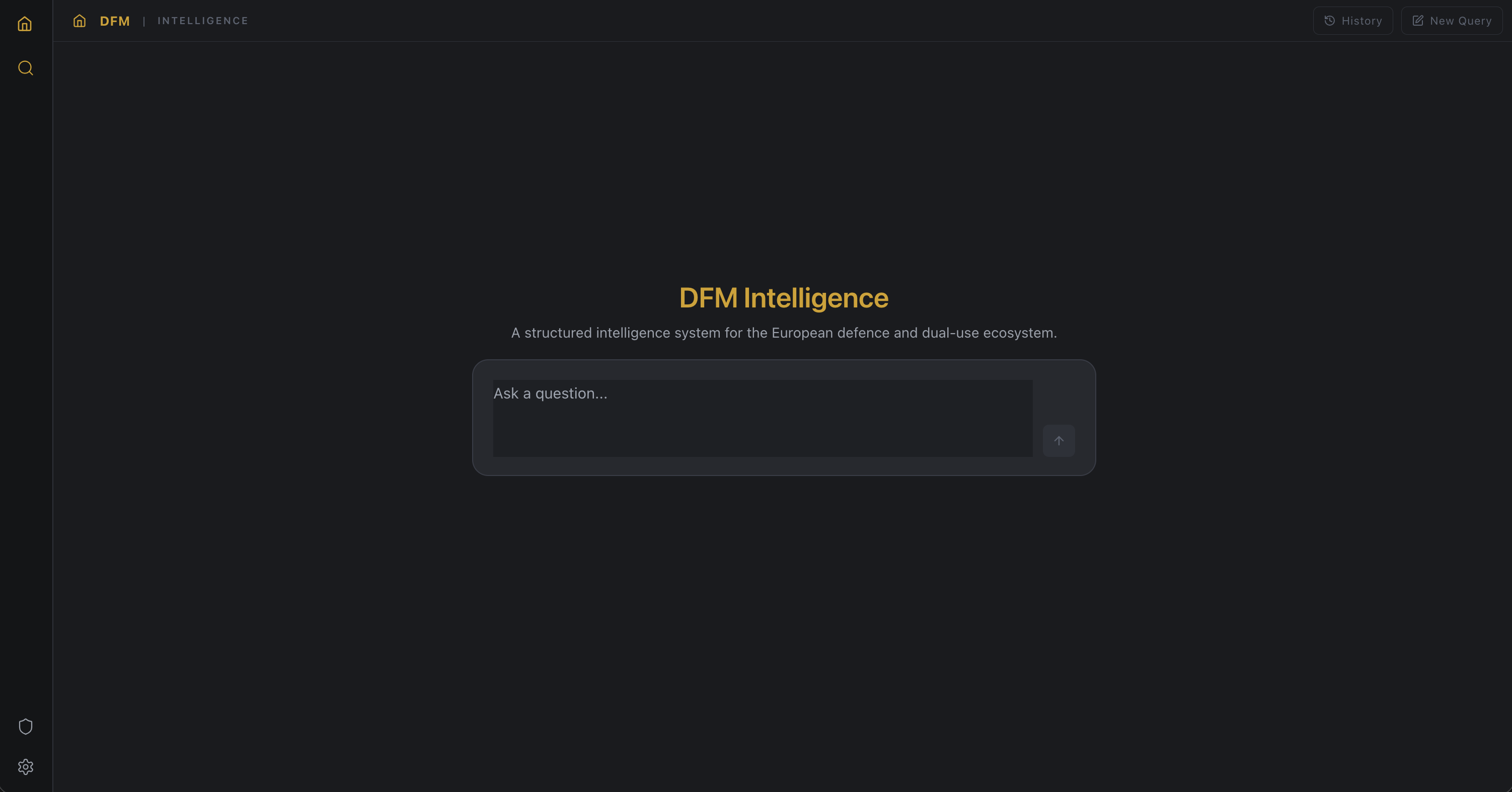
Defence Finance Monitor is an intelligence platform for the European defence-industrial base. It runs on a verified database of more than 2,000 European defence and dual-use enterprises, each mapped against the strategic priorities defined by EU and NATO policy, and maintained as the perimeter evolves through procurement awards, ownership changes, regulatory notifications and programme participation.
A single structured query resolves work that has traditionally required extended analyst effort: identifying the Tier-2 and Tier-3 suppliers behind a prime contractor, determining which firms are exposed to EDIP origin rules, Golden Power notifications or critical-raw-material dependencies, reconstructing contract awards under EDF, EDIRPA and ASAP, or tracing the ownership chain behind a strategic asset. Every statement carries a stated confidence level and a citation to the official institutional source it rests on. Where a fact cannot be verified against source, it is marked as such rather than asserted.
For a law firm, a corporate-development team, a sovereign fund or a procurement office, the consequence is direct: institutional research that once defined the cost and timing of a deliverable now defines where the analysis begins.
DFM Intelligence is reserved for subscribers to the DFM annual programme.
For further information about DFM Intelligence, access conditions or payment by bank transfer, please contact: mastrolia@stroncature.com