


Defence Finance Monitor applies a top–down method that traces how NATO, EU and allied strategic priorities are translated into regulations, funding lines and procurement programmes, and then into demand for specific capabilities, technologies and companies. We use official doctrine as the organising frame to identify where strategic relevance is being institutionally defined and where it is materialising in concrete budgets, acquisition pathways and industrial capacity.
Our working assumption is that what becomes structurally relevant in NATO/EU strategy tends, over time, to become relevant also from a financial and industrial point of view. In the European context, this includes the progressive operationalisation of strategic autonomy: the effort to reduce critical dependencies, secure supply chains, strengthen the European defence technological and industrial base, and align regulatory, financial and procurement instruments with long-term security objectives. On this basis, DFM operates as a decision-support tool: it benchmarks investment and industrial choices against institutional demand, clarifies which capabilities are rising on the spending agenda, and maps the funding instruments, eligibility constraints and supply-chain factors that shape real-world feasibility across investors, industry, public authorities and research organisations.
Defence Finance Monitor rests on a single analytical premise: within the Euro-Atlantic security architecture, strategic doctrine precedes regulation and capability planning, regulation precedes budgets, and budgets shape markets.
EU Defence Finance Stack 2025–2030
The €800 billion is not a fund. It is a stack — and most of the market is still reading it as a treasury. The Readiness 2030 headline combines nearly €650 billion of fiscal space under the national escape clause with €150 billion of SAFE loans, layered over EDF grants, EDIP’s €1.5 billion, EIB intermediation that explicitly excludes weapons and ammunition, and €343 billion of national budgets already spent in 2024. These are not commensurable objects: some are legal ceilings, some are borrowing capacity, some are committed cash. The report maps each layer, separates hard envelopes from contingent capacity, and flags the operational fact that matters most right now: SAFE’s publicly visible pipeline already stands at roughly €130 billion endorsed — the instrument is nearly full, which makes successor rounds a live financing question. The disciplined conclusion: Europe’s defence-finance environment is defensibly worth €800–900 billion, approaching €1 trillion only with public-bank channels and Germany’s national surge — and never as a single pot. For primes, banks and counsel, the stack is a sequencing problem, not a subsidy list.
The EU Defence Funding Map 2026–2027
A budget line is not demand. Between an adopted work programme and an actual order sits a transmission chain — calls, consortia, grant agreements, national plans, Council decisions, loan agreements, procurement — and each EU instrument converts public money into industrial demand through a different route, at a different speed, with different eligibility filters. This report, the operational companion to the Finance Stack, maps that conversion instrument by instrument: EDF 2026’s €1 billion across ten calls; EDIP’s work programme with €166 million for energetic components and milestone-based common procurement in counter-drone and ammunition; SAFE’s eighteen Council-approved national plans, now past the declaratory stage; EUDIS and cascade funding as the entry layer — the first EDF sub-call drew 200+ proposals, over 70 per cent from first-time participants; and the capital stack of DEF, FAST and EIB intermediated lending. It closes with the hierarchy that matters for allocation: SAFE converts fastest into orders, EDIP IRA into factories, EDF into position. For every beneficiary class — prime, SME, university, fund — the map shows where to enter the chain and what each selection actually signals.
The Wave and the Walls
Two forces are colliding, and the collision explains the capital flows this publication tracks every week. A technological wave of historic scale — AI, synthetic biology, robotics, quantum, energy, defence manufacturing — is meeting a world in which every major region is racing to reduce dependence on the others. The central finding is that strategic autonomy does not act uniformly on that wave: it deforms it. It accelerates the technologies of the body — chips, energy, weapons, robotics — because they can be territorialised, anchored in plant, raw materials and sovereign demand; and it slows the technologies of the brain — frontier AI and bio research — because they live on the open exchange that closure severs. The financial trace is already visible: global spending on AI, clean energy and defence is moving from $6.9 trillion in 2025 toward a projected $16 trillion by 2030, and a decisive share of that surge is political, not market-driven. Up to a threshold, autonomy is prudence — diversification against single points of failure. Beyond it, it becomes a cage. The essay maps where that threshold lies, why the race keeps crossing it, and what a tripolar world of unequal poles means for the one region whose historic strength was integration itself.
DFM Intelligence · Platform Capability
Problems DFM Intelligence Now Solves
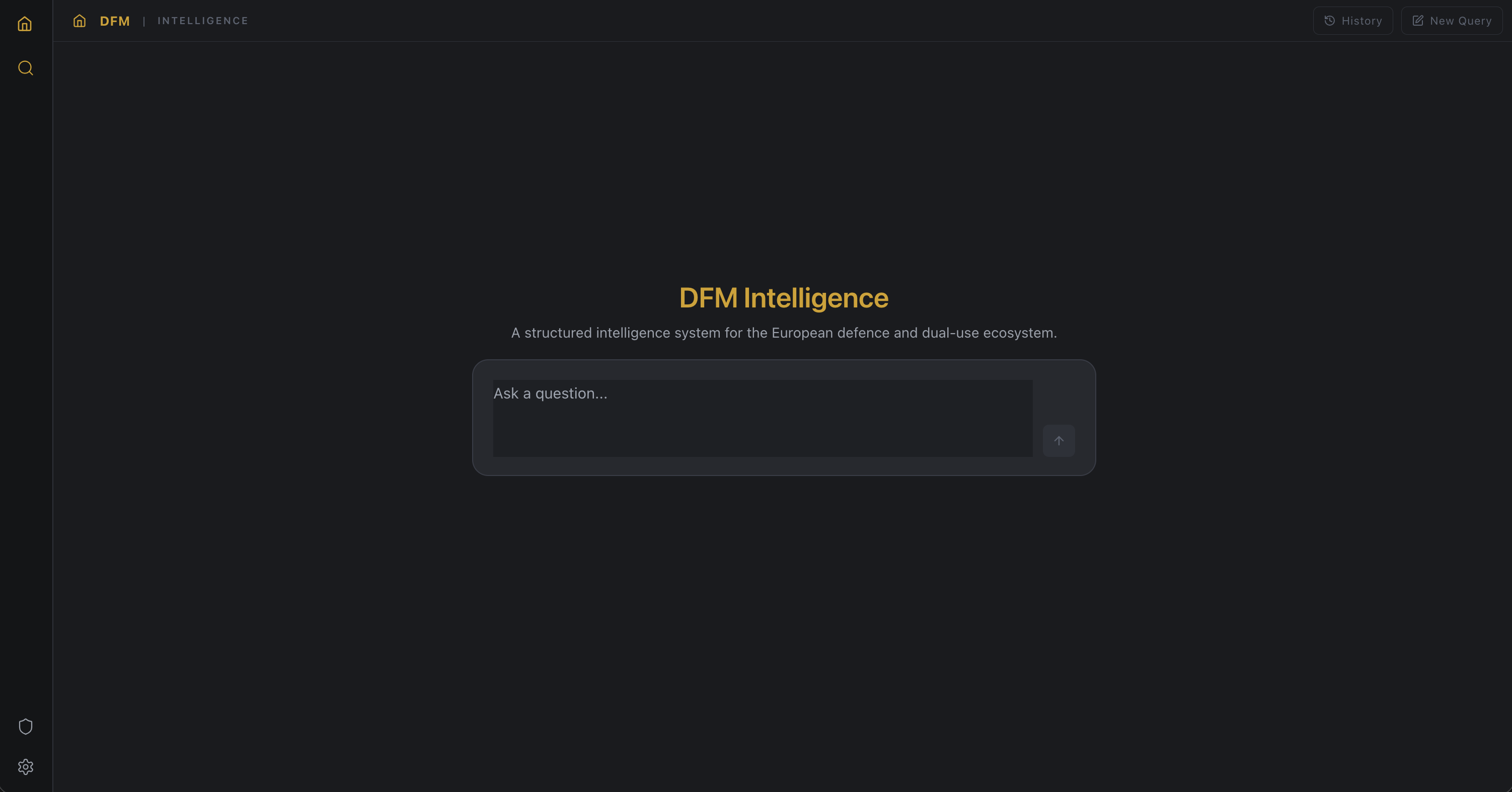
Defence Finance Monitor is an intelligence platform for the European defence-industrial base. It runs on a verified database of more than 2,000 European defence and dual-use enterprises, each mapped against the strategic priorities defined by EU and NATO policy, and maintained as the perimeter evolves through procurement awards, ownership changes, regulatory notifications and programme participation.
A single structured query resolves work that has traditionally required extended analyst effort: identifying the Tier-2 and Tier-3 suppliers behind a prime contractor, determining which firms are exposed to EDIP origin rules, Golden Power notifications or critical-raw-material dependencies, reconstructing contract awards under EDF, EDIRPA and ASAP, or tracing the ownership chain behind a strategic asset. Every statement carries a stated confidence level and a citation to the official institutional source it rests on. Where a fact cannot be verified against source, it is marked as such rather than asserted.
For a law firm, a corporate-development team, a sovereign fund or a procurement office, the consequence is direct: institutional research that once defined the cost and timing of a deliverable now defines where the analysis begins.
DFM Intelligence is reserved for subscribers to the DFM annual programme.
For further information about DFM Intelligence, access conditions or payment by bank transfer, please contact: mastrolia@stroncature.com