


Defence Finance Monitor applies a top–down method that traces how NATO, EU and allied strategic priorities are translated into regulations, funding lines and procurement programmes, and then into demand for specific capabilities, technologies and companies. We use official doctrine as the organising frame to identify where strategic relevance is being institutionally defined and where it is materialising in concrete budgets, acquisition pathways and industrial capacity.
Our working assumption is that what becomes structurally relevant in NATO/EU strategy tends, over time, to become relevant also from a financial and industrial point of view. In the European context, this includes the progressive operationalisation of strategic autonomy: the effort to reduce critical dependencies, secure supply chains, strengthen the European defence technological and industrial base, and align regulatory, financial and procurement instruments with long-term security objectives. On this basis, DFM operates as a decision-support tool: it benchmarks investment and industrial choices against institutional demand, clarifies which capabilities are rising on the spending agenda, and maps the funding instruments, eligibility constraints and supply-chain factors that shape real-world feasibility across investors, industry, public authorities and research organisations.
Defence Finance Monitor rests on a single analytical premise: within the Euro-Atlantic security architecture, strategic doctrine precedes regulation and capability planning, regulation precedes budgets, and budgets shape markets.
Privatised Power: When Strategic Infrastructure Goes Public
This month, public markets will put a number on a sovereign dependency. SpaceX is targeting a June listing at roughly $1.75 trillion — the largest IPO ever conducted — and the analytical question is not whether the price is right but what the price is for: per Quilty Space estimates, 97 per cent of the Pentagon’s PLEO task orders run through one supplier, there is no credible substitute for heavy lift or crewed flight inside the planning horizon, and the Sevastopol episode established that the operator can deny service to a military operation of a Western-backed state — at the time under no contract at all. The valuation, in other words, capitalises the state’s absence of alternatives. The note reads the listing through the only adequate historical analogue, the chartered trading companies, whose public-private hybrid over sovereign functions held in stable conditions and broke in crises — and maps the instrument set now forming around the category: war-use clauses, golden shares, structural separation, each with a measurable valuation cost. Readers of this publication will recognise the wider perimeter: the migration of strategic functions onto corporate balance sheets — subsea cables, frontier compute, fabrication — is a line DFM has tracked from seabed infrastructure to hidden champions in advanced packaging. The SpaceX listing is the moment that perimeter acquires a ticker. Share registers have become security-relevant documents on a par with orders of battle.
EDIP Eligibility and the New Test of European Defence Industrial Control
EDIP is not a subsidy regime. It is becoming a structuring regime. Regulation (EU) 2025/2643, approved by the Council on 8 December 2025 with €1.5 billion for 2025-2027, has turned foreign participation in European defence into an operational legal test — and the test is multi-vector. A US, Japanese, Korean or British group can fail it even with a wholly owned EU subsidiary, if the parent retains decisive influence through shareholder vetoes, IP reversion clauses, export-control dependencies or design-change approval rights. DFM has followed the construction of this eligibility perimeter from its origins in the EDF framework through SAFE to the final EDIP text; this report is the consolidated result — each test broken down (establishment plus executive management, effective control, the 35% component cap, design authority, the Article 12(4) bridge to 2033 for ammunition and missiles) and applied to the four jurisdictions that matter, from the Rheinmetall-Lockheed centre of excellence to Hanwha’s Romanian build-out, the closest thing the market offers to a model case, and the UK’s unresolved classification problem after the SAFE talks broke down. It closes with the six-file diligence template — control, guarantees, IP, supply chain, transfers, financing covenants — that M&A advisers, banks and sovereign capital now need. Eligibility has become a valuation issue.
The Critical Minerals Front of European Rearmament
Europe’s next defence bottleneck is not assembly capacity. It is upstream — and, more precisely, midstream: as this publication argued when mapping the rare-earth value chain, the real chokepoint is not the ore but the separation chemistry, the refining and the magnet-making that remain overwhelmingly concentrated in China. The numbers are stark: the EU is still 100 per cent dependent on China for heavy rare earths, China accounts for 99 per cent of primary gallium production, and Beijing has moved in a deliberate sequence — gallium and germanium in July 2023, graphite, antimony, then tungsten, bismuth and indium by February 2025 — to convert that concentration into administrative leverage. The Critical Raw Materials Act was not designed as a defence regulation, but it has become one in substance, and it is widely misread: the 65 per cent benchmark is a maximum dependency cap on any single third country, not a domestic production target. The report maps the defence bill of materials behind the CRMA list, explains why Strategic Project designation is emerging as a bankability filter for project finance, and connects the act to SAFE — which expressly allows loan-funded stockpiling of raw materials — and to EDIP’s new security-of-supply machinery. Upstream materials have moved from sustainability annex to core diligence.
Defence Data Architecture
Every industrial era of European defence has had a control layer — propulsion, electronics, munitions. The next one is data, and with this report DFM opens a new standing line of coverage on it. Modern capability is software-defined, sensor-dense and update-dependent, which means operational effectiveness is decided less by who builds the platform than by who controls the data model, the metadata, the access policies, the releasability rules and the rights to train AI on what the platform generates. Since November 2025, the Commission’s Data Union Strategy has formally placed a defence data space inside the EU’s data and AI agenda — the direction is confirmed, even if the legal blueprint is not yet public. The report sets out why the credible architecture is neither a central supranational repository nor a web of bilateral bridges, but a three-layer federation: sovereign national nodes, a common European policy and metadata fabric, and NATO-aligned mission layers built on the Federated Mission Networking method. NATO’s acquisition of Palantir’s Maven Smart System and ICEYE’s direct data feed to Alliance headquarters show the operational direction; the open question is whether Europe funds the middle layers — connectors, policy orchestration, provenance tooling, mission-assured MLOps — or overinvests in hardware and generic cloud that cannot be federated. That middle layer is where value is migrating, and where the next reports in this series will go.
DFM Intelligence · Platform Capability
Problems DFM Intelligence Now Solves
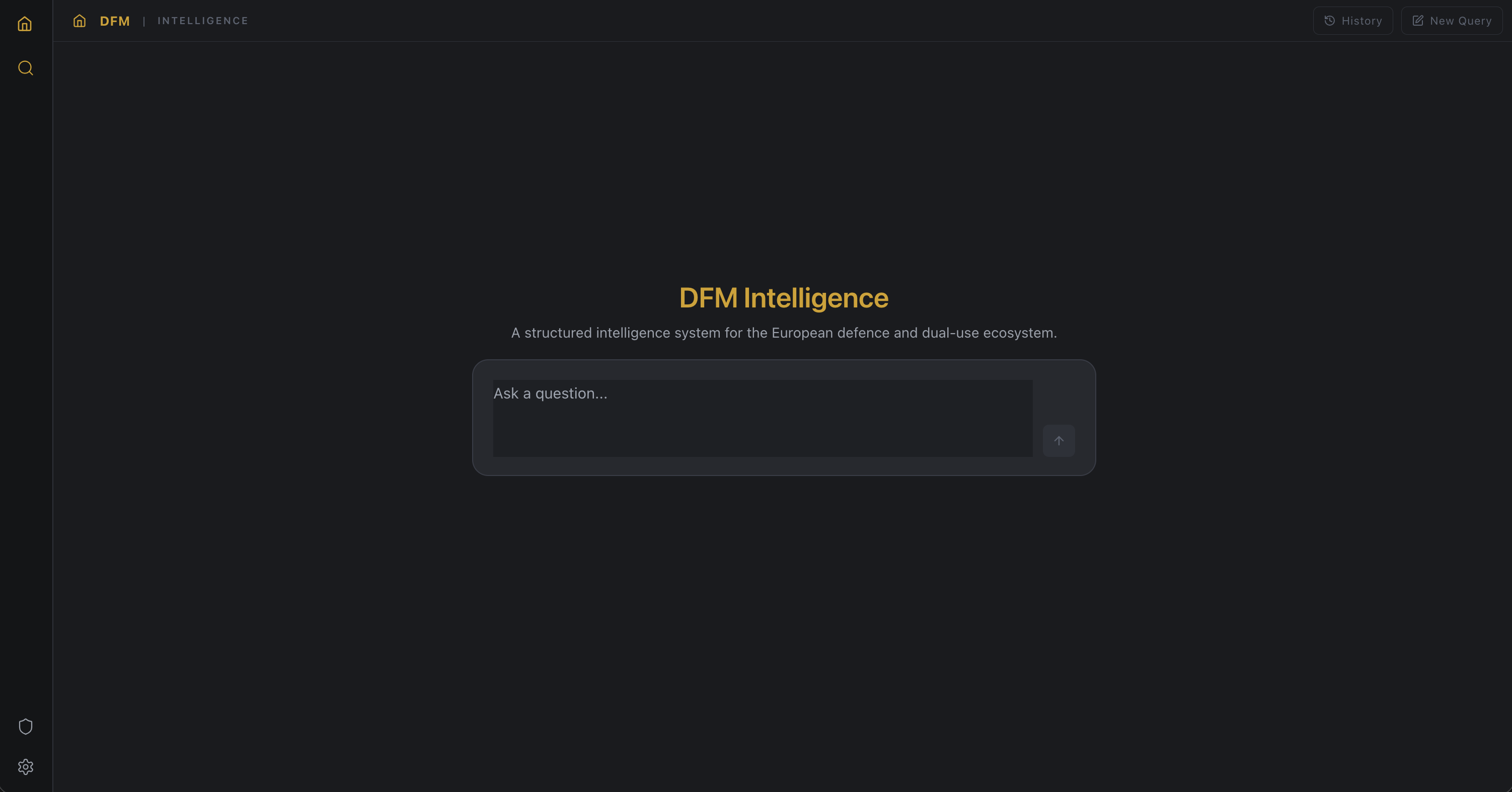
Defence Finance Monitor is an intelligence platform for the European defence-industrial base. It runs on a verified database of more than 2,000 European defence and dual-use enterprises, each mapped against the strategic priorities defined by EU and NATO policy, and maintained as the perimeter evolves through procurement awards, ownership changes, regulatory notifications and programme participation.
A single structured query resolves work that has traditionally required extended analyst effort: identifying the Tier-2 and Tier-3 suppliers behind a prime contractor, determining which firms are exposed to EDIP origin rules, Golden Power notifications or critical-raw-material dependencies, reconstructing contract awards under EDF, EDIRPA and ASAP, or tracing the ownership chain behind a strategic asset. Every statement carries a stated confidence level and a citation to the official institutional source it rests on. Where a fact cannot be verified against source, it is marked as such rather than asserted.
For a law firm, a corporate-development team, a sovereign fund or a procurement office, the consequence is direct: institutional research that once defined the cost and timing of a deliverable now defines where the analysis begins.
DFM Intelligence is reserved for subscribers to the DFM annual programme.
For further information about DFM Intelligence, access conditions or payment by bank transfer, please contact: mastrolia@stroncature.com