


Defence Finance Monitor applies a top–down method that traces how NATO, EU and allied strategic priorities are translated into regulations, funding lines and procurement programmes, and then into demand for specific capabilities, technologies and companies. We use official doctrine as the organising frame to identify where strategic relevance is being institutionally defined and where it is materialising in concrete budgets, acquisition pathways and industrial capacity.
Our working assumption is that what becomes structurally relevant in NATO/EU strategy tends, over time, to become relevant also from a financial and industrial point of view. In the European context, this includes the progressive operationalisation of strategic autonomy: the effort to reduce critical dependencies, secure supply chains, strengthen the European defence technological and industrial base, and align regulatory, financial and procurement instruments with long-term security objectives. On this basis, DFM operates as a decision-support tool: it benchmarks investment and industrial choices against institutional demand, clarifies which capabilities are rising on the spending agenda, and maps the funding instruments, eligibility constraints and supply-chain factors that shape real-world feasibility across investors, industry, public authorities and research organisations.
Defence Finance Monitor rests on a single analytical premise: within the Euro-Atlantic security architecture, strategic doctrine precedes regulation and capability planning, regulation precedes budgets, and budgets shape markets.
Build-with-Allied-Country as a Permanent Defence-Industrial Architecture
For most of the past four decades the European defence prime sold a finished platform across a border and called it an export. That model is no longer the dominant one. From Albania to Romania, from Ukraine to the Czech Republic, from Greece to Arctic Canada, foreign primes are embedding themselves inside allied countries through joint ventures, local subsidiaries, outright acquisitions, framework agreements, MoUs, maintenance hubs and R&D centres. What changes from case to case is the legal wrapper. Rheinmetall and KNDS have built majority-minority joint ventures in Kyiv on a 51/49 split that the Fincantieri-KAYO shipyard in Albania reportedly mirrors; Otokar has acquired 96.77 per cent of Romania’s Automecanica outright; KNDS has opened a wholly-owned subsidiary; BAE Systems has gone in through a local legal entity and framework agreements; Patria and ELVO are still in the MoU phase that precedes the equity structures. What does not change is the industrial logic: a foreign prime anchors the programme, a host-country counterpart supplies sovereign legitimacy and local capacity, technology transfer is formalised rather than promised, and the hub serves a market wider than the host state alone. EDIP and SAFE have turned this from a pattern into a legal framework — the Ukraine Support Instrument is close to a statutory blueprint for it, and SAFE Article 17 has already opened the architecture to Canada. The question this report addresses is not whether primes will localise. It is where, with whom, under what ownership and through which legal pathway into EU-funded or EU-compatible demand the 2026-2030 contest will be fought.
Full-Service Provider Model and Cross-Segment Integration
Rheinmetall’s acquisition of NVL closed on 1 March 2026, and in its first-quarter results the company stopped describing itself as a land-and-munitions prime with strong air-defence and digital positions. It began calling itself a German full-service provider for all branches of the armed forces, significant on land, at sea, in the air, in the cyber sector and in space. The language matters because the transaction it describes is not a horizontal consolidation in the conventional sense — it is the moment a European prime tries to span the modern operational stack rather than one platform family or one mission-system layer. The verified financial evidence is more modest than the strategic claim: Q1 sales of €1.938 billion, operating profit of €224 million, backlog of €73 billion including €5.5 billion of inherited naval contracts, naval revenue of €77 million on a single month of consolidation. The market narratives that surround the deal — a 2030 naval revenue target, a roughly €20 billion second-quarter nomination figure — are not in the primary sources and are kept in suspense in this report. What is in those sources is the structural question. Europe’s policy documents now reward primes capable of bundling production scale, R&D re-use, security-of-supply credibility and collaborative procurement readiness into a single industrial counterparty. Rheinmetall-NVL is the clearest live test of that thesis. The report assesses it against BAE, Saab, Leonardo and KNDS — three competing consolidation pathways for the rest of the decade — and asks not whether the model will work operationally but whether it sets the benchmark against which other European primes will be judged.
Engine Bottlenecks and European Propulsion Sovereignty
In its first-quarter 2026 results, Airbus told investors that the principal constraint on Europe’s most important civil aerospace programme remained a United States-controlled engine stream — that Pratt & Whitney, an RTX subsidiary, was the key pacer of the A320 ramp-up trajectory for both 2026 and 2027. The statement is the easy half of the problem. The harder half is that the European fallback, the CFM LEAP, is produced by a 50/50 Safran-GE joint venture already running at maximum utilisation, and that the same European propulsion base now supporting civil narrowbody capacity is simultaneously being pulled by Eurofighter EJ200 demand, A400M TP400 sustainment, FCAS engine development under EUMET, and a GCAP propulsion architecture that is, by construction, a UK-Italy-Japan answer rather than an EU one. Europe has strong engine champions. It does not yet have a fully unconstrained, EU-governable propulsion base. The EDIP Regulation has begun to recognise the problem — Articles 10(3), 10(4) and especially 10(5) require recipients of Union funding to be able to decide on design evolution and to substitute restricted components without third-country veto — but the regulation does not create a dedicated propulsion-industrial fund, and the EIB framework that finances much of the adjacent infrastructure still excludes weapons and ammunition. The report sets out a defensible €2-5 billion capital hypothesis for 2026-2030, decomposed into five investment blocks, and argues that propulsion sovereignty is no longer a policy slogan but an investment problem whose contours can now be drawn.
DFM Intelligence · Platform Capability
Problems DFM Intelligence Now Solves
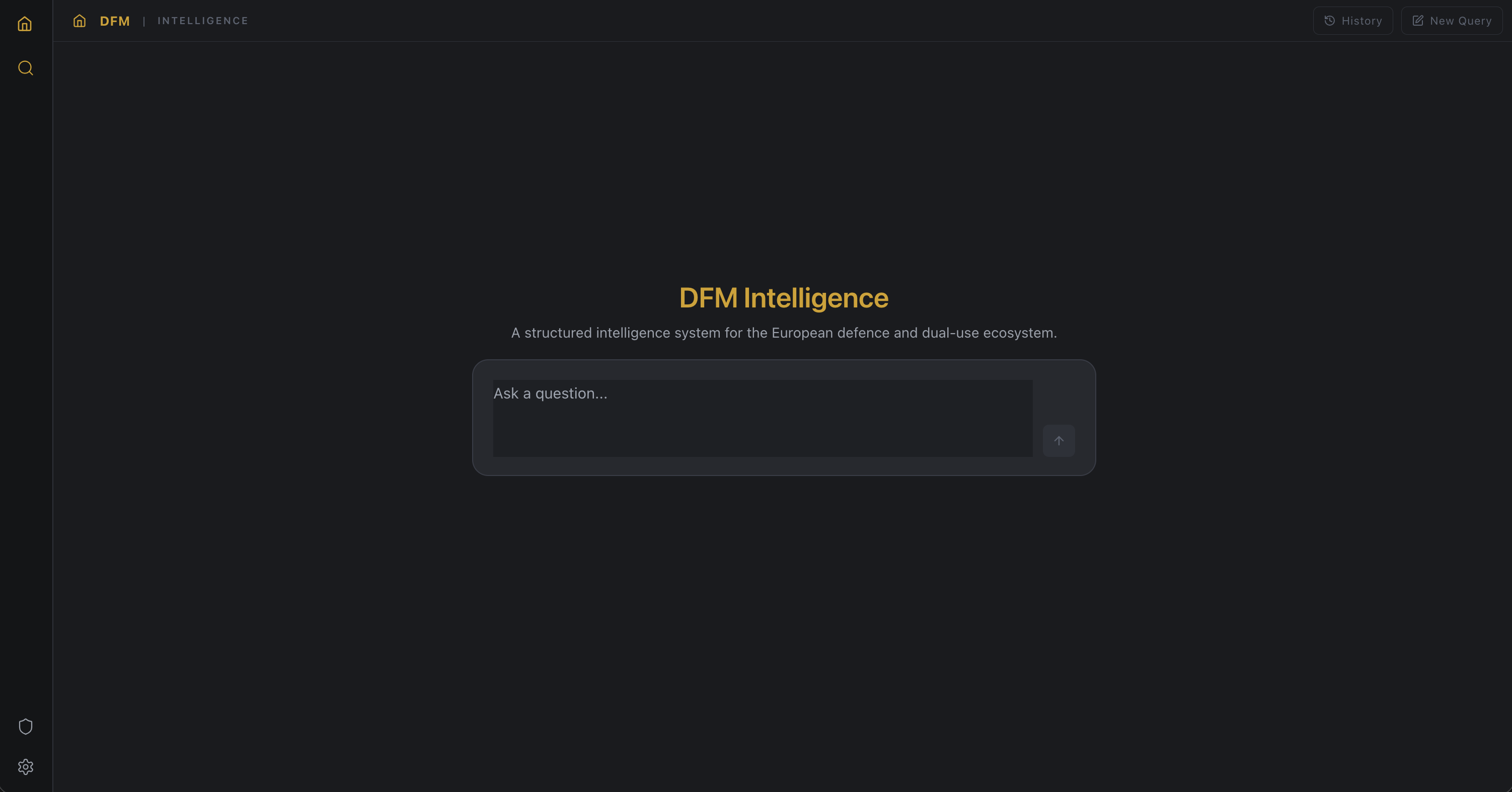
Defence Finance Monitor is an intelligence platform for the European defence-industrial base. It runs on a verified database of more than 2,000 European defence and dual-use enterprises, each mapped against the strategic priorities defined by EU and NATO policy, and maintained as the perimeter evolves through procurement awards, ownership changes, regulatory notifications and programme participation.
A single structured query resolves work that has traditionally required extended analyst effort: identifying the Tier-2 and Tier-3 suppliers behind a prime contractor, determining which firms are exposed to EDIP origin rules, Golden Power notifications or critical-raw-material dependencies, reconstructing contract awards under EDF, EDIRPA and ASAP, or tracing the ownership chain behind a strategic asset. Every statement carries a stated confidence level and a citation to the official institutional source it rests on. Where a fact cannot be verified against source, it is marked as such rather than asserted.
For a law firm, a corporate-development team, a sovereign fund or a procurement office, the consequence is direct: institutional research that once defined the cost and timing of a deliverable now defines where the analysis begins.
DFM Intelligence is reserved for subscribers to the DFM annual programme.
For further information about DFM Intelligence, access conditions or payment by bank transfer, please contact: mastrolia@stroncature.com